
Introduction
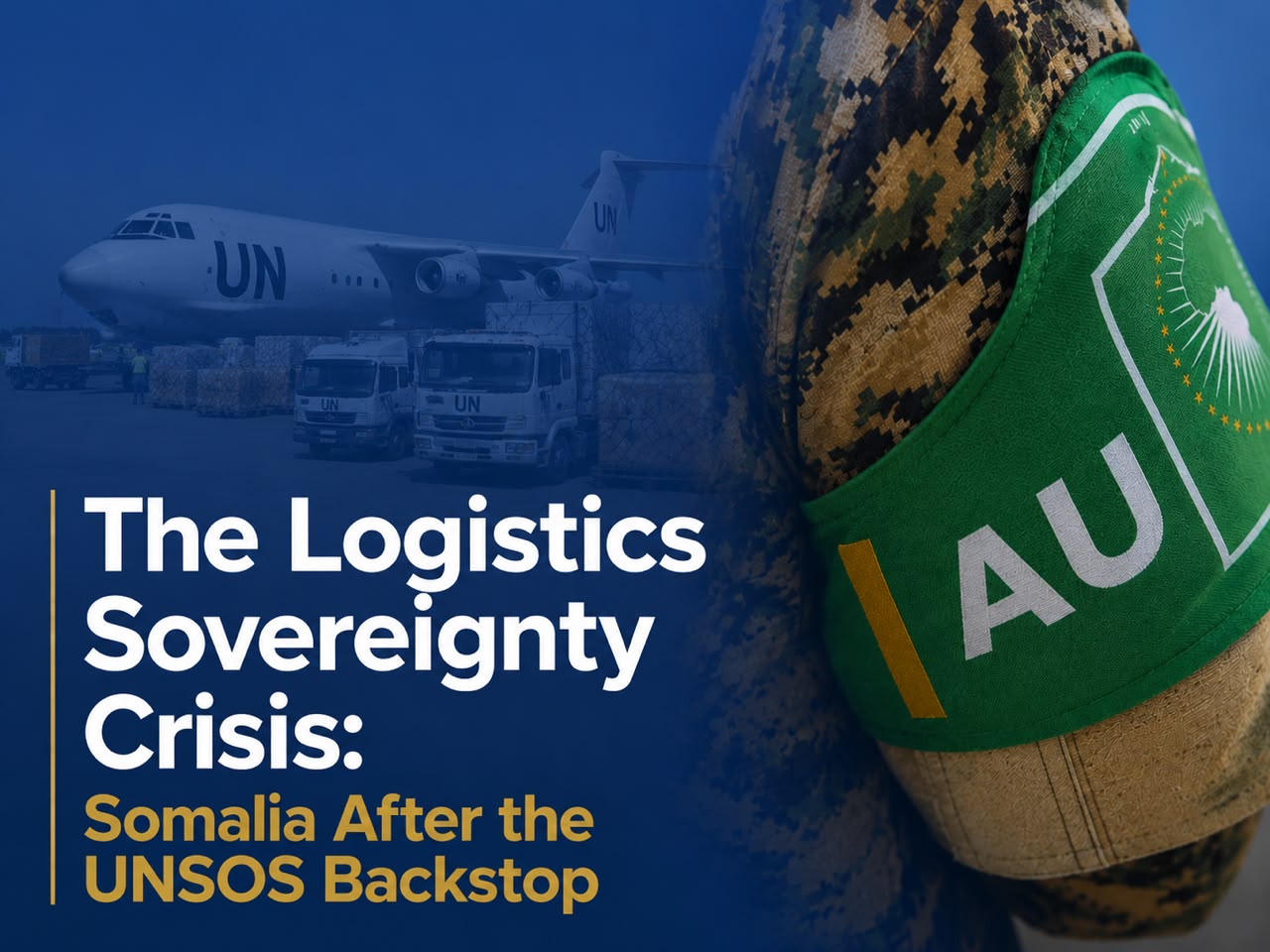
The reported United States decision not to support the continuation of the United Nations Support Office in Somalia (UNSOS) beyond 31 December 2026 should not be understood primarily as a funding dispute. It exposes a deeper structural question about the nature of Somali sovereignty itself. Somalia formally carries responsibility for national security, yet its ability to sustain territorial control has remained dependent on an externally financed logistics architecture that provides food, water, fuel, transport, medical evacuation, engineering, communications and other mission-critical services.
The emerging crisis is therefore not simply whether the African Union Support and Stabilization Mission in Somalia (AUSSOM) will retain its mandate. It is whether the Somali state and its security partners can preserve the operational infrastructure that converts political authority into presence on the ground. A government may possess international recognition, constitutional authority and formal command structures, but it cannot consistently hold territory if troops cannot be supplied, rotated, treated, transported or connected. This assessment describes that condition as logistics-conditioned sovereignty: sovereignty whose practical reach depends upon an outsourced system of sustainment.
The immediate danger is not necessarily the abrupt collapse of AUSSOM. It is the gradual separation of mandate from capability. If that separation widens, Somalia may enter a transition not from external dependence to national self-reliance, but from coordinated multilateral dependence to fragmented bilateral dependence. Such a shift would reshape relations among Mogadishu, federal member states, African troop contributors, Western donors, Türkiye, Gulf partners and other regional actors, while creating operational space that Al-Shabaab is positioned to exploit.
From a funding dispute to a sovereignty problem
For almost two decades, Somalia's security architecture has rested on a specialized international division of labour. African states supplied troops and carried much of the operational risk. The African Union provided political legitimacy, command arrangements and continental ownership. The United Nations organized logistics and operational support. European partners financed troop allowances and mission requirements. The United States supplied assessed contributions, diplomatic backing, counterterrorism support and wider strategic assistance. Bilateral partners developed selected Somali institutions and specialized capabilities.
No single actor performed every function. The system worked because these separate contributions were connected within a broadly recognizable multilateral framework. It was often underfunded and politically contested, but it provided a coordinating structure that bilateral arrangements alone could not easily reproduce.
According to reporting in early July 2026, Washington informed the African Union that it would not support continued UN operational assistance to AUSSOM from 2027, while not necessarily opposing renewal of the mission itself. The United States has contributed nearly USD 2 billion in assessed funding to UNSOS and its predecessor. UNSOS has an annual budget of roughly USD 500 million and supports a mission authorized at up to 11,826 uniformed personnel through the end of 2026.
The significance of these services is not administrative. Fuel creates mobility. Airlift and transport make troop rotation possible. Medical evacuation affects the willingness of contingents to operate in exposed areas. Engineering sustains forward positions. Communications and intelligence support connect sectors into a functioning force. Supply chains determine whether authorized units can remain present beyond major towns and defensible corridors. When these functions weaken, sovereignty contracts operationally even when it remains intact legally.
Mandate without operational reach
The first consequence of a weakened UNSOS backstop would be a widening gap between AUSSOM's formal responsibilities and its practical ability to carry them out. The mission could remain institutionally present, retain an African Union mandate and continue to deploy contingents, while its operational reach gradually contracts.
Forward positions would become harder to sustain. Troop rotations could become less predictable. Constraints on transport, force protection and medical support may encourage national contingents to concentrate around major towns, airports and protected corridors. AUSSOM would not necessarily stop operating at once; instead, it could become progressively less able to maintain continuous presence across contested districts.
This form of mandate-capability decoupling would benefit Al-Shabaab. The organization does not need to seize Mogadishu to gain strategic advantage. It can expand influence by taxing communities, adjudicating disputes, intimidating officials, controlling movement and preserving access where government and mission presence is intermittent. A security architecture can therefore lose territorial and political influence long before it experiences formal institutional collapse.The central issue is consequently not whether AUSSOM exists on paper, but whether the logistical functions that make its mandate meaningful remain connected. The difference between mission renewal and mission viability will be determined by sustainment.
Fragmented substitution and competitive dependence
Somalia is unlikely to be abandoned by its partners. A more probable outcome is fragmented functional substitution: several actors may replace individual elements of the current system without assuming responsibility for the architecture as a whole. The European Union can offset part of the financial pressure. In April 2026, it approved an additional EUR 75 million for AUSSOM, bringing European support for successive AU-led missions in Somalia since 2007 to almost EUR 2.8 billion. This is a substantial commitment, but financing allowances and operational readiness does not automatically recreate the integrated logistics platform provided through UNSOS.
Türkiye has developed one of Somalia's broadest bilateral partnerships, including infrastructure, humanitarian engagement, military and police training, maritime security and defence cooperation. Gulf actors may provide finance, equipment, infrastructure and political backing. Egypt has expanded defence relations with Mogadishu and expressed interest in contributing personnel to AUSSOM. Qatar and the United Arab Emirates also possess relationships, financial instruments and security interests that could become more consequential if the collective framework contracts.
These contributions may be valuable, but influence will increasingly flow through control over critical logistics functions rather than troop numbers alone. The actor that supplies fuel, airlift, medical evacuation, communications, training or equipment can acquire leverage over operational choices and institutional development. In such an environment, assistance may become attached to particular units, ministries, regions, commercial projects or political constituencies.
The result could be a shift from coordinated multilateral dependence to competitive bilateral dependence. Burden-sharing distributes responsibility while preserving a common framework. Burden fragmentation distributes functions without clearly establishing who connects them. The first can strengthen collective security; the second can generate multiple chains of command, financing and political loyalty.
Federalism and the domestic politics of logistics
The logistics cliff would also enter Somalia's unresolved federal politics. Federal institutions, member states, security agencies and political networks may seek direct external arrangements as confidence in the collective framework declines. Puntland and Jubaland, in particular, could use access to territory, ports, local forces and external partnerships to bargain against federal security centralization.
This does not mean that relations between Mogadishu and federal member states will inevitably deteriorate. It does mean that logistics will become a source of political leverage. A regional administration capable of securing direct fuel, equipment, training, maritime support or financial backing can gain practical autonomy even when constitutional authority remains disputed. Conversely, attempts by the federal government to monopolize external assistance could intensify resistance from member states that distrust centralized command.
Selective bilateral substitution may therefore strengthen individual security units while weakening nationally accountable command structures. Somalia's sovereignty would appear more diversified externally but become more fragmented internally. The underlying contest would not simply be over who commands the security sector, but over who supplies the material systems that allow command to function.
Regional consequences
A weakening of the AUSSOM-UNSOS framework would have consequences across the Horn. Ethiopia, Kenya and Djibouti would face greater pressure to protect borders, transport corridors and vulnerable frontier communities if mission presence contracts. Uganda and other troop contributors would reassess the balance between operational exposure and logistical support. Türkiye may seek to protect its military, maritime and economic partnerships. Egypt may deepen its role in Somali institutions. Gulf partners may expand selective financing, infrastructure and equipment support.
Each response may be understandable when considered separately. Taken together, however, they could produce more security activity without a clear coordinating centre. The regional balance would then depend not only on who contributes the most troops or money, but on who can connect finance, logistics, political legitimacy, intelligence, training and national institutions within a workable framework.
This is where the U.S. decision could generate effects beyond its immediate budgetary purpose. Budget pressure may be intended to discipline burden-sharing and encourage greater African or Somali responsibility. Yet if introduced without a credible replacement mechanism, it may accelerate mission fragmentation rather than orderly transition. The difference will depend on whether essential functions are collectively reconstituted or divided among competing sponsors.
The African institutional gap
The uncertainty surrounding UNSOS illustrates the continuing implementation gap between African political ownership and African operational autonomy. The African Union authorizes the mission and African states provide personnel, yet the ability to sustain operations remains conditioned by external logistical and financial infrastructures.
United Nations Security Council Resolution 2719 created a framework under which qualifying AU-led peace-support operations may receive UN-assessed contributions of up to 75 per cent of authorized annual budgets on a case-by-case basis. That framework narrowed an important institutional gap. The Somalia case nevertheless demonstrates that predictable logistics remain politically contingent. Continental authorization does not, by itself, ensure continental operational control.
For the African Union and IGAD, the challenge is therefore larger than replacing one donor. It is to prevent a division of labour from becoming a division of the mission itself. African institutions must be able to connect troop contributors, Somali authorities, European financing, bilateral partners and the indispensable functions currently delivered through UNSOS. Without that coordinating role, formal African ownership risks coexisting with fragmented external control over the systems that make operations possible.
Ethiopia's strategic interest
Ethiopia is particularly exposed to this transition. Its interests include containing Al-Shabaab, protecting its long border with Somalia, preserving stability in adjacent areas, managing displacement and cross-border commerce, securing transport corridors and preventing regional alignments that could adversely affect its national security. Ethiopia is also a troop contributor, a central member of IGAD and the host country of the African Union. Its role is therefore operational, diplomatic and institutional.
Ethiopia's long-term interest is not simply preserving AUSSOM in its present form. It is preventing Somalia's security sector from fragmenting into parallel logistics networks sponsored by competing external actors. Such fragmentation would weaken national command structures, complicate regional counterterrorism cooperation and create operational discontinuities that Al-Shabaab could exploit along Ethiopia's eastern frontier.
Addis Ababa should avoid framing the issue as a contest for exclusive influence. Somalia has the sovereign right to diversify its partnerships, and external actors possess legitimate security and economic interests. Ethiopia's stronger position lies in exercising architecture-building power: helping establish rules that make assistance transparent, interoperable and consistent with Somali national institutions and African Union arrangements.
Four principles should guide that approach. First, bilateral assistance should strengthen nationally accountable Somali institutions rather than create formations dependent on a single sponsor. Second, external training, financing and equipment should remain compatible with Somalia's national security architecture and relevant AU command arrangements. Third, partners should improve transparency regarding force financing, operational sectors, training programmes and command relationships. Fourth, the African Union and IGAD should establish a standing coordination mechanism linking Somali institutions, troop contributors, European financing, bilateral partners and the essential logistics functions currently delivered through UNSOS.
Such a mechanism could not fully replace the existing support office. It could, however, preserve interoperability, limit duplication and reduce the risk that competition among external partners becomes institutional fragmentation inside Somalia. Five developments will indicate whether the post-2026 transition produces manageable diversification or destabilizing fragmentation.
First, the form of any replacement for UNSOS. New funding will matter, but the decisive question is whether fuel, transport, medical evacuation, communications, engineering, airlift and supply chains remain integrated rather than divided among separate bilateral arrangements.
Second, the position of troop-contributing countries. Continued deployment will depend on reimbursement, force protection, medevac guarantees and confidence that contingents can be rotated and sustained.
Third, the conduct of Somali institutions. A coordinated national framework for external assistance would strengthen sovereignty. A proliferation of separate arrangements involving ministries, units and regional administrations would indicate deeper fragmentation.
Fourth, the role of Türkiye, Gulf states, Egypt and other bilateral partners. The critical issue will be whether they support a common logistics architecture or build parallel systems tied to specific institutions and political relationships.
Fifth, the capacity of the African Union and IGAD to perform a genuine coordination function. The central test will be whether African institutions can connect the resources entering Somalia or remain reactive to an increasingly dispersed security landscape.
Conclusion
The reported U.S. position may be remembered not simply as a reduction in financial support, but as the moment when the logistical foundations of Somalia's security architecture became openly contested. The central question is not whether AUSSOM retains a formal mandate. It is whether the practical systems that convert authorization into mobility, presence and territorial control can survive after the UNSOS backstop.
Somalia is not necessarily moving from external intervention to self-reliance, nor simply from a U.S.-supported multilateral framework to multipolarity. It may be moving toward a more dispersed order in which different actors finance, train, equip and sustain different parts of the security sector. This could diversify assistance and encourage greater Somali and African responsibility. Without an organizing framework, however, it could also weaken command coherence, politicize external support and intensify competition among federal institutions, member states and foreign partners.
The deeper strategic issue is therefore one of logistics sovereignty. Formal authority will remain insufficient unless Somalia and its partners can build an accountable system capable of supplying, moving, protecting and coordinating the forces responsible for national security. Influence in the emerging Horn will belong not only to actors that provide troops, weapons or money, but to those capable of organizing these resources within a coherent and legitimate regional framework. Whether the present architecture is reconstituted through a more sustainable African-led arrangement or divided among competing external partnerships will shape Somalia's security transition, Al-Shabaab's operational space and the wider balance of power in the Horn.
Foot note
Reuters, 2 July 2026, reporting on the U.S. position regarding post-2026 UN support to AUSSOM.
United Nations Security Council Resolution 2809 (2025), extending AUSSOM and relevant UNSOS authorizations through 31 December 2026.
Council of the European Union, 21 April 2026, EUR 75 million European Peace Facility support for AUSSOM.
United Nations Security Council Resolution 2719 (2023), establishing a framework for assessed contributions to qualifying AU-led peace-support operations.
African Union Assembly Decision 916 (XXXVIII), 16 February 2025, on AUSSOM force generation and prospective contributors.
By Bemnet Almayehu, IFA
Disclaimer:
The content disseminated by the Institute of Foreign Affairs (IFA) – including, but not limited to, publications, public statements, events, media appearances, and digital communications – reflects the views of individual contributors and does not necessarily represent the official positions or policies of the Institute, its partners, or any affiliated governmental or non-governmental entities.
While the IFA endeavors to ensure the accuracy, integrity, and timeliness of the information presented, it makes no representations or warranties, express or implied, regarding the completeness, reliability, or suitability of such content for any purpose. The Institute expressly disclaims any liability for errors or omissions, as well as for any actions taken or decisions made based on the information provided.
The inclusion of external links, references, or third-party resources does not constitute an endorsement by the Institute. Additionally, engagement on social media platforms – including, but not limited to, likes, shares, retweets (RTs), or reposts – shall not be interpreted as an endorsement or validation of the views expressed therein.
Readers and audiences are encouraged to exercise critical judgment and seek independent verification when interpreting or relying upon any information disseminated through publications and posts on the Institute’s platforms or representative.