
Al-Shabaab is competing as an authority system, not merely as an insurgency
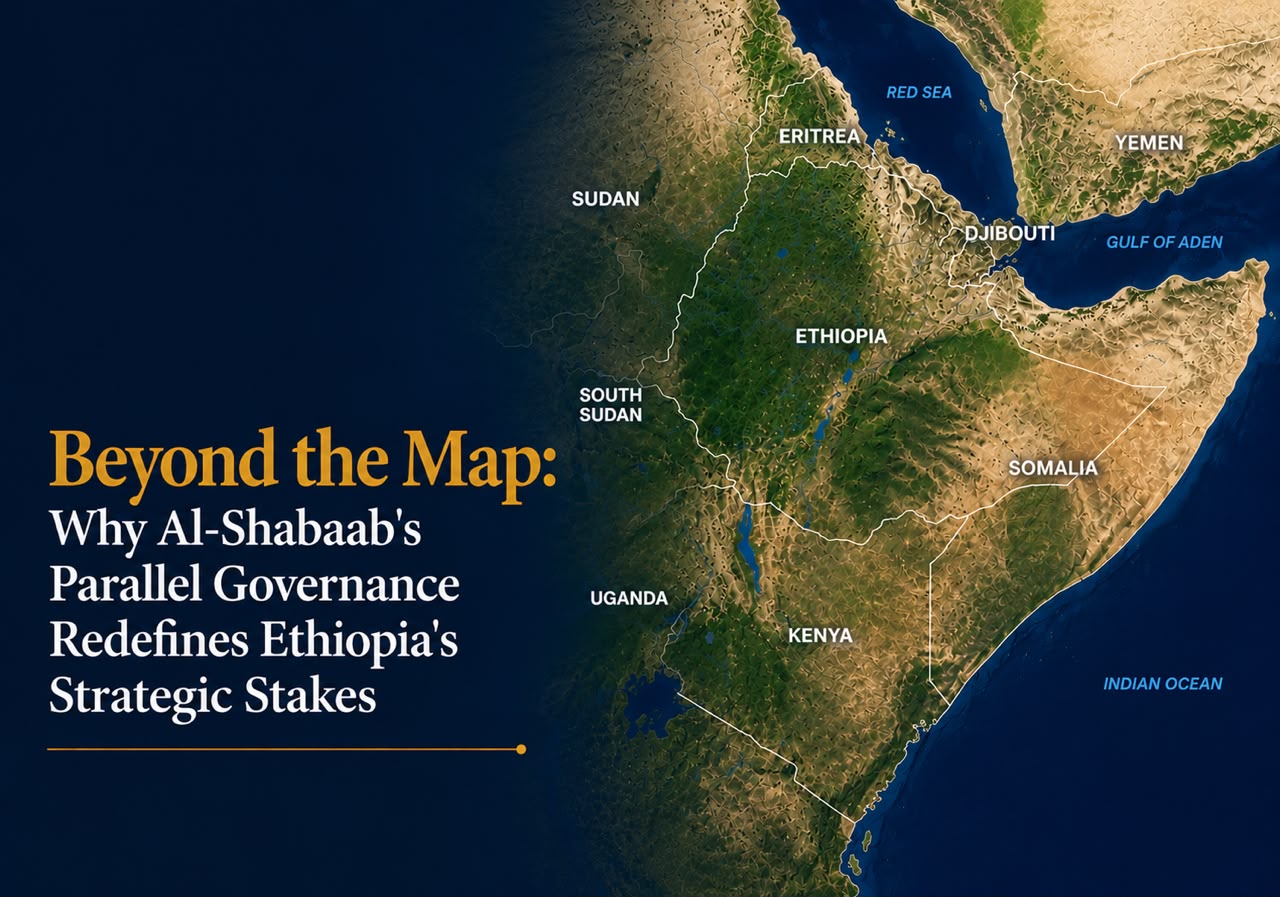
Somalia's war is usually measured through territorial control: which towns changed hands, which offensive stalled, and which side holds the advantage. By that measure, 2025 marked a difficult year for Mogadishu's counter-Shabaab campaign.The International Crisis Group reports that al-Shabaab's advances eroded much of the government's progress from the 2022-23 counteroffensive, returning the conflict to a familiar military-political stalemate. Yet the map may be tracking the wrong variable. The more consequential contest is increasingly over authority: which actor can tax, regulate movement, settle disputes, gather information, and impose rules consistently across contested districts.
This distinction matters directly for Ethiopia. Addis Ababa's security interests in Somalia are tied to border protection, intelligence cooperation, the stability of Ethiopia-facing corridors, and the ability of Somali partners to hold territory after military operations. If al-Shabaab's durability rests partly on its capacity to organize daily economic and legal life more predictably than the institutions competing with it, then military pressure alone cannot produce lasting security. The task is not only to dislodge armed units, but to weaken the shadow administration that allows the organization to endure, recover, and re-enter areas after state forces withdraw.
The Wrong Metric
Territory remains important, but it is an incomplete measure of insurgent strength. A district can appear under government control while traders still pay al-Shabaab taxes, residents still use its courts, and local officials still respond to its demands. Conversely, al-Shabaab can lose visible military positions while retaining the networks that structure commercial movement, collect revenue, and enforce compliance. Battlefield maps therefore capture presence more readily than endurance.
The concept of a shadow administration offers a more revealing framework. Authority here is comparative: al-Shabaab does not need to provide legitimate, humane, or popular governance. It only needs to make its rules more intelligible and enforceable than those of the institutions it competes with. Where multiple authorities impose overlapping or inconsistent demands, even coercive predictability can become a comparative advantage. This is not legitimacy. It is the capacity to shape behaviour through a combination of fear, routine, and administrative consistency.
Checkpoints and Courts as Administrative Infrastructure
The contrast is visible at roadside checkpoints. Some reporting suggests that informal, individually negotiated payments at certain state-aligned checkpoints can create repeated friction for traders travelling the same routes.2 Al-Shabaab's checkpoints are also coercive, but are reportedly more standardized: payments recorded, receipts issued, and passage recognized across areas under its influence. For traders, the distinction is less between freedom and coercion than between predictable coercion and inconsistent demands.
That difference has strategic effects. Predictable taxation lowers uncertainty, encourages routine compliance, and converts movement along roads into revenue. Checkpoint and tax personnel also generate information about who travels, what goods move, and where security forces are deployed. The administrative network therefore functions as both a financing system and an intelligence system. This is the mechanism connecting governance to durability: predictable rules encourage adaptation, adaptation produces compliance, and compliance generates the revenue and information that allow al-Shabaab to remain embedded through periods of military pressure. When state forces later withdraw or reorganize, the organization can reactivate a shadow administration that was never fully dismantled.
Reporting by the Global Initiative Against Transnational Organized Crime reinforces this reading, describing an organized taxation apparatus supported by penetration of clan and commercial networks, intelligence gathering, and the threat of punishment.3 Field reporting cited by the Soufan Center similarly indicates that after capturing towns, al-Shabaab moves quickly to erect roadblocks and collect revenue — an early instrument for converting temporary presence into structured authority, not a secondary activity that follows it.
Dispute resolution performs a comparable function. Reports from Somali media and research organisation describe individuals and businesses turning to al-Shabaab's courts after experiencing delay or limited access elsewhere.5 These shadow courts reportedly address land conflicts, commercial disagreements, and clan grievances. Their reach demonstrates that authority is exercised not only through violence, but through the capacity to produce decisions that shape daily life.
This should not be mistaken for lawful or legitimate justice: the courts operate without the safeguards of independent legal systems, and human rights organisation have documented harsh punishments and coercive enforcement. The narrower analytical point is that a coercive institution can still gain practical authority when it resolves matters more quickly and consistently than an alternative that is inaccessible or slow. Every dispute adjudicated also deepens al-Shabaab's understanding of local relationships, property claims, and loyalties, strengthening its capacity to tax, recruit, and identify resistance.
Coordinated Governance as a Counterinsurgency Variable
This framework also reshapes how coordination between Somalia's federal and regional institutions should be understood. Political coordination between Mogadishu and regional administrations is often treated as a separate constitutional matter. In contested districts, however, uncoordinated administration can generate competing checkpoints, overlapping taxation, and unclear responsibility for policing and courts — conditions that al-Shabaab's shadow administration is well positioned to exploit. Closer federal-regional coordination on frontier administration is therefore not a political question to defer until after stabilization; it is itself a counterinsurgency instrument. Where institutions coordinate closely, the state presents a single, coherent alternative rather than several parallel authorities for al-Shabaab to outcompete individually.
Why This Matters for Ethiopia
Ethiopia's engagement in Somalia is rooted in immediate national-security concerns. Ethiopian forces have contributed to African Union operations against al-Shabaab, and cross-border dynamics keep the Somali Region and adjoining corridors central to Addis Ababa's security planning. Ethiopia has also worked with Kenya and regional Somali administrations, including Jubaland, to strengthen frontier security. These partnerships deliver the most value for regional stability when pursued in close coordination with Somalia's federal government, reinforcing — rather than complicating — the broader effort to build a single, coherent Somali security architecture.
If al-Shabaab's shadow administration extends through Gedo, Bay, Bakool, Hiiraan, and other districts connected to Ethiopian trade and security corridors, then Ethiopia cannot evaluate cooperation only through troop numbers or towns held. It must also weigh who taxes commercial movement, who settles disputes, who gathers local intelligence, and whether the administration that follows a military operation is more reliable than the one it replaced.
First, border security assessments should incorporate administrative intelligence. Mapping taxation routes and dispute-resolution networks near Ethiopia-facing corridors would help distinguish areas of substantive government authority from areas where al-Shabaab's shadow administration persists beneath the surface.
Second, security partnerships should be judged partly by the quality of governance that follows military action. Supporting Somali and allied forces to hold a district achieves less if civilians face extortion or inaccessible courts immediately afterward. Handovers should include clear arrangements for checkpoint discipline, revenue administration, and dispute resolution.
Third, intelligence cooperation should target the informational backbone of insurgent governance, linking military intelligence with financial tracking, commercial reporting, and community-level early warning. Fourth, Ethiopia has a direct interest in stronger federal-regional coordination in frontier areas, since a more coherent Somali authority structure narrows the space in which al-Shabaab's shadow administration can compete for legitimacy.
The Limits of the Argument
A shadow administration does not mean al-Shabaab is moving inexorably toward national political control. The organisation faces military pressure, urban resistance, clan constraints, and financial vulnerabilities of its own. Nor does administrative reach automatically translate into public consent. The more defensible claim is narrower: governance penetration helps explain resilience. It clarifies why territorial gains against al-Shabaab are often difficult to consolidate, and why military setbacks do not necessarily destroy its capacity to return. Governance analysis does not replace battlefield analysis; it identifies the infrastructure that makes battlefield recovery possible.
Conclusion
Somalia's conflict is not becoming less military. It is becoming clearer that military outcomes are shaped by a deeper competition over authority. Al-Shabaab's durability lies partly in its capacity to make coercion administratively predictable, convert routine economic activity into revenue and intelligence, and preserve networks that survive changes on the battlefield. For Ethiopia, the strategic question is therefore not only how much territory al-Shabaab controls today. It is whether Somali and regional institutions can consistently outperform its shadow administration in the everyday functions through which authority is recognised: regulating movement, settling disputes, collecting revenue, and protecting commerce. Maps show where forces are present. Shadow administrations show which authority is likely to endure.
Notes
1. International Crisis Group, "New Chapter, Same Stalemate: Somalia's War with Al-Shabaab," Briefing No. 212, June 2026.
2. African Arguments, "What Al-Shabaab Understands About Somali Authority," June 2026.
3. Global Initiative Against Transnational Organized Crime, Inside Al-Shabaab's Revenue-Collection Machine.
4. The Soufan Center, "Al-Shabaab's 2025 Offensive and the Unravelling of Somalia's Federal Counterinsurgency," July 2025.
5. Africa Security Lab, Justice and Terror: Al-Shabaab's Informal Justice Mechanism; Hiiraan Online, "No Justice, No Peace: Al-Shabaab's Court System," March 2023.
6. Africa Center for Strategic Studies, Somalia at Risk of Becoming a Jihadist State, Africa Security Brief No. 45.
By Brook Gebremedhine Birega, IFA
Disclaimer:
The content disseminated by the Institute of Foreign Affairs (IFA) – including, but not limited to, publications, public statements, events, media appearances, and digital communications – reflects the views of individual contributors and does not necessarily represent the official positions or policies of the Institute, its partners, or any affiliated governmental or non-governmental entities.
While the IFA endeavors to ensure the accuracy, integrity, and timeliness of the information presented, it makes no representations or warranties, express or implied, regarding the completeness, reliability, or suitability of such content for any purpose. The Institute expressly disclaims any liability for errors or omissions, as well as for any actions taken or decisions made based on the information provided.
The inclusion of external links, references, or third-party resources does not constitute an endorsement by the Institute. Additionally, engagement on social media platforms – including, but not limited to, likes, shares, retweets (RTs), or reposts – shall not be interpreted as an endorsement or validation of the views expressed therein.
Readers and audiences are encouraged to exercise critical judgment and seek independent verification when interpreting or relying upon any information disseminated through publications and posts on the Institute’s platforms or representative.