
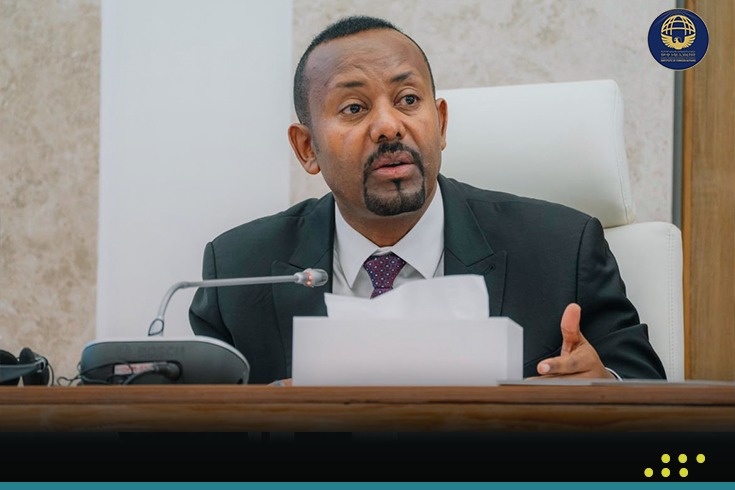
In a world of shifting alliances and external meddling, PM Abiy has codified Ethiopia's answer: strategic self-reliance, not retreat, but rooted strength.
Prime Minister Abiy Ahmed’s July 7, 2026, address to the House of Peoples’ Representatives did more than restate Ethiopia’s determination to defend its sovereignty. It presented a coherent foreign-policy logic for how the country intends to operate in an international system defined by strategic rivalry, economic disruption and increasingly fluid alliances.
At the centre of that logic is strategic self-reliance: the capacity to engage the world widely while preserving Ethiopia’s freedom to make consequential national decisions. The Prime Minister organized this approach around three mutually reinforcing pillars: resilience, the ability to convert challenges into opportunities, and the determination to shape Ethiopia’s own path. Taken together, they represent an emerging grand-strategic logic linking domestic capability to diplomatic agency.
The doctrine is not a call for isolation, self-sufficiency or withdrawal from international cooperation. Ethiopia remains dependent on trade, investment, technology, external markets and access to maritime corridors. Self-reliance in this context means something more practical: managing those interdependencies in ways that expand rather than restrict national choice. Its central proposition is clear. Formal sovereignty is insufficient when a state lacks the economic, political or security capacity to absorb external pressure. Genuine sovereign agency therefore requires more than rejecting interference. It requires building the internal strength that reduces the effectiveness of external pressure.
Sovereignty as national capacity
Ethiopia’s historical understanding of sovereignty has been shaped by resistance to external domination. Adwa remains the most powerful symbol of that tradition. Yet the nature of vulnerability has changed. In the twenty-first century, a country may retain territorial independence while remaining exposed through food insecurity, external debt, technological dependence, fragile institutions, imported energy and narrow transport corridors.
The contemporary defence of sovereignty must therefore extend beyond the battlefield. It must include productive capacity, economic diversification, institutional competence, social cohesion and diplomatic flexibility. This is the deeper significance of the Prime Minister’s first pillar: resilience.
In his parliamentary remarks, resilience was linked to filling national capability gaps through both hard and soft power. The idea is that Ethiopia must possess institutions capable of surviving shocks rather than remaining excessively dependent on external support. In foreign-policy terms, resilience creates room for manoeuvre. A state capable of feeding its population, financing essential functions, maintaining public order and protecting its strategic infrastructure is better positioned to withstand coercive pressure and negotiate from strength.
The economic section of the speech was therefore not separate from its foreign-policy message. The Prime Minister connected sectoral reform, agricultural expansion, industrial development, exports and reserve accumulation to Ethiopia’s ability to endure a turbulent international environment. The specific performance figures require verification against final institutional data, but the strategic connection is important: economic transformation is being treated as part of Ethiopia’s sovereignty infrastructure.
This logic is also reflected in the Homegrown Economic Reform agenda, which has emphasized macroeconomic stability, productivity, market development and inclusive growth. These priorities matter diplomatically because chronic economic vulnerability can give creditors, suppliers and external partners disproportionate influence over national choices.Strategic self-reliance thus begins at home. It is difficult to sustain an independent foreign policy when domestic vulnerabilities allow external shocks to determine national priorities.
Turning pressure into opportunity
The second pillar, leveraging opportunities, moves the doctrine beyond defensive resilience.
States cannot prevent every crisis. Global conflicts will continue to disrupt fuel, fertilizer, finance and logistics. Regional tensions will create new security burdens. Competition among major powers will produce both pressure and opportunity. Ethiopia’s challenge is therefore not simply to survive disruption, but to use it to accelerate structural change This is the difference between passive endurance and strategic adaptation.
The Prime Minister’s argument is that crises can expose dependencies that might otherwise remain politically comfortable. Supply shortages can stimulate domestic production. Restricted access to finance can encourage more careful borrowing and stronger revenue mobilization. Regional insecurity can expose the importance of national defence, intelligence and border institutions. International competition can create additional diplomatic and investment options.
The doctrine therefore treats adversity as a strategic test: can Ethiopia translate immediate pressure into longer-term capacity?
Food production provides the clearest illustration of this logic. Global disruptions to fertilizer, fuel and commodity markets can deepen dependency, but they can also reinforce the case for domestic agricultural transformation. The objective is not to remove Ethiopia from international markets. It is to ensure that participation in those markets does not leave the country permanently vulnerable to decisions made elsewhere.
The same principle applies to industrialization, energy, technology and logistics. Import substitution is strategically valuable where it reduces exposure in critical sectors, but self-reliance cannot mean attempting to produce everything domestically regardless of cost. The relevant question is which dependencies create unacceptable political or economic risk and which forms of interdependence generate mutual benefit.
Self-reliance must therefore be selective and strategic, not indiscriminate.
Shaping Ethiopia’s own path
The third pillar, shaping Ethiopia’s own path, is the doctrine’s most ambitious component.
Resilience protects the state from pressure. Opportunity leveraging converts shocks into capability. Independent agenda-setting then uses that capability to influence the external environment. This is the transition from defensive sovereignty to proactive sovereign agency.
A reactive state spends much of its diplomatic energy responding to decisions taken by others. Its agenda is shaped by crises, external demands and rival initiatives. A proactive state defines its interests in advance, proposes its own diplomatic frameworks and uses its partnerships to advance nationally determined objectives.
Prime Minister Abiy made national interest the central reference point for Ethiopia’s conduct in an unpredictable global system. He stated that the three pillars would guide the country’s international posture and declared that Ethiopia would not permit external actors to interfere in its national decisions.
This should not be read as a rejection of diplomacy. On the contrary, agenda-setting requires deeper engagement. A state cannot shape regional or global outcomes by withdrawing from them. The doctrine instead proposes engagement without subordination. Ethiopia should work with multiple partners, participate actively in international institutions and seek investment and technological cooperation while retaining the authority to determine its own priorities. Strategic self-reliance is therefore best understood as the conversion of domestic capacity into bargaining autonomy.
Navigating multipolarity without alignment traps
The changing international order gives this approach particular relevance. Power is becoming more dispersed. Traditional Western powers remain influential, but China, India, Russia, Gulf states and other actors increasingly shape investment, security, infrastructure and diplomatic agendas across Africa. Global institutions are more contested, while geopolitical competition has intensified around trade routes, critical resources, technology and political influence. For Ethiopia, this environment creates both opportunity and risk.
A wider range of partnerships can reduce dependence on a single political or financial centre. Ethiopia can cooperate with Western states, emerging powers, Gulf countries and African institutions according to the requirements of individual sectors. Its membership in BRICS adds another platform through which it can pursue financial, political and development partnerships within a more multipolar order. But diversification is not automatically autonomy.
Replacing dependence on one partner with dependence on another would not fulfil the doctrine’s purpose. Nor should flexible diplomacy become unpredictability. Partners must be able to distinguish national-interest pragmatism from abrupt or contradictory alignment.
The appropriate strategy is disciplined hedging: maintaining multiple relationships, avoiding unnecessary exclusivity and judging each partnership according to its contribution to Ethiopia’s long-term national capacity.
Under this model, cooperation with one power does not require hostility toward another. Ethiopia can seek financing from emerging institutions while maintaining relations with traditional development partners. It can participate in BRICS while supporting the African Union and multilateral cooperation. It can expand Gulf partnerships while preserving relations with other regional and international actors. The measure of success is not the number of partnerships Ethiopia possesses, but whether those partnerships collectively increase its freedom of action.
Domestic cohesion as foreign-policy infrastructure
The speech also suggests that sovereign agency has a political and social foundation. The recent national elections, the National Dialogue, and the implementation of the Pretoria Agreement are commonly treated as domestic files. Yet they have direct foreign-policy consequences.
A state facing persistent internal conflict must divert resources, political attention and diplomatic capital toward crisis management. Internal fragmentation can also create openings for external actors to exploit or influence domestic divisions, and this is where the doctrine's more difficult claims sit: the government has pointed to alleged external backing for armed spoilers in parts of the country, an allegation that remains contested and unverified in open sources, but one that, if accurate, illustrates precisely why the government treats domestic cohesion as inseparable from external vulnerability.
National cohesion is therefore not separate from strategic self-reliance. It is one of its essential conditions. The recent election cycle, held despite disruption attempts, and the National Dialogue process, described by the Prime Minister as an opportunity to work toward a new social contract, both matter for the same reason: the more Ethiopia can resolve political disputes through institutions and legitimate processes, the less vulnerable it becomes to external manipulation, and the more credible its claim to regional leadership becomes. Domestic peace protects strategic attention. Institutional legitimacy strengthens diplomatic authority. Economic inclusion expands resilience. Together, these provide the internal foundation from which an independent external posture can be sustained.
A doctrine for the Horn of Africa
The three-pillar framework has particular consequences for Ethiopia’s neighbourhood.
The Horn of Africa is experiencing overlapping crises: Sudan’s war, Somalia’s continuing security challenges, post-war tensions in northern Ethiopia, maritime competition in the Red Sea and recurring rivalry over external military and political influence. Ethiopia cannot insulate itself from these developments.
Strategic self-reliance offers a way to respond without falling into either complacency or an encirclement mentality.
Regional actors may pursue policies that conflict with Ethiopian interests. External powers may support competing initiatives. Armed groups may attempt to benefit from cross-border alignments. These developments require monitoring and deterrent capacity. But they should be evaluated through actual capabilities, coordination and leverage rather than through fear alone. A confident Ethiopia should not interpret every diplomatic meeting or defence agreement as proof of a unified hostile coalition. Nor should it ignore emerging risks. It should strengthen its economic, military and diplomatic position while preserving channels of engagement with neighbouring governments and societies.
This is where the doctrine’s constructive potential is strongest. Self-reliance can enable Ethiopia to serve as a stabilizing regional anchor, not by dominating its neighbours, but by possessing enough capacity to contribute to collective security, trade, mediation and infrastructure.
A resilient Ethiopia is better able to support regional peace operations, manage refugee and humanitarian pressures, sustain cross-border commerce and participate in African diplomatic initiatives. A vulnerable Ethiopia, by contrast, risks transmitting its own instability across the region.
Regional leadership must therefore begin with national consolidation, but it cannot end there.
Sea access, the Nile and managed interdependence
Ethiopia’s most important strategic interests also demonstrate why self-reliance cannot mean isolation.
As a landlocked country, Ethiopia’s international trade depends on access through neighbouring states. Its rivers connect it to downstream countries. Its security is inseparable from developments in Somalia, Sudan, Eritrea, Djibouti and the wider Red Sea.
Geography makes interdependence unavoidable.
The purpose of strategic self-reliance is therefore not to escape geography, but to improve Ethiopia’s bargaining position within it.
On maritime access, internal economic strength can support corridor diversification and peaceful negotiation. A larger market, stronger infrastructure and more productive economy give neighbouring coastal states greater incentives to enter mutually beneficial arrangements with Ethiopia. Maritime policy becomes more sustainable when access is framed as shared commercial opportunity rather than zero-sum territorial competition.
The same principle applies to the Nile. Ethiopia’s sovereign right to development must be defended, but durable outcomes require technical capability, diplomatic persistence and regional engagement. Sovereignty and cooperation are not opposites. Strong states are often better able to negotiate equitable cooperation because they do not enter negotiations from vulnerability. Strategic self-reliance should therefore produce more, not less, regional diplomacy.
The doctrine’s implementation test
The three-pillar framework provides a coherent direction, but its authority will depend on implementation.
The first test is capacity. Ethiopia must sustain the productive, institutional and security foundations required to absorb pressure. Sovereign language without material capability can become rhetorical rather than strategic. The second is consistency. Multi-vector diplomacy must remain predictable enough to maintain trust. National interest can guide flexible partnerships, but partners must understand Ethiopia’s principles and long-term priorities.
The third is regional reassurance. Ethiopia’s neighbours must be able to see that Ethiopian strength can generate shared benefits. Assertiveness without communication may create resistance, while strength combined with credible cooperation can generate leadership.
Transparent communication is therefore essential. Ethiopia must explain that its pursuit of autonomy is not directed against international partnership. It seeks to prevent unequal dependence while expanding mutually beneficial engagement.
From resilience to influence
Prime Minister Abiy Ahmed's parliamentary remarks mark an important attempt to articulate how Ethiopia understands sovereignty in a volatile world.
The doctrine's originality does not lie in rejecting external interference; Ethiopia has long defended its political independence. Its significance lies in connecting sovereignty to a systematic chain of capability: resilience at home, strategic adaptation during crisis and independent agenda-setting abroad. That chain provides the foundation of an emerging grand-strategic logic for twenty-first-century sovereignty.
The strategic payoff, if this doctrine holds, is substantial: reduced vulnerability to proxy pressure, a stronger position from which to pursue equitable outcomes on the Nile and the Red Sea, and the ability to convert demographic scale and resource endowment into sustained rather than episodic regional influence. Sustained over time, this is the foundation on which Ethiopia's claim to being a continental economic powerhouse, and a stabilizing contributor to Horn of Africa security, ultimately rests.
Its central insight is that sovereignty must be produced continuously, through institutions that function under pressure, an economy capable of sustaining national priorities, political mechanisms that reduce internal fragmentation, and diplomacy that creates options rather than dependencies. Strategic self-reliance is therefore neither retreat nor self-sufficiency. It is the disciplined management of interdependence. For Ethiopia, the ultimate strategic objective is not to stand alone. It is to ensure that engagement with the world strengthens its capacity to choose, act and contribute on its own terms.
Footnotes
EBC English, "PM Abiy Ahmed Addresses Parliament to Review the 2018 Report and Answer 2019 Budget Questions," July 7, 2026.
By Bemnet Alemayehu, IFA
Disclaimer:
The content disseminated by the Institute of Foreign Affairs (IFA) – including, but not limited to, publications, public statements, events, media appearances, and digital communications – reflects the views of individual contributors and does not necessarily represent the official positions or policies of the Institute, its partners, or any affiliated governmental or non-governmental entities.
While the IFA endeavors to ensure the accuracy, integrity, and timeliness of the information presented, it makes no representations or warranties, express or implied, regarding the completeness, reliability, or suitability of such content for any purpose. The Institute expressly disclaims any liability for errors or omissions, as well as for any actions taken or decisions made based on the information provided.
The inclusion of external links, references, or third-party resources does not constitute an endorsement by the Institute. Additionally, engagement on social media platforms – including, but not limited to, likes, shares, retweets (RTs), or reposts – shall not be interpreted as an endorsement or validation of the views expressed therein.
Readers and audiences are encouraged to exercise critical judgment and seek independent verification when interpreting or relying upon any information disseminated through publications and posts on the Institute’s platforms or representative