
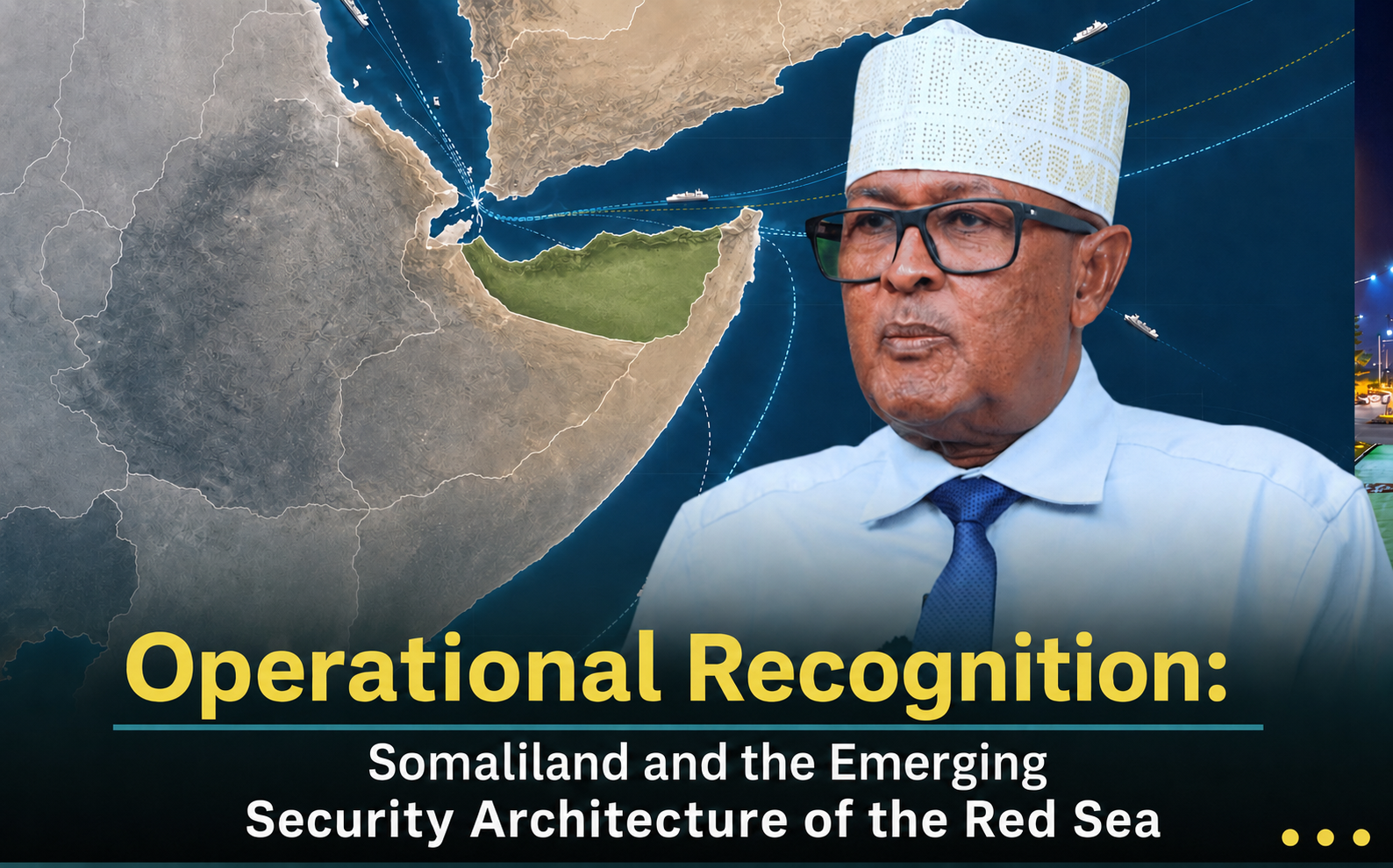
The debate over Somaliland is no longer simply about legal recognition. As insecurity in the Red Sea transforms ports, maritime corridors, and coastal territories into instruments of geopolitical competition, the politics of recognition is increasingly giving way to the operational logic of access. Somaliland's strategic importance is no longer determined solely by whether it is formally recognized as a sovereign state, but by whether regional and external powers already regard it as an indispensable security and logistical partner. This emerging dynamic suggests that recognition is evolving from a juridical act into a strategic instrument through which states pursue security, maritime access, and regional influence.
For more than three decades, the Somaliland question has been framed within the legal principles of sovereignty and territorial integrity. Since declaring independence from Somalia in 1991, Somaliland has established relatively stable political institutions, conducted multiple competitive elections, and maintained effective control over its territory. Yet these achievements have not translated into international recognition because the African Union has remained committed to preserving inherited colonial borders while Somalia continues to reject any challenge to its territorial integrity. The prevailing assumption has therefore been that diplomatic recognition must precede meaningful international engagement. That assumption is becoming increasingly difficult to sustain.
The catalyst is the changing security environment of the Red Sea. Maritime attacks, disruptions to commercial shipping, and intensifying competition among regional and external powers have transformed the Bab el-Mandeb into one of the world's most strategically contested maritime corridors. Protecting sea lanes now depends as much on access to reliable ports, logistics hubs, intelligence cooperation, and politically stable coastal authorities as it does on naval deployments. Somaliland's location along the Gulf of Aden therefore carries strategic significance that extends far beyond its unresolved legal status. Increasingly, external actors have compelling incentives to deepen practical engagement with Somaliland irrespective of its diplomatic standing.
This emerging pattern can be understood through the concept of operational recognition. Unlike formal diplomatic recognition, operational recognition describes the gradual integration of an unrecognized territory into regional security, economic, and diplomatic networks through practical cooperation rather than legal endorsement. Port investment, commercial agreements, maritime security coordination, infrastructure development, and diplomatic engagement collectively reduce the practical importance of formal recognition. Somaliland increasingly illustrates this transformation. Its strategic utility is generating patterns of cooperation that functionally normalize its international role even as its legal status remains contested.
Berbera provides the clearest illustration of this shift. Once regarded primarily as a commercial port, it has evolved into a strategic node where maritime security, regional connectivity, and geopolitical competition converge. For Ethiopia, whose dependence on Djibouti remains a structural economic vulnerability, Berbera represents an opportunity to diversify maritime access and strengthen long-term economic resilience. For external powers seeking to secure freedom of navigation through the Red Sea, the port offers proximity to one of the world's busiest maritime chokepoints. Geography alone, however, does not create strategic value. It becomes decisive when combined with governance capacity, infrastructure, and political stability. Somaliland's relative institutional resilience therefore transforms its geography into strategic leverage.
The consequences extend well beyond Somaliland itself. Operational recognition creates a cascading strategic dilemma by reshaping the calculations of multiple regional actors simultaneously. Somalia continues to regard Somaliland as an inseparable part of its sovereign territory and therefore interprets expanding international engagement as a direct challenge to its constitutional order. Yet legal opposition alone is unlikely to prevent Somaliland's growing integration into regional security and commercial networks. This is the central paradox of the Somaliland question: formal non-recognition may persist even as operational recognition steadily deepens. Diplomatic ambiguity increasingly coexists with expanding strategic cooperation.
For Ethiopia, this transformation presents both opportunity and constraint. Diversifying maritime access has become a strategic necessity driven by economic growth, demographic expansion, and long-term national development. Yet Berbera can no longer be viewed solely as an infrastructure project. As Somaliland becomes increasingly embedded within evolving regional security arrangements, Ethiopia's maritime ambitions risk becoming intertwined with wider geopolitical rivalries involving Somalia, Turkey, Egypt, Gulf states, and other external actors. The strategic challenge for Addis Ababa is therefore no longer simply how to secure access to the sea, but how to ensure that maritime diversification strengthens regional stability rather than accelerating geopolitical polarization.
Turkey and Egypt illustrate how Somaliland's evolving strategic position reverberates across the wider Horn of Africa. Ankara has invested heavily in Somalia's security institutions, infrastructure, and state-building efforts while consistently affirming Somalia's territorial integrity. Somaliland's expanding operational role therefore complicates Turkey's regional posture by exposing growing tension between its political commitments and evolving maritime realities. Egypt approaches Somaliland through a different strategic lens. Its expanding Red Sea security interests, coupled with broader strategic competition with Ethiopia, mean that developments surrounding Somaliland increasingly influence Cairo's wider regional calculations. Somaliland has therefore become embedded within a broader geopolitical contest that extends far beyond the Somalia-Somaliland dispute itself.
These developments also expose a widening governance gap within African regional institutions. The African Union and IGAD continue to operate within legal frameworks emphasizing territorial integrity and negotiated political settlement. Yet geopolitical realities increasingly move faster than institutional adaptation. As external actors deepen cooperation through infrastructure investment, maritime security, commercial engagement, and diplomatic partnerships, legal doctrines risk being overtaken by operational realities. Existing regional governance mechanisms therefore face an increasingly difficult challenge: preserving established norms while adapting to a rapidly evolving strategic environment.
This does not imply that Somaliland's formal recognition has become inevitable. Somalia's sovereignty claims continue to command substantial diplomatic support, and many African governments remain reluctant to establish precedents that could encourage secessionist movements elsewhere on the continent. These concerns remain politically significant. Nevertheless, they no longer fully explain contemporary patterns of international engagement. Strategic utility increasingly shapes external behavior. Rather than recognition enabling cooperation, cooperation itself may gradually normalize recognition.
Somaliland is therefore no longer simply a recognition dispute. It has become a strategic test case for understanding how maritime insecurity, geopolitical competition, and infrastructure politics are reshaping the relationship between sovereignty and security across the Horn of Africa. As the Red Sea continues to emerge as a unified strategic space, stable coastal territories capable of facilitating trade, surveillance, and security cooperation will become increasingly valuable regardless of their diplomatic status. The future of Somaliland may ultimately be determined not by a single act of diplomatic recognition, but by the operational security architecture already taking shape around it.
Notes
1. African Union, Report of the African Union Fact-Finding Mission to Somaliland (Addis Ababa: African Union, 2005).
2. United Nations Conference on Trade and Development (UNCTAD), Review of Maritime Transport 2024 (Geneva: United Nations, 2024).
3. International Crisis Group, The Ethiopia–Somalia–Somaliland Triangle: Managing Escalating Tensions in the Horn of Africa (Brussels: International Crisis Group, 2024).
4. Harry Verhoeven, The Horn of Africa and the New Geopolitics of the Red Sea (London: Chatham House, 2022).
5. Aleksi Ylönen, "Recognition, Sovereignty, and Geopolitical Competition in the Horn of Africa," African Security Review 33, no. 1 (2024): 45–61.
By Eman Ferid, IFA
Disclaimer:
The content disseminated by the Institute of Foreign Affairs (IFA) – including, but not limited to, publications, public statements, events, media appearances, and digital communications – reflects the views of individual contributors and does not necessarily represent the official positions or policies of the Institute, its partners, or any affiliated governmental or non-governmental entities.
While the IFA endeavors to ensure the accuracy, integrity, and timeliness of the information presented, it makes no representations or warranties, express or implied, regarding the completeness, reliability, or suitability of such content for any purpose. The Institute expressly disclaims any liability for errors or omissions, as well as for any actions taken or decisions made based on the information provided.
The inclusion of external links, references, or third-party resources does not constitute an endorsement by the Institute. Additionally, engagement on social media platforms – including, but not limited to, likes, shares, retweets (RTs), or reposts – shall not be interpreted as an endorsement or validation of the views expressed therein.
Readers and audiences are encouraged to exercise critical judgment and seek independent verification when interpreting or relying upon any information disseminated through publications and posts on the Institute’s platforms or representative