
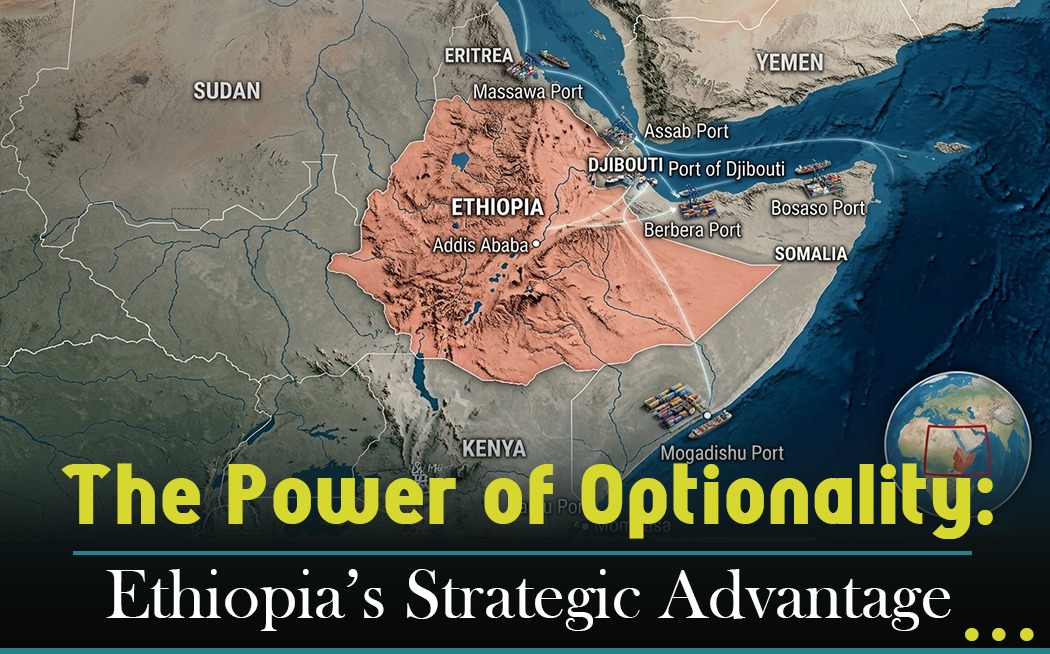
In a fragmented international system, power is increasingly measured not by the ability to dominate a single sphere but by the ability to preserve multiple strategic options simultaneously. As geopolitical competition intensifies, supply chains fragment, maritime chokepoints become contested, and traditional alliances become more transactional, states capable of maintaining alternative partnerships, corridors, institutions, and sources of leverage gain a distinct strategic advantage.
This emerging form of power can be called optionality. Optionality is the capacity of a state to avoid dependence on any single route, patron, institution, or geopolitical bloc. It is not neutrality, nor is it strategic ambiguity. Rather, it is the deliberate preservation of alternatives before a crisis narrows available choices. In an era of overlapping geopolitical, economic, and security disruptions, optionality has become a strategic asset in its own right. Few countries illustrate this phenomenon more clearly than Ethiopia.
With a population of approximately 135.9 million, Ethiopia is Africa's second-most populous country and one of the continent's fastest-growing economies. Yet these attributes alone do not explain why the country remains difficult to isolate despite being landlocked, facing internal security pressures, and operating within one of the world's most contested geopolitical regions. Ethiopia's growing influence derives less from its size than from its ability to maintain multiple diplomatic, economic, security, and logistical options simultaneously.
Why Dependency Is the Real Strategic Threat
Conventional discussions of Ethiopian foreign policy often focus on maritime access. Yet access itself is not the central strategic challenge. Dependency is. For a country of Ethiopia's scale, reliance on a single trade corridor, a single external partner, or a single institutional framework creates structural vulnerability. The relevant question is no longer whether Ethiopia can secure access to international markets, but whether that access remains diversified enough to prevent external coercion.
Recent disruptions in the Red Sea illustrate the point. Continued attacks on commercial shipping and recurring threats to maritime traffic have increased transportation costs, disrupted shipping schedules, and contributed to broader uncertainty across global supply chains. The U.S. Maritime Administration has repeatedly warned that attacks on commercial vessels have expanded the risk environment throughout the Red Sea and Gulf of Aden. For Ethiopia, such disruptions translate directly into higher import costs, delayed exports, increased fertilizer prices, and pressure on industrial production. The lesson is not simply that maritime instability is dangerous. The deeper lesson is that any state dependent upon a single strategic artery becomes vulnerable to events beyond its control.
This makes corridor diversification a matter of national security rather than transportation policy. Railways, dry ports, alternative trade routes, and diversified commercial partnerships are not merely economic projects; they are instruments for preserving strategic choice. The objective is not to replace one dependency with another but to ensure that no external actor can hold a veto over Ethiopia's economic future.
The Rise of Diplomatic Optionality
The same logic increasingly shapes Ethiopia's diplomacy. For much of the post-Cold War period, smaller and medium-sized states often operated within relatively stable geopolitical alignments. Today, however, the fragmentation of the international order has expanded room for maneuver. States no longer face a binary choice between competing blocs. Instead, they can selectively engage multiple centers of power simultaneously.
Ethiopia's participation in BRICS while maintaining close engagement with the International Monetary Fund illustrates this evolving strategy. Ethiopia formally joined BRICS on 1 January 2024 while simultaneously pursuing an IMF-supported economic reform program. Rather than treating these institutions as mutually exclusive, Ethiopia has used them for different purposes. BRICS broadens diplomatic and financial networks across the Global South, while IMF engagement remains central to macroeconomic stabilization and reform. This is not evidence of ideological inconsistency. It is evidence of strategic optionality.
The same pattern is visible in Ethiopia's relationships with Gulf states, Western partners, African institutions, and emerging powers. Gulf countries have become increasingly important investors in Ethiopian agriculture, logistics, infrastructure, telecommunications, and real-estate sectors over the past decade. Ethiopia's foreign policy increasingly seeks to widen its network of relationships without becoming fully dependent on any single actor.
Security Optionality in a Fused Regional Environment
The Horn of Africa no longer operates as a collection of separate crises. Sudan's war, Somalia's fragility, Red Sea insecurity, Nile Basin politics, and broader Middle Eastern competition increasingly interact within a single strategic environment. This fusion changes the meaning of security. Somalia, for example, cannot be understood solely through the lens of counterterrorism. Ethiopia remains a key stakeholder in the African Union Support and Stabilization Mission in Somalia (AUSSOM), which became operational in January 2025.Ethiopia's security engagement there is tied simultaneously to border stability, maritime security, regional legitimacy, and the containment of transnational threats.
Likewise, instability in Sudan is not merely a neighboring conflict. It influences refugee flows, border management, Nile Basin politics, and regional power balances. The significance of these developments lies not in the individual crises themselves but in their cumulative effect on strategic flexibility. States that become trapped within one security theater risk losing room for maneuver elsewhere.
Optionality as a Development Strategy
Optionality is often discussed in military or diplomatic terms, but its economic dimension may be equally important. The International Monetary Fund projects Ethiopia among the fastest-growing economies in Africa and forecasts strong medium-term growth under ongoing reform efforts. Reuters reported in February 2026 that Prime Minister Abiy Ahmed projected economic growth exceeding 10 percent while pursuing debt restructuring and IMF-supported reforms.
Yet sustained growth depends not only on economic performance but also on diversification of partnerships, markets, and investment sources. Overreliance on any single source of financing, export destination, or development partner creates vulnerability. Economic resilience emerges when states maintain multiple channels through which capital, technology, and investment can flow. In this regard, Ethiopia's engagement with Gulf investors, multilateral lenders, African institutions, and emerging economic blocs reflects more than a search for financing. It reflects an effort to build a wider architecture of economic optionality capable of absorbing external shocks.
The Future Belongs to States That Preserve Choice
The broader implication extends beyond Ethiopia. The international system is becoming increasingly fragmented. Great-power competition is intensifying. Maritime chokepoints are more vulnerable. Global institutions face growing pressure. Regional conflicts increasingly overlap with one another. Under these conditions, traditional measures of power tell only part of the story. Population size matters. Military capability matters. Economic output matters. Yet an equally important measure of power is the ability to preserve strategic alternatives when circumstances change.
States that anchor themselves exclusively to one corridor, one alliance, one market, or one patron become vulnerable to disruption. States that maintain multiple pathways acquire resilience, bargaining power, and strategic autonomy. What emerges from Ethiopia's experience is therefore a broader lesson about contemporary statecraft. In an era of uncertainty, optionality is no longer simply a diplomatic technique. It is becoming a form of power. For Ethiopia, the challenge is not merely to expand its influence. It is to continue preserving the alternatives that make influence possible in the first place.
Notes
1. International Monetary Fund, World Economic Outlook: Navigating Global Divergences (Washington, DC: IMF, 2025).
2. Richard Haass, The Age of Disorder (New York: Penguin Press, 2022), 87–103.
3. World Bank, The World Bank in Ethiopia: Overview (Washington, DC: World Bank, 2025).
4. Reuters, "Houthis Threaten Israeli-Linked Shipping in the Red Sea," June 8, 2026.
5. U.S. Maritime Administration, Red Sea and Gulf of Aden Security Environment Advisory (Washington, DC: U.S. Department of Transportation, September 2025).
6. United Nations Conference on Trade and Development (UNCTAD), Review of Maritime Transport 2025 (Geneva: UNCTAD, 2025).
7. Amitav Acharya, The End of American World Order, 2nd ed. (Cambridge: Polity Press, 2018).
8. BRICS Information Centre, BRICS Expansion and Membership Framework (Toronto: University of Toronto, 2026).
9. International Monetary Fund, Ethiopia Country Profile (Washington, DC: IMF, 2026).
10. Institute of Foreign Affairs, Gulf Investments and Strategic Engagement in Ethiopia (Addis Ababa: Institute of Foreign Affairs, May 2026).
11. African Union, High Representative for the Horn of Africa and the Red Sea: Strategic Framework (Addis Ababa: African Union Commission, 2026).
12. African Union, African Union Support and Stabilization Mission in Somalia (AUSSOM): Mandate and Operational Framework (Addis Ababa: African Union Commission, 2025).
13. United Nations High Commissioner for Refugees, Sudan Regional Refugee Response Plan 2026 (Geneva: UNHCR, 2026).
14. International Monetary Fund, World Economic Outlook Database (Washington, DC: IMF, April 2026).
15. Reuters, "Ethiopia Projects 10.2 Percent Growth Amid IMF-Backed Reform Program," February 3, 2026.
By Eman Ferid, IFA
Disclaimer:
The content disseminated by the Institute of Foreign Affairs (IFA) – including, but not limited to, publications, public statements, events, media appearances, and digital communications – reflects the views of individual contributors and does not necessarily represent the official positions or policies of the Institute, its partners, or any affiliated governmental or non-governmental entities.
While the IFA endeavors to ensure the accuracy, integrity, and timeliness of the information presented, it makes no representations or warranties, express or implied, regarding the completeness, reliability, or suitability of such content for any purpose. The Institute expressly disclaims any liability for errors or omissions, as well as for any actions taken or decisions made based on the information provided.
The inclusion of external links, references, or third-party resources does not constitute an endorsement by the Institute. Additionally, engagement on social media platforms – including, but not limited to, likes, shares, retweets (RTs), or reposts – shall not be interpreted as an endorsement or validation of the views expressed therein.
Readers and audiences are encouraged to exercise critical judgment and seek independent verification when interpreting or relying upon any information disseminated through publications and posts on the Institute’s platforms or representative