
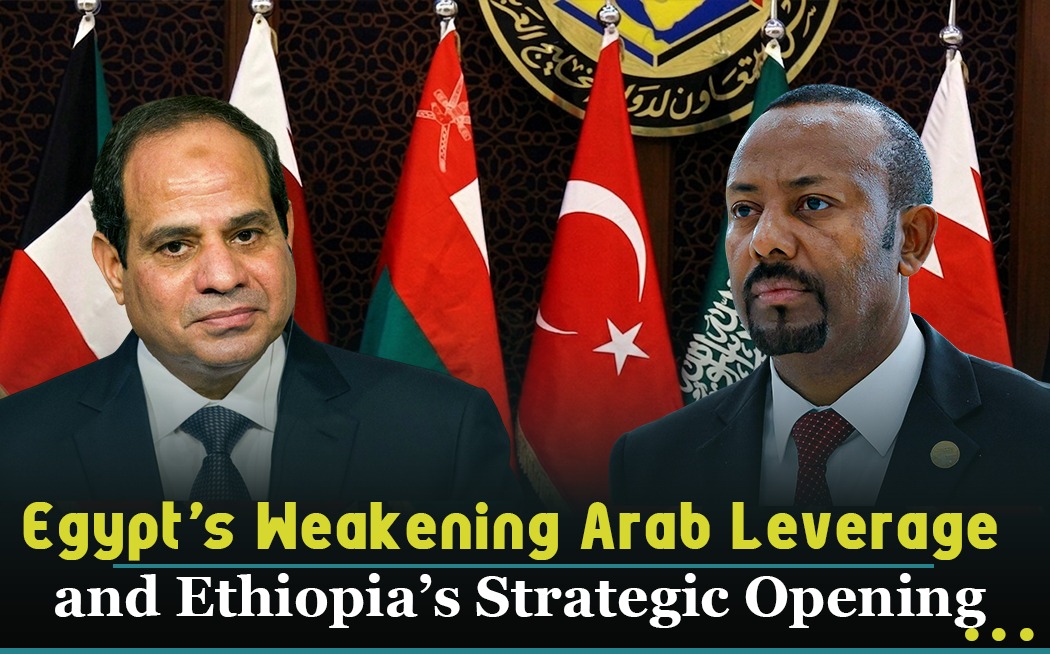
Egypt’s pressure on Ethiopia is weakening, the Arab nationalist order that once turned Egyptian interests into wider Arab causes has lost much of its force. This does not mean Egypt has become irrelevant. Egypt still has the Suez Canal, a large military, long diplomatic experience, influence in the Arab League, ties with African institutions, and strong security relations with several outside powers. But these assets no longer work as they did in the age of pan-Arab nationalism. In that earlier period, Egypt could often present its own security concerns as the concerns of the wider Arab world. Today, that ability has weakened. This is the deeper change behind Ethiopia’s wider room for action in the Nile Basin, the Horn of Africa, and the Red Sea.1
For Ethiopia, the most important point is simple: Egypt has not only lost some influence; it has lost the old political language that once helped it multiply that influence. Arab nationalism gave Egypt more than popularity. It gave Egypt strategic depth. It allowed Egypt to speak beyond its borders, shape Arab opinion, and build pressure around questions that were, at their core, Egyptian national interests. Nile security, suspicion of Ethiopia’s upstream position, and resistance to Ethiopia’s regional rise could all be framed as wider Arab strategic questions.2
That was the heart of Egypt’s old strength. Egypt did not need to rely only on soldiers, treaties, or direct pressure. It could also rely on a shared Arab political imagination. When Egypt spoke, it could claim to speak for a wider Arab cause. When Ethiopia moved to use the Nile for development, Egypt could try to present that move not only as a challenge to Egypt, but as a challenge to Arab security. This gave Egypt a pressure tool that was larger than Egypt itself.
That tool is now weaker. The decline did not happen in one moment. The 1979 peace treaty between Egypt and Israel weakened Egypt’s claim to be the uncontested voice of Arab resistance and changed how many Arab actors viewed Egypt’s regional role.3 The 1991 Gulf War then showed that Arab states no longer shared one security outlook. The 2003 invasion of Iraq removed another major Arab republican center. After 2011, the Arab uprisings pushed many Arab states toward regime survival, domestic order, economic pressure management, and narrow state interest rather than pan-Arab coordination.
The result is a regional environment in which Egypt must work harder to build support. Saudi Arabia, the United Arab Emirates, and Qatar now carry far greater financial, media, diplomatic, and logistical weight than before. Their policies in the Horn of Africa are not simply extensions of Egypt’s Nile agenda. They are shaped by ports, food security, investment, logistics, military access, energy routes, and Red Sea competition.4 They may sympathize with Egypt on water security, but they do not automatically subordinate their Horn policy to Egyptian priorities.
This is why the Horn of Africa has become one of the clearest places where Egypt’s reduced leverage can be seen. Ethiopia is no longer facing a single Arab bloc that Egypt can easily mobilize. Ethiopia is dealing with many actors whose interests differ: Gulf states, Turkey, China, Israel, Western powers, African institutions, and Red Sea states. Their agendas overlap in some areas, but they rarely merge into one anti-Ethiopian position. Egypt can still lobby, warn, pressure, and build alignments. What it can no longer do reliably is turn every dispute with Ethiopia into a unified Arab campaign.
The GERD makes this shift visible. Egypt has spent years describing the dam as a threat to its water security. The Arab League has adopted positions sympathetic to Egypt and Sudan, while Ethiopia has rejected those positions as attempts to move an African water issue into an Arab diplomatic forum.5 Yet the larger political reality did not move in Egypt’s favor. Ethiopia completed and inaugurated the GERD in September 2025, establishing a new fact on the Nile and showing that Arab statements alone could not stop Ethiopia’s development path.6
This is not a minor diplomatic failure for Egypt. It is evidence of a larger change in power. In the past, Egypt’s ability to isolate Ethiopia depended on turning Nile politics into Arab politics. Today, Ethiopia has shown that upstream African development cannot be permanently blocked by inherited claims, diplomatic pressure, or symbolic Arab resolutions. The facts on the ground have changed. The Nile Basin is no longer frozen inside the old order Egypt preferred.
The Red Sea shows the same trend. Egypt has often supported a narrow view of Red Sea security that gives priority to coastal states and keeps Ethiopia outside the main table. The Council of Arab and African Coastal States of the Red Sea and the Gulf of Aden, established in 2020, includes coastal states such as Saudi Arabia, Egypt, Sudan, Yemen, Eritrea, Somalia, Djibouti, and Jordan.7 But a coastal-only approach cannot fully manage a corridor that affects hinterland states, landlocked economies, port investors, energy importers, and global shipping powers.
Ethiopia’s argument is therefore stronger than a simple demand for access. Ethiopia is not asking to be recognized because of sentiment. It is pointing to a hard regional fact: a country of Ethiopia’s population, economic weight, and geographic position cannot be treated as a passive inland state in a maritime system that shapes its trade, energy security, food supply, industrial growth, and national security. Red Sea instability directly affects Ethiopia’s future. Excluding Ethiopia from Red Sea discussions does not create stability; it deepens imbalance.
This is where Egypt’s old pressure method becomes less effective. Egypt can argue from coastal status. Ethiopia can argue from regional impact. Egypt can invoke old diplomatic habits. Ethiopia can point to demographic weight, market size, energy potential, African integration, and the need for fair regional inclusion. Egypt’s position depends on keeping the Red Sea and Nile questions under old rules. Ethiopia’s position depends on showing that the region has changed and that new realities require new arrangements.
The pressure on Egypt is also practical. The Red Sea crisis has shown that the Suez Canal, one of Egypt’s core strategic assets, is exposed to instability far beyond Egypt’s control. Attacks on shipping and disruption in the Red Sea sharply reduced Suez Canal revenue in 2024 and 2025, reminding Egypt that control over a canal does not mean control over the whole maritime chain.8 This weakens Egypt’s ability to speak as if Red Sea security can be managed through exclusion or narrow coastal coordination alone.
For Ethiopia, the strategic opening is clear. Egypt’s reduced Arab leverage gives Ethiopia more room to work with Gulf states, African partners, Turkey, China, Western actors, and others without every relationship being filtered through Egypt’s objections. Ethiopia can present itself not only as an upstream Nile state, but as a major African market, a power producer, a logistics partner, a food-security partner, and an essential actor in the Horn–Red Sea space.
But Ethiopia should use this opening carefully. The goal should not be to replace Egyptian pressure with dependence on another outside actor. The goal should be to turn Ethiopia’s regional weight into accepted institutional presence. Ethiopia should push for Red Sea and Nile arrangements that are inclusive, legal, negotiated, and linked to shared economic benefit. Its maritime agenda should be presented as a stability agenda, not as a zero-sum move against any state.
This requires a clear diplomatic message. Ethiopia’s development on the Nile is not a threat to the region; it is part of Africa’s right to use its own resources for electricity, growth, and integration. Ethiopia’s role in the Red Sea is not an intrusion; it is a recognition that the security of the waterway affects both coastal and inland states. Ethiopia’s engagement with Gulf actors is not a campaign against Egypt; it is part of a wider effort to build trade, infrastructure, energy links, and regional balance.
Egypt’s challenge is now evident. It remains powerful, but the old Arab nationalist environment that amplified its power has faded. Egypt can still pressure Ethiopia, but it can no longer assume that Arab states will automatically carry Egypt’s agenda as their own. It can still issue warnings, but warnings do not create the same effect when Gulf states, African actors, Turkey, China, Israel, Europe, and the United States all pursue their own interests in the Horn and Red Sea.
Ethiopia’s opportunity is not Egypt’s collapse. It is the weakening of the old system that allowed Egypt to turn Ethiopian development into an Arab security file. That system no longer commands the region as it once did. The future balance will depend on which state adapts faster: Egypt, by accepting that pressure without consensus has limits; or Ethiopia, by turning its new diplomatic space into durable regional influence.
If Ethiopia stays patient, clear, and institution-focused, Egypt’s pressure campaign will continue to lose weight. The Horn–Red Sea region is no longer organized around Egypt’s old claims of Arab leadership. It is being reshaped by ports, power, trade, investment, shipping lanes, African agency, and new regional partnerships. In that changing order, Ethiopia has a rare chance to move from being treated as a problem to being recognized as an indispensable part of the solution.
References
- Embassy of Ethiopia, “Statement on the Resolution of the League of Arab States on the GERD,” June 16, 2021. Ethiopia rejected the Arab League resolution on the GERD and described it as a misguided position. (Embassy of Ethiopia)
- Reuters, “Ethiopia launches massive hydropower dam against bitter Egyptian opposition,” September 9, 2025; The Guardian, “Ethiopia inaugurates Africa’s largest hydroelectric dam as Egypt rift deepens,” September 9, 2025. (Reuters)
- Saudi Press Agency, “Foreign Minister: The Council of Arab and African Coastal States of the Red Sea and the Gulf of Aden,” January 6, 2020. The founding charter was signed by Saudi Arabia, Egypt, Jordan, Sudan, Yemen, Eritrea, Somalia, and Djibouti. (Saudi Press Agency)
- Reuters, “Egypt Suez Canal monthly revenue losses at around $800 million, Sisi says,” March 17, 2025; Associated Press, “Egypt’s revenue from the Suez Canal plunged sharply in 2024,” April 16, 2025.