
1. Renewed mandate
On 5 October 2026, the seventh FDRE House of Peoples' Representatives opened and swore in Prime Minister Abiy Ahmed for a second term following the 1 June 2026 electoral victory that returned the Prosperity Party to office. The parliamentary session reaffirmed the second term as the Medemer Government. Prime Minister Abiy Ahmed, an architect behind the Medemer philosophy now leads of the Medemer Government for the next five years.
In his Parliamentary address, the Prime Minister described recent years as a period of laying foundations for a resilient political-economic system. Pledging cooperative relations with neighbors based on mutual interest, he reaffirmed that Ethiopia will continue to pursue a maritime interest to ensure access to the sea to meaningfully navigate the nation’s economic statecraft. He underlined the importance of dialogue and the foundational principle of "give-and-take" to realize this ambition. Outlining foundational policy trajectories where Ethiopia can focus over the next five years, the parliamentary address signaled proactive strategies of pursuing reliable maritime access through negotiated arrangements and strengthening the country’s regional diplomatic and economic engagement in East Africa.
In the meantime, the regional environment remains challenging. Among others, three of Ethiopia’s neighbors - Eritrea, Sudan, and Somalia - reach a deal with Egypt recently, potentially complicating Ethiopia’s pursuit of maritime access. On 4 October 2026, the four countries reportedly declared that Red Sea governance is to be the exclusive responsibility of littoral states . Meanwhile internal conflict persists with recent fighting in Tigray . These developments may interact through regional security competition and the risk of proxy conflict . Under these competing contexts, Ethiopia should align its foreign-policy objectives with practical diplomatic methods. In this endeavor, Medemer’s Horn-First approach is set to offer a credible alternative to “zero-sum” competition.
2. How research supports claims
An IFA research report conducted on institutionalization of Medemer in the Horn treats the philosophy as a foreign policy paradigm made up of goals and means, normative ideas, and identity framings of the self and others. The research identifies that the institutionalization of internationalizing Medemer in the Horn sub-region is already underway along two pathways – narrative and structural. While the narrative pathway identifies backcasting, performance and ripple effects, and media and digital diplomacy, the structural pathway points to shuttle diplomacy, infrastructure connectivity, sea-access cooperation, and shared governance of geostrategic resources such as transboundary rivers
Supporting the institutionalization trajectory, four areas of opportunity favor the Medemer paradigm, namely, a sustained Horn-First foreign policy reorientation in its own right, the potential for Medemer to offer a distinctive regional cooperation framework, initiatives of differentiated bilateral ties (e.g. consolidation of Ethiopia-Kenya security cooperation in 2025 and relations with Djibouti that carries an estimated 90 to 95 percent of Ethiopia’s maritime trade), and a foundational “give-and-take” principle in which all Horn countries can leverage Ethiopia’s sheer size, representing a substantial share of the Horn’s population and economy.
However, constraints require serious attention for consolidation. A major constraint is the limited time available for diffusion, learning, and adjustment. Other constraints include, but not limited to, subjective interpretations of Medemer among different actors, fragmented regional politics that favors piecemeal technocratic steps, and the weight of historical legacies. Equally, Eritrea's securitization posture, the contested statehood status of Somaliland, and Somalia's shifting of alignments pose considerable challenges to realizing the visions of civic addition and synergy, cooperative integration, and shared prosperity for making a concerted departure from the legacy of a zero-sum regional hegemony, politics of lamentation, internal polarization, and state-monopolized isolation.Yet, an assessment of the “net balance” between opportunities and constraints appears to be encouraging. These opportunities could help mitigate constraints, provided they are addressed systematically.
3. Why the second term changes the equation
Time: An additional five-year mandate allows the Ethiopian government to sequence planning across a full political cycle, thereby making use of a strategic window for moving from ad hoc engagement toward more predictable planning. This window allows for enough learning, providing an optimal period of diffusion.
Sea access seen as an opportunity, not a liability: The Prime Minister has placed maritime access at the center of the second term's foreign policy. Evidence from the research suggests the need to build on a structural pathway of geostrategic resource cooperation. Consolidating Medemer's synergy principle of shared benefits through port services, corridors, power trade, and revenue arrangements help translate sea access interest into shared opportunity. This strengthens the case that Ethiopia's rise benefits neighbors.
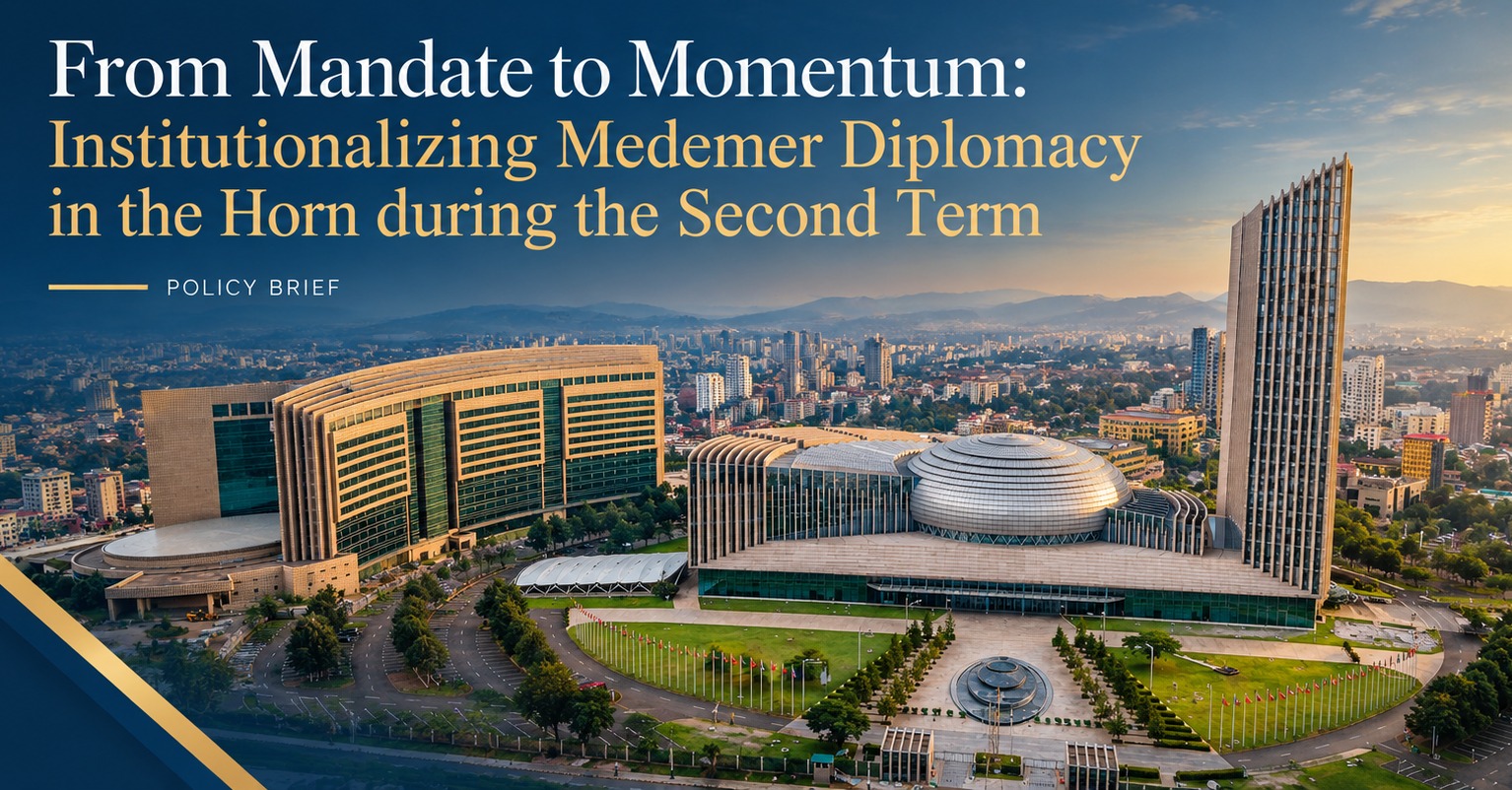
Credibility: Medemer-inspired initiatives that respond to exclusionary framings of Red Sea governance could draw legitimacy from Ethiopia’s already engaged status in regional and global diplomacy. As a host of the African Union (AU) headquarters and that of the United Nations Economic Commission for Africa (UNECA), a member of BRICS, a founding UN member, and as a major aviation connectivity hub for East and Central African aviation connectivity, Ethiopia stands out as a real diplomatic hub in the region. Rich experiences in these international platforms can offer useful lessons for creating durable institutions by moving from goodwill to structures that outlast human leaders. These vantage points can provide the opportunity to translate ideas into concrete agreements.
4. Conclusion
The 7th general election outcome and the formation of the second Medemer Government offer Ethiopia an important opportunity to consolidate its foreign policy vision around Horn-First doctrine. Although efforts to institutionalize the paradigm are underway, challenges remain, the second term offers a window of opportunity to address these limitations while enhancing opportunities. Against this concluding remark, this policy brief offers the following insights from which actionable policy recommendations are considered to translate mandate into real momentum.
5. Recommendations
1. Leading with functional cooperation: Ethiopia should prioritize corridors, power interconnection, trade facilitation, and shared-river management through a proposed multi-year Horn synergy agenda, with designated coordinating institutions and measurable milestones. This helps build trust and interdependence, allowing incremental steps towards political integration.
2. Converting narrative into mutual understanding. The Medemer government should take the initiative to build structured platforms for dialogue, scholarly and media exchange, and text translation into regional languages, including English, while drawing on existing translations where available, so that differing interpretations do not harden into mistrust.
3. Differentiating by partner: The Medemer government should make it a priority to convert goodwill with Kenya and Djibouti into multi-year agreements and joint commissions with clear mandates and periodic reviews. It should pursue a patient, non-zero-sum diplomatic engagement with Somalia and Somaliland, and keep de-escalation and third-party mediation channels open with Eritrea alongside prudent defense readiness.
4. Region-wide multilateral treaties and standing bodies: To reduce dependence on individual leaders and fragmented bilateral initiatives, Ethiopia should explore feasible regional agreements and standing coordination mechanisms through existing institutions, subject to partner consent and agreed mandates.
5. Making use of multilateral platforms to scale: The Medemer government should continue bringing Medemer-inspired proposals such as a shared Red Sea economy and cross-border corridors to the AU, IGAD, BRICS, and UN forums, where Ethiopia's standing gives it a convening power and where inclusive economic cooperation proposals can advance Ethiopia’s interests through dialogue and mutual benefit.
6. Establishing the Medemer Research and Development Centre. The Medemer government could consider establishing a Medemer Research and Development Centre. Its mandate should include evidence for policy, track-two dialogue with neighbors' think tanks, and indicators for tracking progress. A first-year work plan could identify responsible institutions, a funding approach, and measurable outputs.
By Abiot Desta
Researcher at America and Europe Affairs Research Directorate,IFA
Disclaimer
The content disseminated by the Institute of Foreign Affairs (IFA) – including, but not limited to, publications, public statements, events, media appearances, and digital communications – reflects the views of individual contributors and does not necessarily represent the official positions or policies of the Institute, its partners, or any affiliated governmental or non-governmental entities.
While the IFA endeavours to ensure the accuracy, integrity, and timeliness of the information presented, it makes no representations or warranties, express or implied, regarding the completeness, reliability, or suitability of such content for any purpose. The Institute expressly disclaims any liability for errors or omissions, as well as for any actions taken or decisions made based on the information provided.
The inclusion of external links, references, or third-party resources does not constitute an endorsement by the Institute. Additionally, engagement on social media platforms – including, but not limited to, likes, shares, retweets (RTs), or reposts – shall not be interpreted as an endorsement or validation of the views expressed therein.
Readers and audiences are encouraged to exercise critical judgement and seek independent verification when interpreting or relying upon any information disseminated through publications and posts on the Institute’s platforms or representatives.