
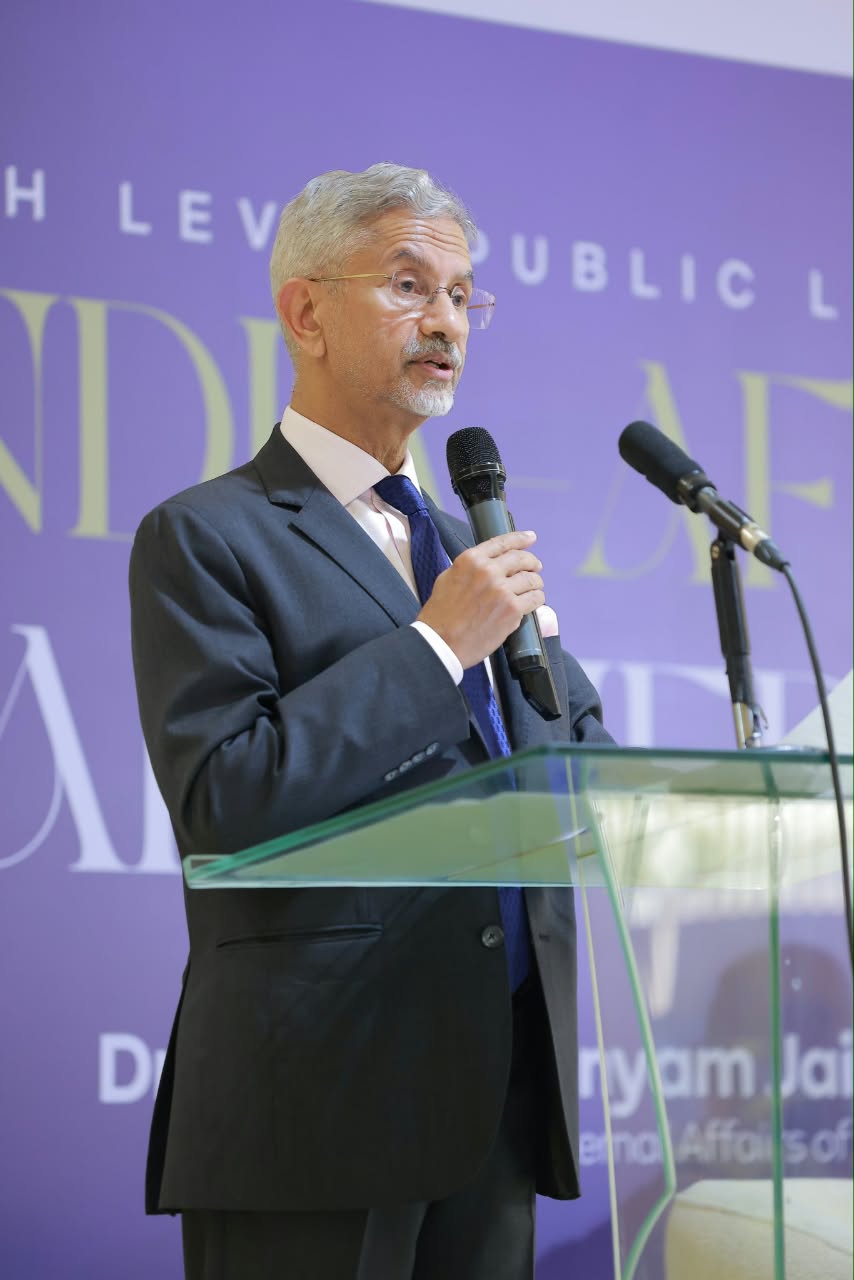
The usual reading of a ministerial lecture is that it marks a warm moment in a bilateral calendar. That reading undersells what was said in Addis Ababa on 9 October 2026. Speaking at the Adwa Victory Memorial Museum, at an event convened by Ethiopia’s Ministry of Foreign Affairs and the Institute of Foreign Affairs, India’s External Affairs Minister, Dr. S. Jaishankar, argued that partnerships should build capabilities rather than dependencies.1 That sentence sets a standard that can be measured, and Ethiopia is well placed to apply it.
Priorities Highlighted by India
This brief argues that the Ethiopia–India relationship has reached the point where its value will be decided by the terms on which cooperation is delivered, as well as by the shared aspirations expressed. We call this approach agency-first partnership: cooperation in which the priorities, sequencing and ownership of projects rest with the host country. The argument is not that the partnership is thin. It is that its strength now lies in follow-through, and that Ethiopia, as host, is the party best placed to advance it. The lecture supplied the vocabulary. The task now is to turn it into practice.
Priorities Highlighted by India
Three signals stood out. The first was historical. Dr. Jaishankar described the Victory of Adwa as a source of inspiration for anti-colonial movements and tied its message of sovereign choice to present demands for a more representative international order. Delivered in the museum that commemorates it, the point carried weight: a partner that honours Adwa is, by its own framing, committing to respect Ethiopian agency.
The second was institutional. Diplomatic relations date from 1948, and the relationship was elevated to a strategic partnership during Prime Minister Narendra Modi’s visit in December 2025. Strategic status raises expectations; it does not by itself deliver outcomes.
The third was practical. The Minister linked Africa’s Agenda 2063 to India’s Viksit Bharat 2047 vision and named the instruments: industrialization, infrastructure, human capital, technology and sustainable growth.2 Together these amount to an offer that Ethiopia can pursue in line with its nationally defined priorities.
From Commitments to Implementation
Strategic partnerships gain their greatest value when announcements are translated into sustained implementation. The lecture pointed to a long list of commitments: expanded scholarships, an upgrade of the Mahatma Gandhi Hospital, a prospective prosthetic-limb assistance initiative, pharmaceutical cooperation, digital and artificial intelligence collaboration, space and drone technologies, and links between young innovators. A proposed Ministry of Foreign Affairs data center and IFA’s links with Indian diplomatic training and research institutions were also highlighted.
Breadth is both a strength and a risk. A long list signals ambition, but without sequencing, ownership and review implementation can become fragmented. The figures cited in the address, more than 600 Indian companies with registered investments over two decades and an estimated 75,000 jobs,3 point to real commercial depth. They also show why selectivity matters: investment already in Ethiopia is a foundation, and the question is whether the next wave connects to Ethiopia’s own development priorities. The Minister himself stressed aligning projects with those priorities. This emphasis provides a useful basis for jointly advancing implementation. Delivery is where national ownership can be most clearly demonstrated.
Assessing the Implementation Challenge
A cautious assessment would note that ministerial lectures primarily articulate diplomatic priorities, that figures quoted in an address are statements rather than audited results, and that the language of capability-building is common to almost every partner courting Africa. Each point has force. Not every item discussed is a confirmed, completed outcome, and this brief treats them as stated intentions.
These considerations also present an opportunity for Ethiopia. Because the commitments were made in public, before diplomats, scholars, students and the media, they can now be referenced, tracked and invited back to the table. A private assurance is easy to forget; a public one is a standing reference point. The Minister’s account of a multipolar world strengthens the case. He argued that diversifying partnerships and de-risking excessive dependencies preserve policy choices and improve negotiating positions. That is an invitation to engage India fully while keeping other partnerships active, a logic that sits comfortably with Ethiopia’s own approach. The test is therefore how effectively agreed priorities are implemented in line with Ethiopia’s development objectives.
Ethiopia’s Stake
For Ethiopia the stakes are concrete. Education and training commitments bear directly on human capital. Health and pharmaceutical cooperation touch daily life. Digital and artificial intelligence cooperation connect to the modernization of public institutions, and the proposed data center would place Ethiopian diplomacy on a stronger technical footing.
At the multilateral level the alignment is equally useful. The Minister welcomed Ethiopia’s BRICS membership, expressed support for Ethiopia’s hosting of COP32 in 2027, referenced India’s support for the African Union’s permanent G20 membership, and advocated reform of the United Nations Security Council with stronger African participation. These positions match Ethiopia’s interest in a more representative global order and give it a reliable interlocutor where African voice remains thin.
The “4F” pressures of fuel, food, fertilizers and finance, which Dr. Jaishankar said fall heavily on developing economies, are not abstractions. They are the shocks that reform and partnership are meant to cushion. Seen this way, the relationship is not a favour extended in either direction. It is cooperation between two states that read the same pressures in similar ways.
Priorities for Ethiopia’s Engagement
First, Ethiopia should translate the lecture’s many commitments into a short, ranked list, led by education and training, health and pharmaceuticals, and digital and artificial intelligence cooperation, and present it through the joint mechanisms of the strategic partnership. Selectivity is how an agency-first partnership begins.
Second, each priority should carry a named owner and a review date, with a brief shared progress note issued after every review. Visible follow-through is the surest way to protect the credibility of both governments.
Third, IFA should build on its existing links with Indian diplomatic training and research institutions through joint research, officer exchanges and a regular policy dialogue, so that the partnership has an intellectual home beyond the ministries.
Fourth, Ethiopia should coordinate positions with India on BRICS, COP32 preparations and reform of global governance, while keeping its wider partnerships active, consistent with the diversification the Minister himself endorsed.
Dr. Jaishankar offered a standard and a framework. Ethiopia’s task is to accept the first and fill in the second. If cooperation is judged by whether it builds capabilities rather than dependencies, the right test of this partnership is simple: Ethiopian priorities, set by Ethiopia, delivered on time. Agency-first partnership is not a demand placed on India. It is the shared interest of two countries that have said, at Adwa, what they want partnership to mean.
Notes
1. S. Jaishankar, keynote address and moderated conversation, High-Level Public Lecture on India–Africa Partnership, Adwa Victory Memorial Museum, Addis Ababa, October 9, 2026.
2. African Union Commission, Agenda 2063: The Africa We Want (Addis Ababa: African Union Commission, 2015).
3. Institute of Foreign Affairs, Event Report: High-Level Public Lecture on India–Africa Partnership (Addis Ababa: Institute of Foreign Affairs, 2026).
By Hermela Getachew, IFA
Disclaimer
Disclaimer
The content disseminated by the Institute of Foreign Affairs (IFA) – including, but not limited to, publications, public statements, events, media appearances, and digital communications – reflects the views of individual contributors and does not necessarily represent the official positions or policies of the Institute, its partners, or any affiliated governmental or non-governmental entities.
While the IFA endeavours to ensure the accuracy, integrity, and timeliness of the information presented, it makes no representations or warranties, express or implied, regarding the completeness, reliability, or suitability of such content for any purpose. The Institute expressly disclaims any liability for errors or omissions, as well as for any actions taken or decisions made based on the information provided.
The inclusion of external links, references, or third-party resources does not constitute an endorsement by the Institute. Additionally, engagement on social media platforms – including, but not limited to, likes, shares, retweets (RTs), or reposts – shall not be interpreted as an endorsement or validation of the views expressed therein.
Readers and audiences are encouraged to exercise critical judgement and seek independent verification when interpreting or relying upon any information disseminated through publications and posts on the Institute’s platforms or representatives.