
Introduction
Policy Implications
For Ethiopia, a large landlocked economy with a rapidly growing population, reliable access to international maritime trade routes is a central requirement for economic development, industrial growth and regional integration. Dependence on external ports shapes the cost and predictability of imports and exports, the competitiveness of domestic industries and the country’s ability to connect with global markets. The strategic question is therefore not simply how Ethiopia can obtain access to the sea, but how it can build a reliable, diversified and mutually beneficial system of maritime connectivity that supports long-term economic resilience.
The scale of this challenge is evident in recent trade figures. During the 2025/26 Ethiopian fiscal year, the Port of Djibouti handled approximately 17.57 million tonnes of Ethiopia’s import and export cargo, accounting for 96.71 per cent of the country’s reported maritime-gateway traffic.[1] This concentration demonstrates the importance of the Djibouti corridor to Ethiopia’s external trade and the value of strengthening the resilience of the wider logistics system.
Ethiopia’s long-term objective can be understood through the concept of corridor resilience: the capacity to sustain the movement of goods through reliable infrastructure, effective institutions, commercially viable arrangements and constructive regional partnerships. This approach does not diminish the importance of existing port relationships. Rather, it seeks to complement them through a broader and more adaptable connectivity network.
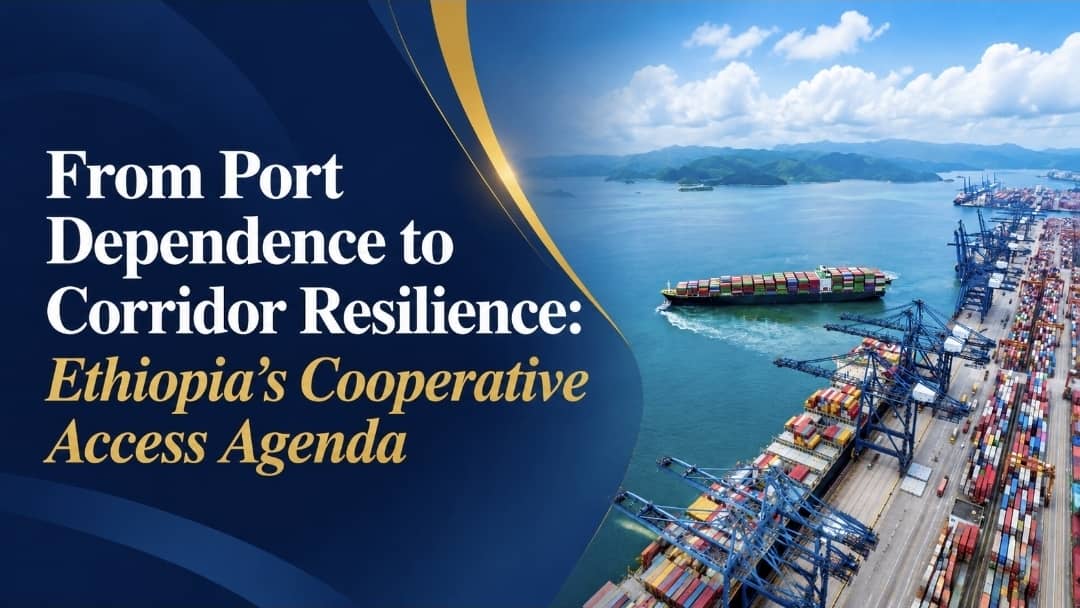
From Port Dependence to Corridor Resilience
The concentration of maritime trade through one principal corridor creates practical considerations for Ethiopia’s economic planning. Changes in shipping costs, transit conditions, infrastructure performance or regional security can affect the movement of essential imports and the competitiveness of exports. These considerations make a more resilient and adaptable logistics system a matter of economic security and competitiveness.
However, developing alternative routes should not be interpreted as an effort to replace established partners or redirect trade regardless of cost and capacity. Its value lies in expanding commercially viable options and improving the ability of the national logistics system to respond to changing circumstances. Djibouti will remain a central partner in Ethiopia’s maritime trade, while other corridors can provide additional options where infrastructure, commercial terms and operational arrangements are competitive.
The Berbera and Tadjourah routes, alongside the emerging Mombasa–Moyale corridor, illustrate the potential for a wider network. Their long-term contribution will depend on practical factors: transport costs, road and rail connectivity, customs procedures, border management, port capacity, transit agreements and service reliability. A wider network will produce meaningful economic benefits only when these elements are assessed together.
The policy priority is therefore not the number of available routes alone. It is the development of an integrated system in which different corridors can perform complementary functions and provide dependable services to businesses and consumers.
Infrastructure Diplomacy and Regional Integration
Connectivity infrastructure is most effective when supported by sustained diplomatic engagement and institutional cooperation. Roads, railways, ports and logistics facilities require more than physical investment. They also depend on predictable regulations, coordinated border procedures, transparent commercial arrangements and effective mechanisms for resolving operational challenges.
The Djibouti–Ethiopia–South Sudan–Uganda (DESSU) Corridor offers an example of this regional approach. The participating countries signed a Memorandum of Understanding in February 2025 to advance the corridor initiative. This was followed by a formal agreement establishing the DESSU Corridor Authority in 2026. The two steps should be understood separately: the MoU provided an initial framework for cooperation, while the subsequent agreement established the institutional basis for coordinating the corridor.[2]
For Ethiopia, the initiative has significance beyond the movement of goods along a single route. It can strengthen regional trade links, improve access to maritime services for participating landlocked countries and support the development of a more connected regional economy. Its effectiveness, however, will depend on implementation: coordinated infrastructure planning, simplified customs procedures, transparent governance and sustained cooperation among the participating governments.
Ethiopia’s infrastructure diplomacy should accordingly prioritise projects that deliver measurable economic value to all participating countries. Regional corridors are more likely to attract investment and sustain political commitment when their benefits are visible in reduced transit times, lower logistics costs, increased trade and improved access to markets.
Commercial Port Partnerships and Cooperative Access
Ethiopia’s pursuit of reliable maritime access also requires commercially sound relationships with port and transit partners. Port access arrangements can take different forms, including service agreements, logistics partnerships, investment cooperation, leases and other mutually agreed commercial modalities. The appropriate arrangement will depend on the interests of the parties, the commercial viability of the project and the applicable legal frameworks.
The Ankara Declaration of 11 December 2024 provides an important diplomatic reference in this regard. Ethiopia and Somalia reaffirmed their commitment to sovereignty, territorial integrity and international law, while acknowledging the potential benefits of Ethiopia’s reliable access to and from the sea. They also agreed to pursue mutually advantageous commercial arrangements through bilateral agreements, including contracts, leases and comparable arrangements, under Somalia’s sovereign authority.[3]
The Declaration is significant as a framework for dialogue and technical negotiations. It should not, however, be presented as a completed port-access agreement. Its practical value depends on continued engagement and the development of mutually acceptable arrangements. This distinction is important for maintaining accuracy and reinforcing the principle that sustainable connectivity is best advanced through consultation, agreement and respect for the legitimate interests of all parties.
A cooperative approach can also help ensure that port partnerships contribute to wider regional development. Commercial arrangements that improve infrastructure, create employment, facilitate trade and strengthen transport links can generate benefits beyond the immediate parties. For Ethiopia, the objective is to secure dependable and economically viable access while supporting constructive relations with neighbouring coastal states.
Maritime Governance and Security Cooperation
Corridor resilience also depends on effective maritime governance. Although Ethiopia is landlocked, its economy remains closely connected to international shipping, maritime administration and the security of trade routes. Developments in the Red Sea and the wider western Indian Ocean can influence shipping schedules, freight costs and the reliability of supply chains serving the country.
Strengthening maritime information-sharing and institutional coordination is therefore an important part of Ethiopia’s connectivity agenda. In August 2026, the International Maritime Organization reported that Ethiopian stakeholders had developed a roadmap towards establishing a National Maritime Information Sharing Centre. The initiative is intended to improve inter-agency coordination, information exchange and cooperation with regional maritime information-sharing mechanisms.[4]
The roadmap represents a step towards stronger institutional capacity; it should not be described as evidence that the Centre is already fully operational. Its implementation will require clear institutional responsibilities, appropriate legal and governance arrangements, trained personnel and sustained technical support.
Effective coordination among relevant institutions—including the Ministry of Transport and Logistics, the Ethiopian Maritime Authority, the Ethiopian Customs Commission, maritime security institutions and the Ministry of Foreign Affairs—can help connect maritime governance with national logistics and diplomatic priorities. The involvement of Ethiopian Shipping and Logistics can further contribute commercial and operational expertise. Cooperation with regional and international partners can support information-sharing, capacity-building and maritime safety.
Addressing the Risks of Alternative Corridors
A reasonable concern is that pursuing several corridors simultaneously could increase public expenditure, fragment infrastructure investment and create expectations that are difficult to sustain commercially. Where alternative routes lack sufficient capacity or competitive pricing, developing them could add costs rather than improve resilience. There is also a need to ensure that connectivity initiatives are understood as economic partnerships rather than as sources of regional competition.
These concerns deserve consideration. They do not, however, negate the case for a wider network. They underline the importance of a phased, evidence-based approach. Ethiopia can assess alternative routes according to transparent criteria, including total transport costs, transit time, infrastructure readiness, customs efficiency, reliability and long-term commercial sustainability. Investment decisions should be informed by demand, feasibility studies and consultation with partner countries and private-sector operators.
The objective is not to pursue every available corridor at once. It is to develop a portfolio of viable options that strengthens the national logistics system while preserving and deepening established partnerships.
Policy Implications
First, adopt an integrated national corridor strategy. The Ministry of Transport and Logistics should coordinate the assessment of maritime gateways, inland transport infrastructure, customs systems and logistics facilities as components of one national connectivity network. The strategy should align investment priorities, identify infrastructure gaps and avoid fragmented planning.
Second, strengthen existing partnerships while developing viable alternatives. The Ministry of Foreign Affairs should lead diplomatic engagement and regional partnerships, working with the Ministry of Transport and Logistics and relevant technical institutions. Cooperation with Djibouti should remain a central element of Ethiopia’s maritime connectivity, alongside the careful assessment of opportunities through Berbera, Tadjourah and the emerging Mombasa–Moyale corridor. Each route should be evaluated on commercial and operational merit.
Third, prioritise implementation of regional corridor agreements. The Ministry of Transport and Logistics should coordinate Ethiopia’s engagement in the DESSU framework with the relevant authorities of participating countries. Practical priorities include infrastructure coordination, customs facilitation, border procedures and performance monitoring. Progress should be measured against tangible outcomes, including reduced transit times and improved trade efficiency.
Fourth, advance commercial access through dialogue and mutually agreed arrangements. The Ministry of Foreign Affairs should lead diplomatic engagement with relevant partners, supported by the technical expertise of the Ministry of Transport and Logistics and other responsible institutions. The Ankara Declaration provides a basis for continued engagement between Ethiopia and Somalia. Technical discussions should be pursued constructively, with due regard for sovereignty, international law and the legitimate interests of both countries.
Fifth, strengthen maritime governance and information-sharing. The Ethiopian Maritime Authority should contribute to the implementation of the National Maritime Information Sharing Centre roadmap in coordination with the Ministry of Transport and Logistics and relevant maritime security institutions. Priorities should include institutional mandates, operational procedures, technical capacity and regional cooperation.
Sixth, establish a practical corridor performance and financing framework. The Ministry of Transport and Logistics should coordinate regular assessments of freight costs, transit times, cargo volumes, infrastructure capacity and service reliability across available routes. The Ministry of Finance should assess financing requirements, fiscal exposure and long-term liabilities. The Ethiopian Customs Commission should contribute to customs modernisation and trade facilitation, while Ethiopian Shipping and Logistics should provide commercial and operational input. These assessments would support evidence-based investment decisions and help identify where cooperation can deliver the greatest economic benefit.
Conclusion
Ethiopia’s maritime connectivity agenda is fundamentally an economic and regional development priority. Its success will depend not on the pursuit of access in isolation, but on the ability to build reliable transport networks, commercially sustainable partnerships and effective institutions. Existing relationships, particularly with Djibouti, remain essential, while carefully developed alternatives can strengthen the resilience of the wider logistics system.
The concept of corridor resilience offers a practical way to frame this agenda. By combining infrastructure investment, commercial cooperation, regional diplomacy and stronger maritime governance, Ethiopia can pursue dependable access to global markets while contributing to shared regional prosperity. The long-term objective is a connected and adaptable system in which Ethiopia and its neighbours benefit from more efficient trade, stronger economic links and durable cooperation.
Notes
1. “Djibouti Port Handles 96.7% of Ethiopian Trade Cargo,” APA News, August 27, 2026. The report, citing Ethiopia’s State Minister for Transport and Logistics, states that the Port of Djibouti handled approximately 17.57 million tonnes of Ethiopia’s import and export cargo during the 2025/26 Ethiopian fiscal year. It also reports that Djibouti accounted for 96.71 per cent of Ethiopia’s maritime-gateway traffic. Available at: https://apanews.net/djibouti-port-handles-96-7-of-ethiopian-trade-cargo/.
2. Ethiopian News Agency, “MoU Signed to Establish Authority of Djibouti-Ethiopia-South Sudan-Uganda (DESSU) Corridor,” February 28, 2025; Djibouti Ports and Free Zones Authority, “The Official Signing of the MoU for the Djibouti Corridor,” March 2, 2025; Djibouti Ports and Free Zones Authority, “Signing of the Agreement Establishing the Djibouti–Ethiopia–South Sudan–Uganda (DESSU) Corridor Authority,” March 1, 2026. The DPFZA’s published event record dates the formal establishment agreement to March 1, 2026. Available at: https://www.ena.et/web/eng/w/eng_6062253; https://dpfza.gov.dj/index.php/official-signing-mou-djibouti-corridor; https://dpfza.gov.dj/node/648.
3. Republic of Türkiye Ministry of Foreign Affairs, “Ankara Declaration by the Federal Democratic Republic of Ethiopia and the Federal Republic of Somalia, Facilitated by the Republic of Türkiye,” December 11, 2024. Available at: https://www.mfa.gov.tr/etiyopya-federal-demokratik-cumhuriyeti-ve-somali-federal-cumhuriyeti-nin-ankara-bildirisi.en.mfa.
4. International Maritime Organization, “Enhancing Maritime Security and Domain Awareness in Ethiopia,” August 12, 2026. Available at: https://www.imo.org/en/mediacentre/pages/whatsnew-2482.aspx.
By Bruktawit Abayneh, Communication Head, IFA
Disclaimer
Disclaimer
The content disseminated by the Institute of Foreign Affairs (IFA) – including, but not limited to, publications, public statements, events, media appearances, and digital communications – reflects the views of individual contributors and does not necessarily represent the official positions or policies of the Institute, its partners, or any affiliated governmental or non-governmental entities.
While the IFA endeavours to ensure the accuracy, integrity, and timeliness of the information presented, it makes no representations or warranties, express or implied, regarding the completeness, reliability, or suitability of such content for any purpose. The Institute expressly disclaims any liability for errors or omissions, as well as for any actions taken or decisions made based on the information provided.
The inclusion of external links, references, or third-party resources does not constitute an endorsement by the Institute. Additionally, engagement on social media platforms – including, but not limited to, likes, shares, retweets (RTs), or reposts – shall not be interpreted as an endorsement or validation of the views expressed therein.
Readers and audiences are encouraged to exercise critical judgement and seek independent verification when interpreting or relying upon any information disseminated through publications and posts on the Institute’s platforms or representatives.