
Why long-term political consensus, alongside democratic competition, matters for Africa's development
Political parties across Africa are commonly assessed by their ability to compete for political power, represent citizens and secure electoral mandates. Elections establish the political calendar, manifestos outline competing priorities, and governments are expected to demonstrate results during their terms in office. These are essential features of democratic governance. Yet an important question remains: how can countries sustain long-term development priorities when governments change?
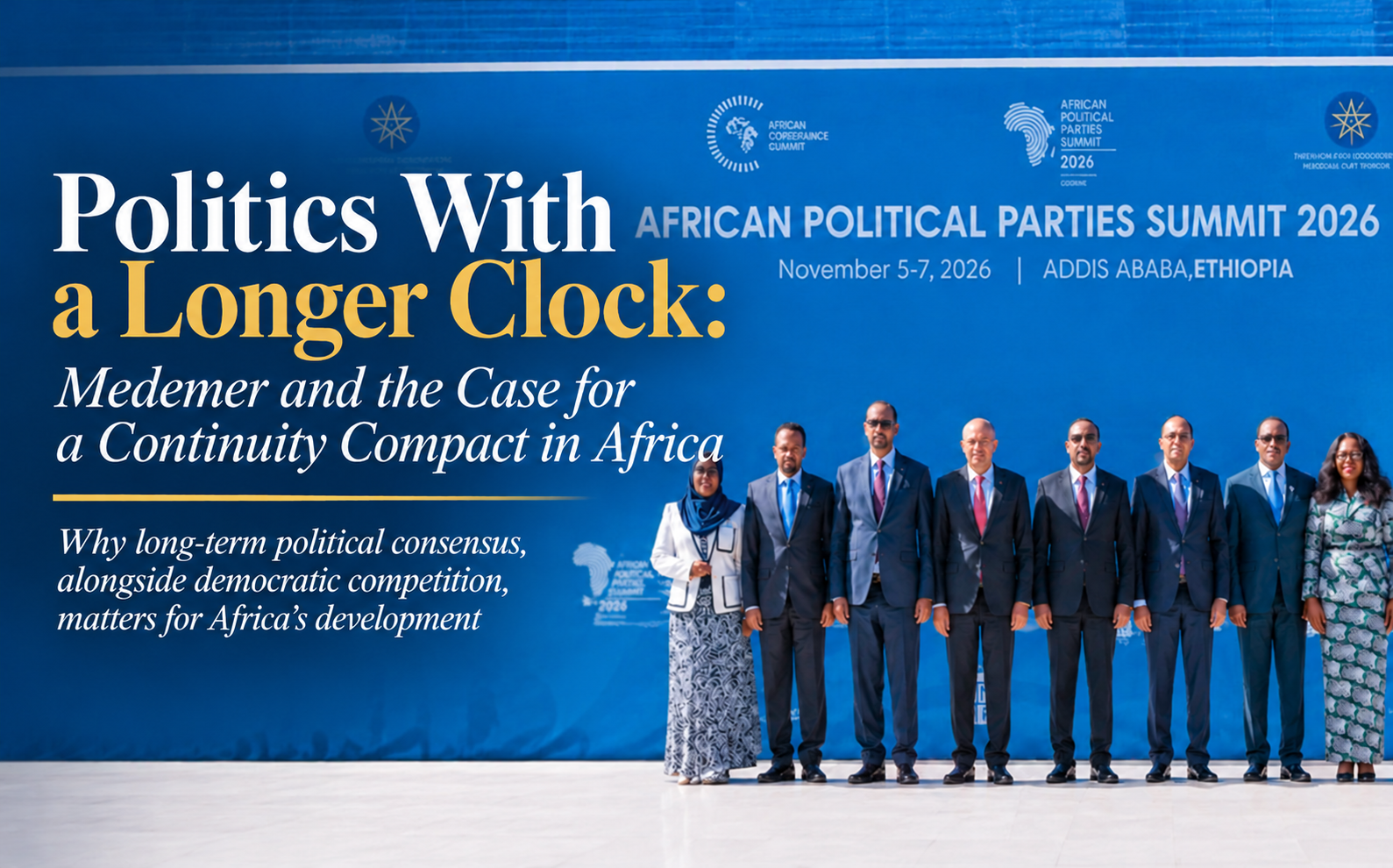
The Second African Political Parties Summit, held in Addis Ababa from 5 to 7 November 2026 under the theme “Governing for Growth: Political Parties as Architects of Africa’s Economic Future,” brought this question into continental discussion. The gathering provided a platform for political leaders and representatives to examine how political parties can contribute not only to electoral processes but also to economic transformation, institutional development and sustainable governance.
Prime Minister Abiy Ahmed's remarks at the summit offered an Ethiopian perspective on this challenge. He called on political parties to look beyond electoral competition, build consensus around long-term national development priorities and invest in leadership renewal. He also proposed two commitments for consideration in the Addis Ababa Declaration: establishing consensus on long-term national development priorities and strengthening leadership development and succession.
These proposals point to an important dimension of Africa's development challenge: the relationship between political time horizons and national development ambitions. While infrastructure, education, industrialization and economic transformation require sustained efforts over decades, political mandates operate within shorter periods. Bridging these different time horizons requires institutions and political arrangements capable of sustaining agreed national priorities while preserving democratic choice and accountability.
This article develops the concept of a continuity compact as an analytical framework for understanding how political parties might address this challenge. The term is the author's own formulation, inspired by the discussions at the Addis Ababa Summit. It refers to a voluntary understanding among political parties to sustain a limited set of nationally agreed development priorities across successive governments, without restricting electoral competition or legitimate policy differences.
The Continuity Compact: Sustaining Priorities Across Political Cycles
A continuity compact is different from a coalition government or a political unity arrangement. It does not require parties to abandon their ideological positions, merge their programmes or surrender their right to compete for political office. Rather, it encourages agreement on a limited number of long-term national priorities that require sustained institutional commitment.
Such priorities may include energy and transport infrastructure, education and skills development, agricultural transformation, industrialization, economic resilience and regional connectivity. Political parties would retain the freedom to propose different approaches, implementation strategies and resource allocations while recognizing the importance of maintaining progress on agreed national objectives.
The rationale is practical. Major development projects frequently extend beyond the tenure of a single administration. Changes in government do not necessarily require the abandonment of existing programmes, particularly where those programmes have demonstrated public value and contribute to established national objectives. Sustaining effective initiatives can reduce implementation delays, improve the use of public resources and strengthen confidence among citizens, investors and development partners.
Africa's Agenda 2063 provides an important continental reference point. Adopted in 2015, the African Union's fifty-year development framework sets out aspirations for an integrated, prosperous and peaceful continent. Its implementation necessarily depends on sustained commitment from successive governments, effective institutions and cooperation among political actors.
The continuity compact concept extends this principle into the political sphere. It highlights the potential responsibility of political parties to contribute to long-term development planning, institutional stability and policy consistency, rather than limiting their engagement to electoral competition.
Medemer and the Logic of Collective Progress
Ethiopia's Medemer philosophy provides an important perspective for considering this relationship. Presented by Prime Minister Abiy Ahmed as an Ethiopian homegrown philosophy, Medemer emphasizes unity, synergy, cooperation and the contribution of different actors towards shared progress.
From the Ethiopian Government's perspective, its relevance to development lies in the principle that collective efforts can produce greater outcomes when different capacities and contributions are brought together. Applied to political institutions, this perspective encourages political actors to recognize areas of common national interest while maintaining their distinct identities and responsibilities.
The continuity compact offers one possible analytical application of this principle. Political parties may disagree on economic priorities, governance approaches and implementation methods, yet still identify certain development objectives that merit sustained attention across electoral cycles. In this sense, political differences need not prevent cooperation on matters of long-term national importance.
The second dimension is accountability. Consensus alone cannot guarantee development outcomes. Commitments require measurable objectives, transparent implementation arrangements and regular public assessment. The Prime Minister's emphasis on accountability and inclusive governance reinforces the importance of ensuring that political cooperation remains connected to public expectations and institutional responsibilities.
Leadership renewal is equally important. Long-term development requires institutions capable of preparing successive generations of leaders. Political parties play a significant role in developing leadership capacity, nurturing policy expertise and preparing individuals for public responsibilities.
At the Addis Ababa Summit, the Prime Minister emphasized the importance of giving younger party members meaningful responsibilities and opportunities to develop their leadership capacities.
He also announced that Ethiopia would open training programmes at the African Leadership Excellence Academy to political parties across the continent. This announcement provides an opportunity for knowledge exchange and leadership development through an Ethiopian institutional contribution to continental engagement. Taken together, these dimensions suggest a relationship between political consensus, accountable implementation and leadership renewal. Continuity becomes meaningful when institutions can preserve effective development priorities, assess their results and prepare future leaders to sustain and improve them.
Democratic Competition and the Conditions for Consensus
Any discussion of political continuity must address an important concern: could consensus-building weaken political pluralism or reduce the space for legitimate political competition?This concern deserves serious consideration. In political systems where institutional participation is uneven, consensus initiatives may create questions about representation, ownership and the extent to which different political perspectives are accommodated. An agreement on national priorities should not become an expectation that opposition parties endorse government policies without independent assessment.
The distinction between political continuity and political uniformity is therefore essential. Continuity should concern the sustained pursuit of agreed development objectives, not the preservation of particular governments, political leaders or party arrangements. Electoral competition must remain meaningful, and citizens must retain the ability to choose between competing political programmes.
A credible continuity compact would consequently require several safeguards. First, participation should be voluntary and inclusive, providing governing and opposition parties with opportunities to contribute. Second, the agreed priorities should be limited, clearly defined and grounded in national development needs. Third, implementation should remain subject to parliamentary oversight, public scrutiny and independent assessment. Finally, political parties should retain the freedom to challenge policies, question expenditure and propose alternative approaches.
These safeguards are consistent with the broader democratic principles highlighted by African Union Commission Chairperson Mahmoud Ali Youssouf during the Addis Ababa Summit. His remarks underscored constitutionalism, accountability, political pluralism and peaceful political competition as essential elements of democratic governance. He also emphasized the importance of meaningful participation by women and young people in political leadership and decision-making.
The objective, therefore, is not to reduce political competition but to strengthen the institutional environment within which competing parties can contribute to national development. A well-designed compact could provide a common reference point for assessing government performance, while allowing opposition parties to scrutinize implementation and advance alternative policy proposals.
From Accra to Addis Ababa: Advancing Continental Dialogue
The Addis Ababa Summit builds on the first African Political Parties Summit, held in Accra, Ghana, from 12 to 14 August 2025. According to the Africa Governance Centre, the inaugural gathering brought together more than 700 delegates from 30 countries and 48 political parties. Its deliberations culminated in the adoption of the Accra Declaration, which committed participating political actors to cooperation and institutional reform in support of Africa's democratic development.
The second summit provided an opportunity to advance this discussion by connecting political leadership with economic transformation and long-term development. Its deliberations also considered the role of political parties in employment creation, inclusive growth, institutional accountability and regional integration.
The Addis Ababa Declaration was identified as an anticipated outcome of the gathering. Among the proposals put forward by Prime Minister Abiy Ahmed were consensus on long-term national development priorities and stronger leadership development and succession. These proposals offer a basis for further consideration by participating political parties and relevant institutions.
The significance of this process will ultimately depend on the clarity of the commitments, the extent of participation and the mechanisms established for implementation and follow-up. Continental declarations become more meaningful when political actors translate shared principles into measurable actions within their respective national contexts.
Why Addis Ababa Has a Strategic Interest
For Ethiopia, the discussion on political continuity has both domestic and continental relevance. Domestically, Ethiopia's development ambitions include major infrastructure investments, economic reforms, industrial development, agricultural transformation and regional connectivity. These priorities require sustained institutional attention, effective implementation and the ability to build on progress over time. Political dialogue around long-term national objectives can contribute to a more predictable environment for development planning while maintaining accountability for policy choices and implementation.
Regionally, the Horn of Africa's economic integration depends increasingly on cooperation in infrastructure, transport, energy and trade. Cross-border connectivity initiatives require coordination among governments and institutions over extended periods. Political parties that understand the long-term value of regional cooperation can contribute to building the institutional and political foundations necessary for these initiatives.Diplomatically, Addis Ababa's role as the headquarters of the African Union provides Ethiopia with an important platform for facilitating continental dialogue. Hosting the summit offered an opportunity to contribute Ethiopian perspectives on political leadership, development continuity and institutional cooperation to a broader African discussion.
Medemer is particularly relevant in this context as an Ethiopian contribution to the exchange of ideas on collective development. Its presentation should recognize the diversity of African political systems, historical experiences and institutional arrangements. The objective is not to prescribe a common political model, but to contribute perspectives that African countries can examine and adapt in accordance with their respective national circumstances.
Policy Implications: From Consensus to Implementation
Translating the summit's discussions into practical outcomes requires attention to institutional design and implementation.
First, establish a clear framework for voluntary political consensus. The Addis Ababa Declaration, where adopted, should encourage participating political parties to identify a limited number of long-term national development priorities that can receive broad political support across electoral cycles. These priorities should emerge through inclusive national consultation and reflect each country's development circumstances.
Second, institutionalize measurable accountability. Any continuity arrangement should include clear benchmarks, periodic progress assessments and public reporting. These mechanisms would enable citizens, legislatures and political parties to evaluate implementation while identifying areas requiring adjustment.
Third, protect democratic competition and political pluralism. The framework should explicitly recognize the right of governing and opposition parties to maintain distinct policy positions, compete in elections and scrutinize government performance. Agreement on long-term priorities must not limit constitutional political rights or weaken democratic accountability.
Fourth, strengthen leadership development and institutional capacity. The African Leadership Excellence Academy's announced engagement with political parties across the continent could provide opportunities for shared learning in governance, economic management, public leadership and institutional development. Its programmes would benefit from participation by political parties and relevant African institutions in identifying training priorities and ensuring that the content reflects diverse national experiences.
Fifth, strengthen regional cooperation through sustained political engagement. Political parties can contribute to the continuity of cross-border development initiatives by supporting dialogue on infrastructure, energy, trade and regional connectivity. Such engagement can complement the work of national governments and regional institutions in advancing shared development interests.
Conclusion: Governing Beyond the Electoral Calendar
Africa's development ambitions require more than the formulation of long-term plans. They require institutions capable of sustaining effective policies, preparing future leaders and maintaining accountability across successive political administrations. Political competition remains indispensable to democratic governance, but it can coexist with cooperation on nationally agreed development priorities.
The Second African Political Parties Summit in Addis Ababa brought these questions into continental discussion and provided an opportunity to consider the responsibilities of political parties beyond electoral processes. Ethiopia's Medemer philosophy, as presented by the Ethiopian Government, offers one perspective on the value of unity, synergy and shared progress in addressing common development challenges.
The continuity compact, as developed in this article, provides a practical analytical framework for advancing that discussion. It does not call for political uniformity or the limitation of electoral choice. Rather, it proposes that democratic competition and long-term development commitment can reinforce one another when supported by inclusive participation, institutional accountability and respect for political pluralism. Ultimately, Africa needs a political clock that recognizes both the importance of electoral mandates and the longer time horizons of development. The continuity compact captures this balance: sustaining shared national priorities while preserving the democratic competition through which citizens shape their political and economic future.
References
African Governance Centre. “Summary Report of the African Political Parties Summit (APPS) 2025.” September 9, 2025.
African Union. Agenda 2063: The Africa We Want. Addis Ababa: African Union Commission, 2015.
African Union Commission. “AUC Chairperson at the Second African Political Parties Summit.” November 6, 2026.
Ethiopian News Agency. “African Political Parties Summit Opens in Addis Ababa.” November 5, 2026.
Ethiopian News Agency. “PM Abiy Urges African Political Parties to Prioritize Leadership Renewal, Long-Term Dev’t.” November 2026.
Government Communication Service of Ethiopia. “Message of Prime Minister Dr. Abiy Ahmed.” November 6, 2026.
By Desu Bekele
Public Relations and Communication Department, IFA
Disclaimer
The content disseminated by the Institute of Foreign Affairs (IFA) – including, but not limited to, publications, public statements, events, media appearances, and digital communications – reflects the views of individual contributors and does not necessarily represent the official positions or policies of the Institute, its partners, or any affiliated governmental or non-governmental entities.
While the IFA endeavours to ensure the accuracy, integrity, and timeliness of the information presented, it makes no representations or warranties, express or implied, regarding the completeness, reliability, or suitability of such content for any purpose. The Institute expressly disclaims any liability for errors or omissions, as well as for any actions taken or decisions made based on the information provided.
The inclusion of external links, references, or third-party resources does not constitute an endorsement by the Institute. Additionally, engagement on social media platforms – including, but not limited to, likes, shares, retweets (RTs), or reposts – shall not be interpreted as an endorsement or validation of the views expressed therein.
Readers and audiences are encouraged to exercise critical judgement and seek independent verification when interpreting or relying upon any information disseminated through publications and posts on the Institute’s platforms or representatives.