
Summary
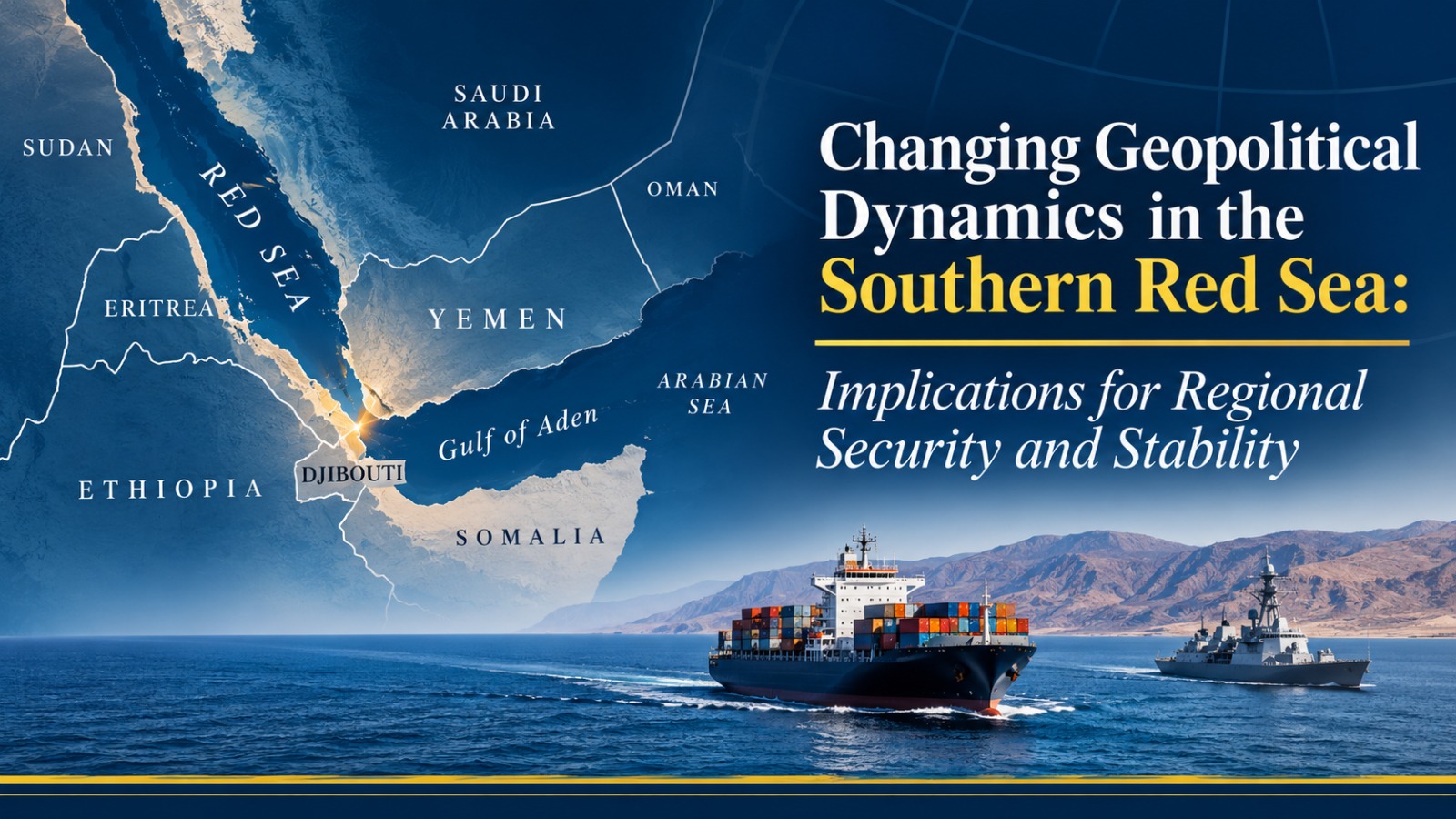
The Bab el-Mandab Strait emerged as a maritime corridor of growing strategic importance. While geopolitical rivalry once centered on the Red Sea’s northern gate, international focus has recently pivoted southward. This shift stems from the prolonged governance challenges in Yemen, the ascent of non-state maritime threats, heightened engagement by global and regional powers, and political instability across the Horn of Africa. Expansion of foreign military facilities, long reigning internal crisis, and interstate disputes are key geopolitical trends characterizing the region. These factors, along with external engagement and its implications for domestic decision-making, create significant challenges for the region's geopolitical and security landscape. As a result, the Bab el-Mandab strait has become one of the most complex security environments on Earth, where global superpowers and middle powers indirectly shape the fate of the region – constraining local policy autonomy and complicating nascent efforts for regional integration.
Background
Since the opening of the Suez Canal, much of the geopolitical contestation in the Red Sea region has historically concentrated on the northern half. Recent geopolitical shifts, however, drawn attention to its southern half – the Bab el Mandab Strait. Several factors have contributed to this increased focus, including the slight reduction of U.S. presence in the region, the Arab Spring, long reigning civil war in Yemen, and the rise of non-state actors targeting international shipping. Gulf States renewed interest through economic diversification initiatives is also equally important for the increasing international attention in the Red Sea’s Southern gate. As a result, Bab el-Mandab become a key site of international security concern and a space of growing militarization. The following are key trends emerging in the region with manifold consequences for its stability.
1) Proliferation Foreign Military Bases
The rise of maritime threats from non-state actors, such as the Houthis, has prompted an increase in militarization along the Red Sea’s Southern gate by both global and regional powers. France has maintained a military presence in Djibouti since 1977. The US established a base in 2002, following the 9/11 terror attacks, while Japan set up its facility in 2011, Italy in 2013, and China in 2017. Additionally, Germany and Spain have maintained a military presence in the region via France's base, and the United Kingdom operates from US’s Camp Lemonier.
Regional middle powers also expanded their military footholds. Apart from discontinued arrangements in Assab and Socotra, the UAE still maintains bases in Bossaso and Berbera, Kingdom of Saudi Arabia in Djibouti and Yemen, and Turkey in the outskirts of Mogadishu. Israel has reportedly increased its strategic engagement in Berbera in recent years – a response to its unilateral recognition of Somaliland. One key lesson geopolitical analysists learnt more recently from the ongoing de facto closure of the Strait of Hurmuz is the significant danger posed by competing foreign military deployments at critical maritime checkpoints.
2) Escalating Regional Instability
The Bab el-Mandab strait is currently experiencing significant political instability, with many countries grappling with internal conflicts and ongoing wars. Sudan is embroiled in a civil war, whereby competing groups are unable to reach an agreement; meanwhile foreign powers are exploiting the civil war and engaging in proxy wars so that efforts for a peaceful resolution have failed frequently. Somalia has continued lingering in ongoing clashes between government forces and Al-Shabaab, with international peace support efforts facing persistent challenges over two decades.
Additionally, there is also pressure among factions of the federal forces for greater administrative autonomy, while the issue of Somaliland's independence still remain contentious. Very recently, there is also a resurgence of traditional piracy along the Gulf of Aden and Indian Ocean coasts – a concerning recurrence to the already complicated security situation as it is detour to international commercial vessels in the event blockade occurs either in Bab el Mandab or the Suez Canal.
Ethiopia has been also experiencing low level insurgency and internal instability. While Djibouti is entertaining intensified rivalry among foreign powers for military bases. Eritrea, one of the least studied state in the region that locked its international relation for years continuously hit by migration due to a repressive political system. Yemen has been in constant turmoil since 2011 and currently characterized by state decay - a typical manifestation where extra-regional military presence and meddling resulted for state failure.
3) Persistence of Interstate Disputes
The region has also many flashpoints, ranging from border disputes to competition over resources to commonality issues. These factors intensify interstate tensions, hampering the region’s ability to develop a coordinated approach to external engagement. Border disputes between Ethiopia and Somalia, Ethiopia and Eritrea, Ethiopia and Sudan, Eritrea and Sudan, Eritrea and Djibouti, and Sudan and South Sudan are frequent sources of tensions. Resources such as the Nile waters and sea access claims are also among matters complicating the region’s geopolitical situation with substantial, little or total absence of external influence.
Compounding this issue is the lack of a powerful host nation with sovereign control over the Bab el Mandab Strait. This is largely attributed to Ethiopia's current landlocked status – by all criteria including but not limited to its size, sharing border with all members of the region, history of influencing regional affairs, seat for the AU, demographic giant, economically and militarily powerful nation in the region with a track record of an anchor state. Although Ethiopia possesses the technical and material capacities to address external involvement in the region's geopolitical landscape, its current landlocked position exposes the southern gate of the Red Sea to an greater dependence on external actors in regional affairs – further complicating the geopolitical situation.
Strategic Implications
Maritime Security Risks: Introducing extra-regional military powers in a region that is already destabilized by regional volatility only risks rapid escalation – results for strategic miscalculations and proxy engagements. Recent international shipping disruptions from a de facto closure of Hormuz clearly illustrates how local crisis have the potential to trigger international economic fallouts. Any rippling effect on Bab el-Mandab strait carries an international weight since it serves more than a mere flashpoint. Landlocked Ethiopia and South Sudan, especially, more likely to face sever consequences in the event of sudden shipping disruptions in the Bab el-Mandab.
Erosion of Regional Autonomy: Since the region is home to financially fragile states, excessive external influence amounts to reducing domestic decision-making autonomy. Of course, partnering with financially stronger foreign entities paves windows for security and economic leverages. However, excessive overreliance on foreign support opens the door for extra-regional powers to steer local and regional policies. This erosion of agency downgrades local security and development trajectories.
Obstacles to Regional Integration: Authentic security and economic cooperation in the region has been hampered by persistent interstate conflicts, longstanding differences and external involvement. Such deficits further forces states in the region to confront challenges in isolation – stripping them of collective action leverages. More importantly, such dynamics threaten state’s commitment to African Solutions for African Problem (AfSoL) - a cornerstone to realizing AU’s Agenda 2063.
Strategic Vacuum at the Bab el Mandab: Due to a lack of robust regional security framework, the Bab el-Mandab strait is highly vulnerable to external influence. This is further compounded by political and institutional challenges among littoral states – Yemen’s prolonged internal crisis, Djibouti’s expanding engagement with global and regional partners, Somalia’s longstanding governance challenges and contested territorial questions and demand for greater local autonomy, and Ethiopia’s landlocked status and recent agenda for sea access. In the absence of dependable framework to deter mounting maritime issues, the region becomes highly vulnerable to divergent interests of extra-regional powers – limits the capacity of local actors from formulating regulatory norms and oversight institutions on shared regional priorities.
Policy Recommendations
• Strengthen Regional Maritime Cooperation: The region demands robust regional cooperation in response to maritime threats. Accordingly, states must share information inferred through intelligence, conduct joint patrols, uninterrupted maritime surveillance and rapid response to evolving threats. Strengthening IGAD’s Red Sea and Gulf of Aden task force, for instance could be a crucial step toward institutionalizing these efforts.
• Promote Conflict Resolution and Preventive Diplomacy: resolving intrastate crisis should prioritize the use of shuttle diplomacy. Accordingly, leaders in the region along with continental institutions shall take the crisis in Sudan, Somalia and Yemen very seriously. Addressing these crisis through political agreements is the only way-out.
• Address Interstate Disputes through Dialogue: tensions and disputes between states on borders, resources, or who gets maritime access, regional leaders should prioritize the culture of dialogue. Tackling these tough conversations head-on is key for lasting stability and makes it a lot harder for external pressures to aggravate existing differences.
• Develop a Regional Security Framework: as a response to glaring maritime challenges, the region requires a comprehensive security architecture. Such a system not only regulate uncoordinated external security involvement in local affairs, mitigate power rivalries, and enforce transparency among all stakeholders but also serves as a regional forum for open dialogue to address misunderstandings.
• Enhance Regional Economic Integration: economic interdependence deters interstate tensions – they end up being rivals. Building trade routes, ports, and energy networks is not just about transactions, it gives all a stake in working together rather than pursuing competing approaches.
Conclusion
The southern Red Sea has emerged as a volatile nexus of military proliferation, internal unrest, and competing interests involving regional and global powers. Strategic rivalries, fragile governance, lingering conflicts, and threats to maritime shipping converge to create one of the most complex security challenges globally. Without enhanced cooperation among Red Sea states and improved conflict management, the region will continue to attract external influence, perpetuating instability that endangers regional stability and global trade routes. Policy-makers need to focus on collective efforts in preventing renewed conflict and building connectivity that strengthen regional ownership while maintaining constructive international partnerships. Formulating strong regional security framework is key to bring lasting peace, stability, and safe passage through this crucial chokepoint.
By Amare K. Aweke (PhD) Lead Researcher, Institute of Foreign Affairs
Disclaimer
The content disseminated by the Institute of Foreign Affairs (IFA) – including, but not limited to, publications, public statements, events, media appearances, and digital communications – reflects the views of individual contributors and does not necessarily represent the official positions or policies of the Institute, its partners, or any affiliated governmental or non-governmental entities.
While the IFA endeavours to ensure the accuracy, integrity, and timeliness of the information presented, it makes no representations or warranties, express or implied, regarding the completeness, reliability, or suitability of such content for any purpose. The Institute expressly disclaims any liability for errors or omissions, as well as for any actions taken or decisions made based on the information provided.
The inclusion of external links, references, or third-party resources does not constitute an endorsement by the Institute. Additionally, engagement on social media platforms – including, but not limited to, likes, shares, retweets (RTs), or reposts – shall not be interpreted as an endorsement or validation of the views expressed therein.
Readers and audiences are encouraged to exercise critical judgement and seek independent verification when interpreting or relying upon any information disseminated through publications and posts on the Institute’s platforms or representatives.