
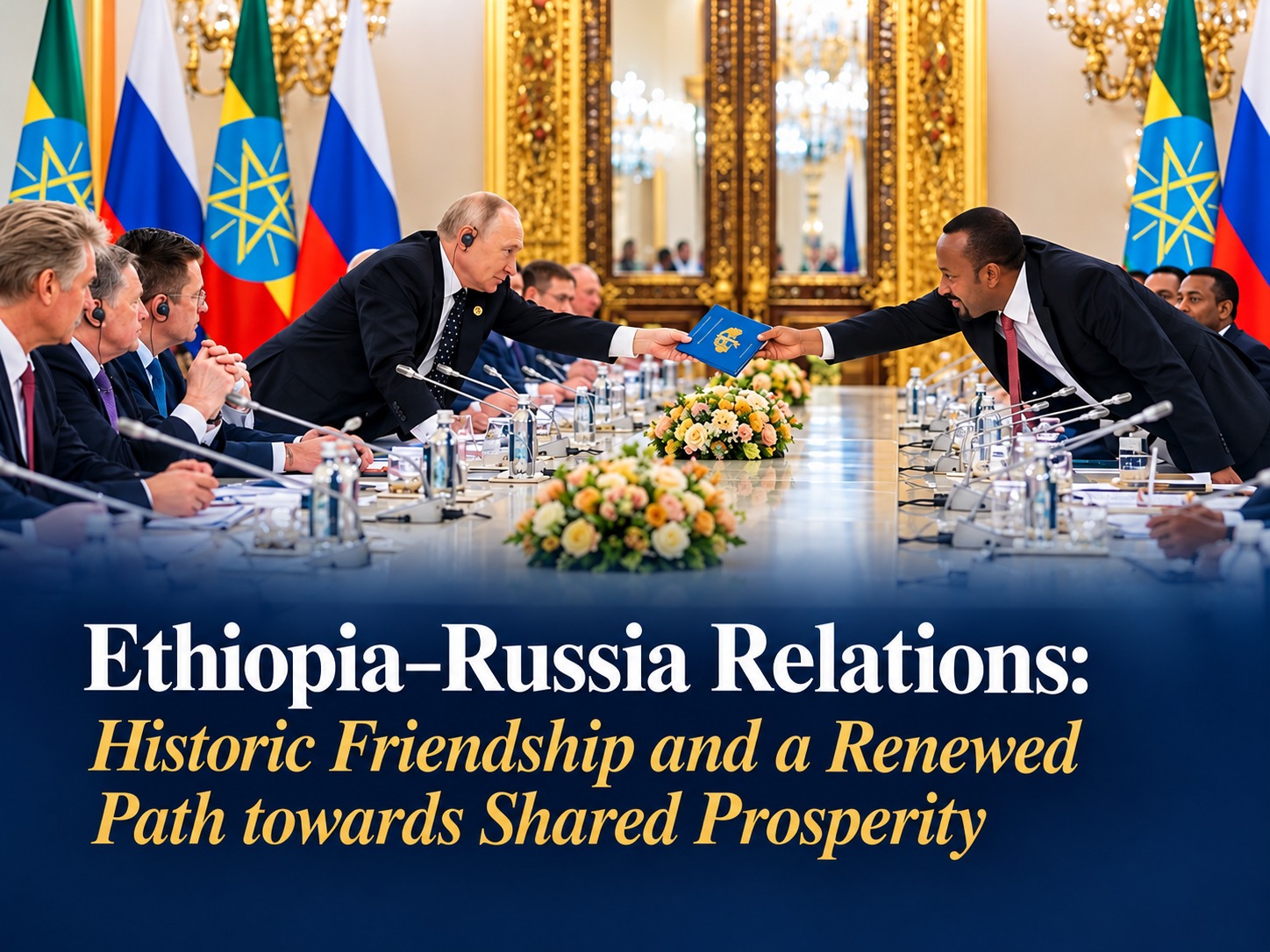
When Prime Minister Abiy Ahmed met President Vladimir Putin in Moscow on the margins of the Third Russia–Africa Summit (28–29 October 2026), the conventional reading was ready-made: another leaders’ meeting, another round of warm words about an old friendship. That reading misses what is distinctive. The Prime Minister’s own account of the talks pointed to concrete areas of cooperation: nuclear energy, health and trade. President Putin, for his part, noted that bilateral trade exceeded USD 1.3 billion in January–September 2026, more than double the figure for the whole of 2025. The friendship is increasingly being asked to produce results, and that is the right test.
This brief examines a relationship in which historical goodwill functions as capital, and each practical project, whether a feasibility study, a shipment or a training programme, yields returns that make the next engagement easier. The concept explains why the Ethiopia–Russia partnership has endured, and it points to what Ethiopia should do to keep it serving national development priorities.
A Friendship With Deep Roots
Russia dates the establishment of diplomatic relations with Ethiopia to 1898, which makes this one of Ethiopia’s oldest partnerships with a major power beyond Africa3 Ethiopian official accounts recall Russia’s solidarity with Ethiopia during the Italian invasion of 1936.⁴ Over the decades, cooperation has extended into education, health and technical training, and generations of Ethiopian professionals have studied in Soviet and Russian institutions.
History matters here less as sentiment than as accumulated trust. Partners that already understand one another’s systems and habits can move faster from declaration to delivery. Contact at the top has also become routine: the two leaders met in Kazan on the margins of the BRICS summit in October 2024, again in Moscow in September 2025, and in New Delhi in September 2026. Ethiopia’s BRICS membership, which began in 2024, has added a standing multilateral setting to this bilateral channel. Regular contact lowers the cost of every subsequent project, which is the first condition of compounding.
The relationship has also proved resilient across Ethiopia’s changing political eras and the wider shifts of the international system. That continuity is itself a diplomatic asset. Ethiopia can approach Moscow without rebuilding trust from scratch, and Russia can treat Addis Ababa, the seat of the African Union and a principal voice in continental diplomacy, as a natural interlocutor on African questions.
Where the Returns Are Appearing
Trade is the clearest indicator. Agriculture accounted for roughly 89 percent of bilateral exchanges in 2024,7 with Ethiopian coffee and Russian fertiliser and grain prominent in recent years.8 The pattern is mutually useful: Russian inputs support Ethiopia’s agricultural modernisation, while Ethiopian exporters gain a growing market. President Putin has also indicated that Moscow will give particular attention to food and energy security and to healthcare in its engagement with African partners.
Two features of these figures deserve attention. The first is pace: trade has grown faster than the institutions that support it, which is why the framework for payments, logistics and market access now matters as much as volume. The second is composition: with agricultural goods dominant, the next stage of growth lies in processed and higher-value products on both sides.
Nuclear energy is the most ambitious track. Putin said as early as July 2023 that agreements on the peaceful use of atomic energy were being prepared.9 For Ethiopia, nuclear power is a long-term option to complement hydropower, solar and wind as electricity demand grows. It must be sequenced carefully through feasibility work, financing, regulatory capacity and training, and conducted under international safeguards.
Health cooperation is more immediate. In 2024 Putin spoke of strengthening interaction in healthcare and research, including a mobile laboratory offered by Russia’s consumer health regulator.
Defence and security also feature in the wider bilateral relationship. Strengthening national capabilities is part of Ethiopia’s responsibility to safeguard its sovereignty and territorial integrity, and cooperation in training and capacity-building is pursued alongside a firm commitment to peaceful diplomacy and regional stability.
Medemer and Ethiopia’s Approach to Partnership
The presentation of Medemer carried significance beyond diplomatic protocol. As Prime Minister Abiy explained at the Kremlin, Medemer represents a philosophy of synergy that informs Ethiopia’s approaches to governance, economic development and international partnerships.
Its central principle is that diverse strengths, when brought together through cooperation, can generate greater collective benefits. The Prime Minister described the presentation of the book as reflecting a shared commitment to dialogue and mutual understanding.
This approach offers a useful perspective on Ethiopia’s international engagement. Partnerships are most productive when they recognise the interests, capabilities and development priorities of all participating countries. In this respect, the Medemer philosophy reinforces the importance of cooperation based on mutual respect, shared responsibility and practical outcomes.
For Ethiopia, international partnerships are not simply diplomatic relationships; they are instruments for advancing development priorities, strengthening institutional capabilities and creating opportunities for mutually beneficial economic engagement
.
.
A Partnership That Adds, Not Replaces
A sceptical reading deserves a direct answer. It holds that closer ties with Moscow could narrow Ethiopia’s room for manoeuvre with other partners; that trade figures, growing from a low base and concentrated in a few commodities, may prove volatile; and that nuclear ambitions carry heavy financial and technical demands.
Each point is fair, and none is a reason for hesitation. Ethiopia’s foreign policy has never been exclusive. It hosts the African Union, works with partners in Africa, Europe, Asia, the Gulf and the Americas, and its BRICS membership reflects breadth rather than a bloc choice. A relationship with Russia adds to this portfolio and does not replace anything in it. Volatility from a low base is an argument for building durable structures, not for staying away. And the demands of nuclear cooperation are precisely why sequencing and transparency matter. The sceptical reading is best treated as a design checklist: diversify, institutionalise, and commit step by step.
The strategic gains are practical. Energy diversification supports industrialisation. Fertiliser and agricultural technology support food security. Training and university links build the skills that Ethiopia’s development plans require. Health cooperation reaches households directly.
There is also a diplomatic dimension. On Ethiopia’s aspiration for reliable maritime access, Russia’s ambassador in Addis Ababa has said the matter should be settled between neighbours in a spirit of good neighbourliness and dialogue, without external interference.12 Ethiopia’s own position is consistent: access to the sea is a developmental and economic need, pursued peacefully and framed around mutual benefit and regional integration. Its preference is dialogue with all its neighbours, in the interest of shared prosperity. At the multilateral level, both countries share an interest in a more representative international order in which African voices carry their due weight.
President Putin described his contacts with the Prime Minister as friendly, substantive and constructive,2 and the Summit gave African partners a shared platform. For Ethiopia, the value lies in using such platforms to advance its own agenda: industrialisation, food security, energy access and a fair place for Africa in global governance.
Keeping the Friendship Productive
Four steps would help the partnership keep compounding. First, sequence the nuclear and energy track: agree timelines for feasibility work, financing options, regulatory development and engineer training, with transparent engagement with the International Atomic Energy Agency so that the project is understood as peaceful, safe and commercially sound. Second, widen the trade basket: move beyond coffee into value-added agro-processing and health-sector manufacturing, and agree predictable, transparent arrangements for settlement and logistics, consistent with Ethiopia’s international obligations, that serve exporters on both sides. Third, institutionalise delivery: use the joint commission, business forums and sector working groups to track commitments, so that each leaders’ meeting is followed by dated, reported milestones. Fourth, invest in people: expand scholarships, university partnerships and language and cultural exchange, with Medemer in Russian as one bridge among many.
Conclusion
The 28 October 2026 meeting between Prime Minister Abiy Ahmed and President Vladimir Putin renewed a historic diplomatic relationship and identified opportunities for cooperation in areas central to Ethiopia's development, including energy, healthcare, trade, education and technology.
The lasting significance of the engagement will depend on its implementation. Advancing feasibility studies, strengthening institutional capacities, expanding trade and investing in human capital will be essential to translating diplomatic discussions into tangible outcomes.
For Ethiopia, cooperation with Russia represents one component of a broader approach to international partnership founded on sovereign equality, mutual respect and shared development interests. Its value will ultimately be measured not simply by the history of diplomatic friendship, but by the practical benefits it delivers to both peoples and its contribution to regional stability.
Historic friendship, renewed engagement and a shared commitment to development can provide a foundation for lasting cooperation and shared prosperity.
Notes
1. Abiy Ahmed, “PM Abiy Ahmed’s Message on His Bilateral Meeting with President Putin,” Government Communication Service of Ethiopia, October 29, 2026, https://www.gcs.gov.et/en/2026/10/29/pm-abiy-ahmeds-message-on-his-bilateral-meeting-with-president-putin/; “Ethiopia: Abiy, Putin Discuss Nuclear Energy, Trade Cooperation at Moscow Summit,” allAfrica, October 29, 2026, https://allafrica.com/stories/202610290539.html.
2. “Ethiopia: Putin Hails Ethiopia-Russia Trade Surge to $1.3 Billion,” allAfrica, October 30, 2026, https://allafrica.com/stories/202610300108.html.
3. Ministry of Foreign Affairs of the Russian Federation, “Today Marks 128 Years since the Establishment of Diplomatic Relations between Our Country and Ethiopia,” February 25, 2026.
4. Embassy of Ethiopia in London, “Core Principles of Ethiopia’s Foreign Policy: Ethiopia-Russia Relations,” accessed October 30, 2026, https://mail.ethioembassy.org.uk/low_contrast/news_archive/EFP_ethio-russia_relations.htm.
5. “Putin Meets with Ethiopia PM Abiy Ahmed in Kazan,” The Star (Kenya), October 26, 2024, https://www.the-star.co.ke/news/world/2024-10-26-putin-meets-with-ethiopia-pm-abiy-ahmed-in-kazan.
6. “Ethiopian Premier Notes Growing Trade, Developing Ties with Russia,” TASS, September 12, 2026, https://tass.com/world/2186783.
7. “Russia-Ethiopia Trade Soars by 40% in 2024, Agriculture Leads the Way,” Ethiopian Business Review, accessed October 30, 2026, https://ethiopianbusinessreview.net/russia-ethiopia-trade-soars-by-40-in-2024-agriculture-leads-the-way/.
8. “Russia–Ethiopia Trade Triples in 2025 as Partnership Deepens,” TV BRICS, November 6, 2025, https://tvbrics.com/en/news/russia-ethiopia-trade-triples-in-2025-as-partnership-deepens/.
9. “Putin Says Number of Agreements with Ethiopia, Including on Peaceful Atom, Being Readied,” TASS, July 26, 2023, https://tass.com/politics/1652305.
10. “PM Abiy’s Medemer Book Launched in Russian, Expanding Ethiopia’s Intellectual Reach,” Ethiopian News Agency, October 28, 2026, https://www.ena.et/web/eng.
11. “Ethiopia, Russia Vow to Deepen Longstanding Ties Across Key Sectors,” Ethiopian News Agency, accessed October 30, 2026, https://www.ena.et/web/eng/w/eng_9831693.
12. “Ethiopia’s Pursuit for Sea Access Must Be Settled in Spirit of Neighborliness: Russian Amb.,” Ethiopian News Agency, November 13, 2024, https://www.ena.et/web/eng/w/eng_5452083.
13. “Geography and Diplomacy: Ethiopia’s Multilateral Pursuit of the Sea,” Horn Review, August 22, 2025, https://hornreview.org/2025/08/22/geography-and-diplomacy-ethiopias-multilateral-pursuit-of-the-sea/.
By IFA Staff Writer
Disclaimer
Disclaimer
The content disseminated by the Institute of Foreign Affairs (IFA) – including, but not limited to, publications, public statements, events, media appearances, and digital communications – reflects the views of individual contributors and does not necessarily represent the official positions or policies of the Institute, its partners, or any affiliated governmental or non-governmental entities.
While the IFA endeavours to ensure the accuracy, integrity, and timeliness of the information presented, it makes no representations or warranties, express or implied, regarding the completeness, reliability, or suitability of such content for any purpose. The Institute expressly disclaims any liability for errors or omissions, as well as for any actions taken or decisions made based on the information provided.
The inclusion of external links, references, or third-party resources does not constitute an endorsement by the Institute. Additionally, engagement on social media platforms – including, but not limited to, likes, shares, retweets (RTs), or reposts – shall not be interpreted as an endorsement or validation of the views expressed therein.
Readers and audiences are encouraged to exercise critical judgement and seek independent verification when interpreting or relying upon any information disseminated through publications and posts on the Institute’s platforms or representatives.
#