
Introduction
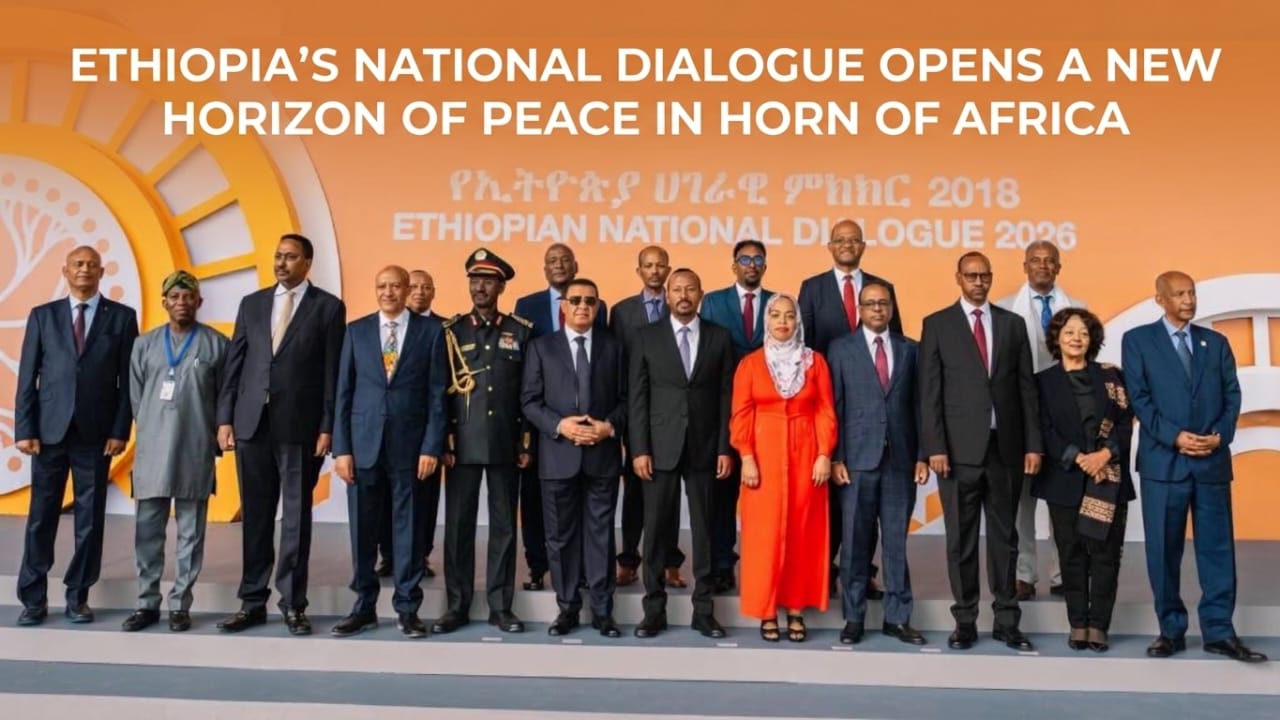
National dialogue is a popular means of peace-building process in times of political transition. Cognizant of this fact, Ethiopia promoted an inclusive public dialogue process, following the post- 2018 political transition (Kenea, 2026). Ethiopia commenced the long awaited national dialogue on July 15, 2026 at the Addis International Convention Center. The event was attended by senior government officials, regional presidents, diplomats, religious leaders and various observers. Approximately 4,000 delegates including the diaspora communities were participated. The delegates were organized into eight thematic working groups that consisted of 500 members. Each thematic group discussed on one specific agenda. The Ethiopian National Dialogue Commission (ENDC) identified eight thematic agenda through consultations conducted over four years. Some of the agenda are Nation building; Government Structure and Form, Political System & Electoral System; Religious Issues; economic affairs and Peace Building (Ethiopian National Dialogue Commission, 2026).
To support the national dialogue, more than 150 facilitators, including myself, participated in the process that was concluded by suggesting 400 possible recommendations. The event marked a historic milestone in the country’s political journey toward lasting peace and democratic nation-building project (Ageazi, 2026). At the moment, the ENDC submitted the outcome of the dialogue to the Parliament, and the country is preparing to launch the implementation phase.
Despite its recent application in Ethiopia, national dialogue is not a new phenomenon. It has been conducted in modern history with different names and contexts (Paffenholz, Zachariassen and Helfer, 2017). Some early examples include the American constitution-making process held in 1787 and the negotiation processes taken place in Africa and Asia during the late 1980s. In 1990s, several African countries including Benin, Mali, Togo and the Democratic Republic of Congo implemented the mechanism as a means of facilitating political transitions. More recently, in response to the Arab Spring, national dialogues caught global attention. Accordingly, countries such as Yemen, Egypt, Tunisia, Libya and Syria used the mechanism to resolve their deep political crises.
These days, the world has witnessed the proliferation of national dialogues in different parts of the world. In the Horn of Africa, a region frequently marked by political upheavals and cyclic conflicts, national dialogues have emerged as vital tools for inclusive peace building processes. Among Ethiopia’s neighboring states, Kenya, Somalia, Sudan, and South Sudan used national dialogues in order to address deep-rooted problems including political divisions, ethnic tensions, governance challenges, and state legitimacy concerns. It is unfortunate; many of these dialogues could not achieve their intended objectives. Consequently, their long-term effectiveness of promoting sustainable peace and stability in the Horn region remains limited. At the midst, Ethiopia’s national dialogue is evolving in the horn region, generating dividends that extended beyond the country. Among other benefits, it presents a unique model for consensus-building. It also enhances Ethiopia’s credibility as a regional partner and creates opportunities for constructive engagement with neighboring states.
Serving as a Unique Model of Consensus-Building
Usually relying on a mix of plenary sessions and working groups, National Dialogues have clear structures as well as defined rules and procedures for dialogue and decision-making. They may last from several days to several years, and their size and composition can vary considerably, from a hundred participants to several thousand. As to Ethiopia’s national dialogue is concerned over 4000 delegates participated. Among countries of the Horn region that underwent through national dialogue, Ethiopia is the latest country that practiced the process. Apparently, the country learnt a lot from its neighbors regarding the ups and downs of the national dialogue process. Yet, Ethiopia would also offer the Horn countries a home-grown example of managing deep differences through structured deliberations, introducing a unique and highly participatory methodology during the process. The methodology employed a multi-tiered discussion approach where delegates participated in groups of 10, 50, 250, 500, and ultimately 4,000 on the same agenda. Such cascading approach enabled issues raised at the small scale level to be progressively aggregated, refined, and deliberated in larger forums (ENDC, 2026).
By moving from small-group to broad thematic working groups, the process sought to ensure inclusiveness, encourage meaningful participation, facilitate consensus-building, and enhance the legitimacy of the dialogue outcomes. In this regard, the approach played a crucial role in reducing disputes, bridging local concerns with national priorities. The methodology allowed diverse perspectives from different communities and stakeholder groups to be incorporated into the dialogue process, thereby creating a fertile ground for reaching agreements, and ultimately ensures the development of consensus. Perhaps this is why the dialogue process concluded with a set of recommendations that garnered the highest level of consensus among participants.
Enhancing Ethiopia’s Credibility as a Regional Partner
A successful National dialogue would not merely strengthen Ethiopia internally, as it could significantly enhance the credibility of the country as a regional partner. By demonstrating political maturity, commitment to peace building, economic resilience, and constructive regional engagement, Ethiopia could emerge as a more trusted and influential actor in the Horn of Africa, following the implementation of its national dialogue. In this context, Ethiopia's credibility would stem not only from its size and strategic location, but also from its ability to transform internal diversity into a foundation for regional cooperation and stability. The post-2018 Ethiopian government is popular for championing regional integration, while pursuing Horn first foreign policy. Regional integration requires predictable and credible partners. A state with a more settled political order can make longer-term commitments on trade corridors, energy exchange, transport links and water cooperation. In all these arenas, the contribution of concluding Ethiopia’s national in a more transformative approach has a paramount significance.
Creating Space for de-escalation with Neighboring Countries
The Horn of Africa is one of the most complex and conflict-prone regions in the world. In such volatile region, Ethiopia’s national dialogue could serves as a stabilization force in the region, and would reduce the risk that domestic disputes become the trigger for interstate war. Accordingly, the outcome of the dialogue process would certainly go hand in hand with Ethiopia’s Horn First foreign policy orientation. The policy underscores the importance of sharing common destiny and collaboration to ensure regional stability and prosperity among Horn of Africa’s countries. Notwithstanding, such pragmatic policy orientation seems to face challenges owing to external forces, mainly related to the subversive role of Egypt in the Horn region. Egypt’s containment strategy is one such instance. Egypt weaponizes the weakness of Ethiopia’s neighboring countries including Sudan, Somalia and Eritrea, and thereby escalates tension in the region (Suadiq, 2026). It should be noted that addressing the numerous challenges in the Horn region requires a coordinated approach grounded in mutual understanding and cooperation, rather than dependence on external powers.
Conclusion and Policy Recommendations
The outcome of the national dialogue process would have a paramount importance beyond the boarder of the country, strengthening peace building efforts in the Horn of Africa. This transformation would contribute to sustainable peace within the country and promote regional cooperation, economic integration, and collective security across the volatile region of the Horn of Africa. In this connection, concerted efforts should be exerted to ensure the effectiveness of the process, and thereby avoiding the limitations that characterized previous dialogue initiatives held in the region. At the moment, as Ethiopia’s national dialogue is evolving, a faithful implementation of the outcome is particularly important. Obviously, the biggest challenge for national dialogues is not reaching an agreement, but rather implementing it. Policy makers, therefore, need to develop a clear follow-up mechanism for the implementation phase of the dialogue. They should also create a platform where national dialogue, regional integration and the “Horn First” policy converge to advance peace-building.
References
Ageazi Berhane. (2026. Ethiopia’s National Dialogue: A homegrown path toward lasting peace and national consensus. Available at https://www.diplomatictimesonline.com/
Ethiopian National Dialogue Commission. (2026).
Kenea Yadeta. (2026). National Dialogue for Peace building in Ethiopia: Lessons from Rwanda, Tunisia, and Yemen. Ethiopian Journal of the Social Sciences and Humanities (EJOSSAH)
Suadiq Sufian. (2026). From Trilateral to Quadrilateral Conspiracy Axis Formation: Cairo’s Failed Containment Strategy against Ethiopia. IFA, website
Thania Paffenholz, Anne Zachariassen, and Cindy Helfer. (2017). What Makes or Breaks National Dialogues? Geneva: Inclusive Peace & Transition Initiative (The Graduate Institute of International and Development Studies).
By Suadiq Sufian (Ph.D.)
Researcher for the Middle East and Asia-Pacific, IFA
Disclaimer
The content disseminated by the Institute of Foreign Affairs (IFA) – including, but not limited to, publications, public statements, events, media appearances, and digital communications – reflects the views of individual contributors and does not necessarily represent the official positions or policies of the Institute, its partners, or any affiliated governmental or non-governmental entities.
While the IFA endeavours to ensure the accuracy, integrity, and timeliness of the information presented, it makes no representations or warranties, express or implied, regarding the completeness, reliability, or suitability of such content for any purpose. The Institute expressly disclaims any liability for errors or omissions, as well as for any actions taken or decisions made based on the information provided.
The inclusion of external links, references, or third-party resources does not constitute an endorsement by the Institute. Additionally, engagement on social media platforms – including, but not limited to, likes, shares, retweets (RTs), or reposts – shall not be interpreted as an endorsement or validation of the views expressed therein.
Readers and audiences are encouraged to exercise critical judgement and seek independent verification when interpreting or relying upon any information disseminated through publications and posts on the Institute’s platforms or representatives.