
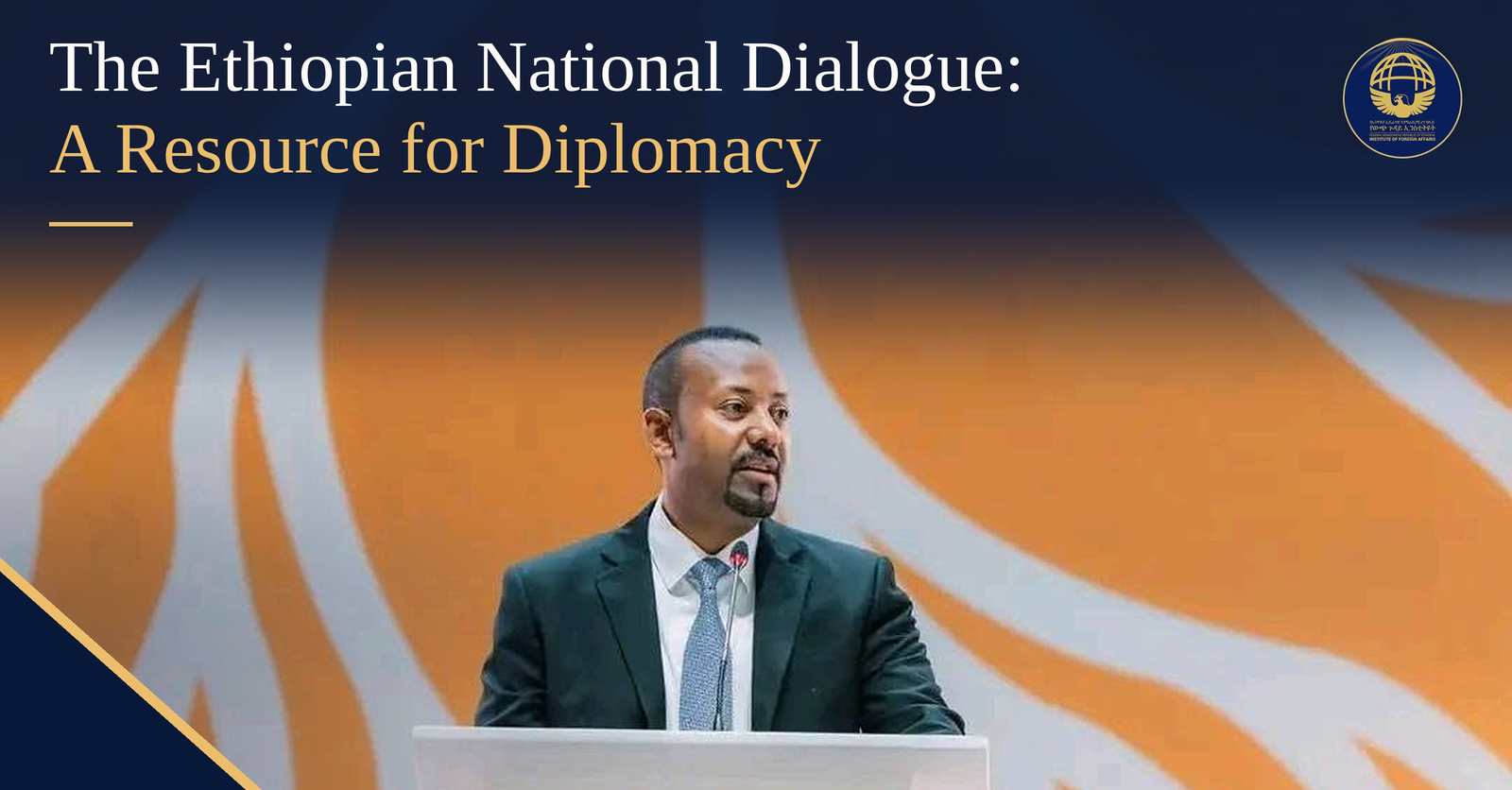
Ethiopia opened a potentially historic chapter in its efforts to resolve long-standing political differences thru dialogue and consensus. The long-awaited National Dialog, which brought together thousands of representatives from all corners of Ethiopian society in an attempt to peacefully consult on the nation's most difficult political and social issues. This marked by significant social, political, and diplomatic developments.
In order to resolve severe political divisions and guide the nation towards stability, Ethiopia initiated a national dialog process in 2022. A national dialog commission was established as part of Ethiopia's procedure. It declared that its goals were to promote democratic transition, strengthen nation building, and foster national cohesion. Theoretically, these discussions can assist societies in putting an end to conflict, restoring confidence, and reaching a consensus on new political regulations.
Nearly 4,000 representatives from regional states, political parties, civil society organizations, religious institutions, professional associations, traditional leadership, youth, women's groups, and Ethiopian diaspora members have gathered for the conference. The Dialogue conference, which was organized by the Ethiopian National Dialog Commission (ENDC), is the most comprehensive national consultation process that has taken place in Ethiopia since 2021. The ENDC, which was established by Proclamation No. 1265/2021, states that the dialogue's goals are to identify Ethiopia's main national issues, create widespread agreement, and develop recommendations that can improve political stability and national cohesion.
Regarding to the agenda collection process, communities at all levels from woreda to regional and federal level were participated. Ethiopians residing overseas have also been included national dialogue in order to ensure that viewpoints from outside the nation contribute to the national dialogue.
The anticipated outcomes will be rebuilding public trust, bolstering democratic institutions, fostering reconciliation, and creating a culture where disagreements are resolved thru discussion, compromise, and constitutional processes rather than confrontation. There will be several advantages for Ethiopia if the current National Dialog will be successful. These advantages include: Resolving deep ethnic and regional tensions thru dialogue rather than violence; fairly acknowledging suffering across regions to establish a legitimate transitional justice process; and substituting divisive narratives with a common civic identity that values community diversity.
A potentially revolutionary attempt to resolve decades of political disagreement thru consultation and consensus rather than conflict was made with the launch of the National Dialog. Both domestically and internationally, the National Dialogue has a capacity to generate useful recommendations, bolster public trust, and tackle Ethiopia's most intricate political issues in the upcoming months.
The implications are not limited to Ethiopia. International partners saw Ethiopia's federal order thru the prisms of self-government, inclusion, recognition, and conflict resolution for a large portion of the post 1991 era, paying less attention to the dangers of regional institutions serving as vehicles for distinct political agendas. They promote the framing of control over territory, institutions, and identity as issues of security, dignity, and political belonging by political actors, including armed groups.
Foreign Policy Relevance
National Dialogue and Foreign diplomacy are deeply interconnected. Because as internal peace and political consensus took the bedrock, the country's external credibility and negotiating power will be high. In addition, a credible domestic dialogue stabilizes the state, while constructive Foreign Diplomacy helps mobilize international support, resources, and goodwill for the implementation of peace outcomes.
The approach Ethiopia has taken toward conducting a national dialogue, as well as the commitment it has demonstrated, carries a significant positive dimension for its relations with the international community. National dialogue is an integral component of democracy. Furthermore, the commitments of a people to deliberate collectively and resolve their challenges through dialogue a hallmark of a democratic culture. It also fosters a favorable perception within the international community.
Although the Ethiopian National Dialogue is primarily aimed at fostering domestic peace, mutual understanding, and political stability, it maintains a direct and strong connection to Ethiopia’s foreign relations and foreign policy. Domestic unity and stability are crucial for a nation to possess a robust and influential foreign policy; the impact of the national dialogue’s success on foreign diplomacy can be characterized by the following key points:
I. Domestic Solidity and Strength of Foreign Policy
• Foreign policy is shaped by and originates from domestic needs and consensus. If a national dialogue succeeds in building a common understanding on key national issues, the country projects on the international stage will not be fragmented and it will be a strong position that represents the voices of all its citizens.
• Political and ethnic conflicts within the country create openings for external actors to intervene in domestic affairs. If the national dialogue proves successful and internal disputes are resolved peacefully, it will reduce the pressure of external actors.
II. National Image and International Credibility
• Ethiopia’s efforts to resolve its complex challenges through dialogue and peaceful means enhance its credibility within the international community and enable the country to secure diplomatic support.
III. Regional Geopolitics and Stability in East Africa
• Ethiopia holds a significant geopolitical position in the Horn of Africa. Domestic instability inevitably exerts a negative impact on the wider region.
Recommendations
By creating unified internal voice, national discourse and consensus through the National Dialogue the state could achieve effective Foreign Diplomacy. So
the government must follow through and ensure implementation until the very end. If the National Dialogue succeeds a nation’s ability to negotiate internationally could be achieved. It ensures the stability and durability of international agreements.
The government and relevant bodies should explain to the diplomatic community about the extensive efforts made to ensure the national dialogue is all-inclusive. Furthermore, they should clarify the numerous, repeated invitations extended by the National Dialogue Commission to those groups that now claim they were not participated.
It is essential to exercise caution to ensure there are no gaps in the remaining implementation process. Engagement with the media is required. Additionally, sharing positive experiences gained prior to the implementation phase with neighboring entities will help garner international attention.
REFERENCE
Abebe Woldeselasie (2026) Why Ethiopia’s Conflict Keep Returning: The Question of Ethiopia’s National Dialogue cannot avoid.
Aboultaif, E.W. (2020) Revisiting the semi-consociational model: democratic failure in prewar Lebanon and post-invasion Iraq. International Political Science Review.
Felek, M.Z. (2024) The 2022 Ethiopia’s first-ever national dialogue formation: analyzing challenges and prospects.
Dereje Melese Liyewu (2026) Ethiopia’s national dialogue was meant to heal the nation, but divisions are deepening Published: https://theconversation.com/ethiopias-national-dialogue-was-meant-to-heal-the-nation-but-divisions-are-deepening-278321
Tadesse Simie Metekia (20 July 2026) Ethiopia’s National Dialogue could give transitional justice new momentum (Policy Brief, Special Projects, ISS Addis Ababa)
Proclamation No. 1265/2021
Paffenholz, T., and Ross, N. (2016). Inclusive political settlements: new insights from Yemen’s national dialogue.
Tegbaru Yared (July 11, 2024). Ethiopia’s National Dialogue needs a reset, Institute of security studies, https://issafrica.org/iss-today/ethiopia-s-national-dialogue-needs-a-reset
Yohannes, D. and Dessu, M.K. (2020) National dialogues in the Horn of Africa: lessons for Ethiopia’s political transition. Institute for Security Studies (ISS)
Addis standard (August 17, 2026), https://addisstandard.com/beyond-national-dialogue-political-architecture-for-democratic-transition-in-ethiopia/
Ethiopian News Agency. (August, 2026) Ethiopia’s National Dialogue: A Historic Path toward Peace and National Consensus by Yordanos D. https://www.ena.et/web/eng/w/eng_9386389
Ethiopian News Agency. (July, 2026), Ethiopian National Dialogue Commission, “National Dialogue Forum Preparations Enter Final Stage as Commission Confirms Readiness,”
By Addis Alemahu, Researcher at Institute of Foreign Affairs.
Disclaimer
The content disseminated by the Institute of Foreign Affairs (IFA) – including, but not limited to, publications, public statements, events, media appearances, and digital communications – reflects the views of individual contributors and does not necessarily represent the official positions or policies of the Institute, its partners, or any affiliated governmental or non-governmental entities.
While the IFA endeavours to ensure the accuracy, integrity, and timeliness of the information presented, it makes no representations or warranties, express or implied, regarding the completeness, reliability, or suitability of such content for any purpose. The Institute expressly disclaims any liability for errors or omissions, as well as for any actions taken or decisions made based on the information provided.
The inclusion of external links, references, or third-party resources does not constitute an endorsement by the Institute. Additionally, engagement on social media platforms – including, but not limited to, likes, shares, retweets (RTs), or reposts – shall not be interpreted as an endorsement or validation of the views expressed therein.
Readers and audiences are encouraged to exercise critical judgement and seek independent verification when interpreting or relying upon any information disseminated through publications and posts on the Institute’s platforms or representatives.