
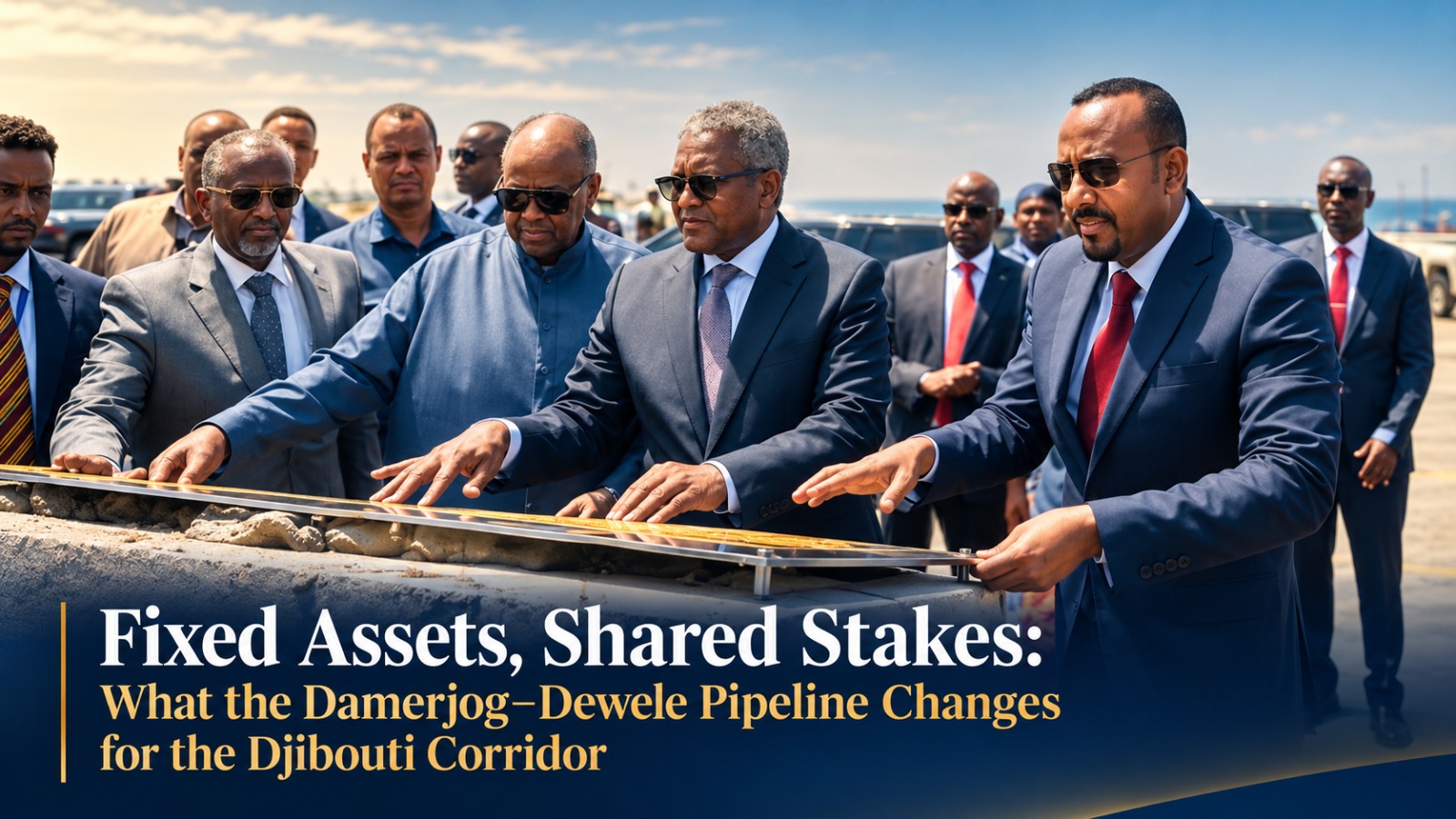
The standard reading of Ethiopia’s position on maritime access begins with a practical constraint: the country’s international trade is heavily concentrated on the Addis–Djibouti corridor. That concentration creates exposure to disruption and makes logistics efficiency a national economic concern. Against this background, the 24 September 2026 announcement of a proposed 120-kilometre fuel pipeline from Damerjog in Djibouti to Dewele on the Ethiopian side of the border may appear to deepen reliance on the same corridor. Yet it may also help make that corridor more efficient and resilient.
The project, valued at a reported $660 million and launched by Prime Minister Abiy Ahmed, Djiboutian President Ismaïl Omar Guelleh and the Dangote Group, is intended to shift some refined-fuel transport from road tankers to fixed infrastructure. Its strategic significance lies not in eliminating dependence, but in changing how that dependence is managed. This brief uses the term “hardened interdependence” to describe a relationship in which shared infrastructure and mutual commercial interests can increase the incentives for cooperation. The effect is not automatic: it will depend on implementation, transparent commercial arrangements and reliable joint management.
From Dependence to Shared Assets
Hardened interdependence has three elements: physical infrastructure that requires sustained cooperation, commercial arrangements that deliver benefits to both parties, and shared responsibility for operational risks. The proposed pipeline could provide the first element. Project reports describe a route connecting a new terminal at Damerjog with Dewele in Ethiopia, alongside storage facilities and links to Djibouti’s wider port and transport infrastructure. The precise storage specifications should be confirmed against the project’s official technical documents before publication, as public reports have cited differing figures.
If completed and operated as planned, the pipeline could improve the predictability of refined-fuel deliveries, reduce reliance on road-tanker movements and strengthen Ethiopia’s ability to manage temporary supply interruptions. The size of these benefits will depend on construction, commissioning, throughput, maintenance and the effective management of storage. Claims that the project will reduce a journey from five days to one should not be treated as established unless an authoritative source clearly defines the baseline and the journey being measured.
Fuel is strategically important to transport, agriculture, manufacturing and electricity generation. More predictable delivery could therefore support economic activity and reduce some logistics-related risks. However, the pipeline should be assessed as one component of a wider fuel-supply system, not as a stand-alone guarantee of energy security.
The project also complements the approach set out in IFA’s 16 October 2026 policy brief on Ethiopia’s Red Sea strategy, which emphasises energy security, adequate reserves and the assessment of corridors by total logistics cost. Improving the efficiency of the Djibouti corridor is compatible with diversification, provided Ethiopia continues to assess alternative routes on commercial, technical and security grounds.
What Djibouti Gains
A sustainable corridor must generate benefits for the transit state as well as the landlocked state. Djibouti could gain from additional port activity, investment, employment and a stronger role in regional energy logistics. At the project launch, the parties presented the pipeline as part of a broader ambition to expand industrial and logistics capacity. The extent of these gains will depend on project delivery and the commercial terms governing its operation.
This creates a constructive diplomatic opportunity. Ethiopia’s economic and maritime interests can be advanced through negotiated projects that recognise the sovereignty and legitimate interests of neighbouring states. The pipeline is not evidence that every corridor challenge has been resolved; it is an example of how practical infrastructure cooperation may align the interests of Ethiopia, Djibouti and an African investor.
For Ethiopia, the relevant objective is not dependence for its own sake, nor the displacement of one partner by another. It is to secure reliable, affordable and diversified access to essential imports while sustaining mutually beneficial relations with neighbouring states. For Djibouti, a more efficient corridor can reinforce its position as a regional logistics and energy hub. These interests can be complementary, even as both governments retain distinct national priorities.
The Skeptic’s Case
Three concerns merit serious consideration. First, a pipeline can create a new point of failure if the line, terminals or supporting systems are disrupted. Second, investment in the established Djibouti corridor may appear inconsistent with the objective of diversification. Third, the reported implementation schedule for a project of this scale is ambitious, and delays could affect the expected benefits.
These concerns should shape project governance rather than be dismissed. Storage capacity on the Ethiopian side, if constructed, commissioned and adequately stocked, could help cushion temporary interruptions; it would not eliminate the risks associated with a single pipeline or terminal. Joint security, maintenance and emergency-response arrangements would therefore be essential.
On diversification, the distinction is between strengthening an existing corridor and relying on it exclusively. The pipeline could improve the performance of fuel imports through Djibouti, while Ethiopia continues to evaluate other transport routes for their feasibility, cost, capacity, security and diplomatic arrangements. Alternative corridors, including possible routes through Kenya, require their own technical and commercial assessment; they should not be presented as ready substitutes unless that status is verified.
Finally, the project’s schedule should be treated as a target to monitor, not a guarantee. Publicly reported cost, timing and capacity figures should be checked against official project documentation and updated as implementation progresses.
What Addis Ababa Has at Stake
Ethiopia’s stakes are economic and diplomatic. More reliable fuel delivery could reduce exposure to transport delays and support sectors across the economy. The scale of any savings, however, will depend on tariffs, throughput, financing, maintenance costs and the extent to which pipeline transport replaces existing road movements.
The diplomatic stakes are equally important. The project offers a practical illustration of how Ethiopia can pursue its economic and maritime interests through negotiated infrastructure cooperation that respects sovereignty and recognises mutual benefit. It also demonstrates the potential role of African investment in addressing regional infrastructure needs. These are meaningful contributions to regional cooperation, but their value will be established through delivery and operation rather than the announcement alone.
Keeping the Pipeline on Schedule
First, Ethiopia and Djibouti should publish a joint implementation timetable covering construction, terminal development, commissioning and the key milestones required for safe operation. Regular progress updates would improve transparency and help both publics assess delivery against the announced schedule.
Second, the governments and project partners should clarify the commercial framework before operations begin. Transparent rules on tariffs, throughput, access, pricing and dispute resolution would help protect the interests of all parties and reduce uncertainty around the use of a strategic asset.
Third, the parties should establish joint security, maintenance and emergency-response arrangements for the pipeline and terminals. These should define responsibilities, communication channels, procedures for managing interruptions and the conditions under which stored fuel could be released during an emergency.
Fourth, Ethiopia should maintain practical redundancy across road, rail and other feasible supply routes. A pipeline strengthens the system most effectively when alternative modes remain available and can be used when conditions require.
Fifth, public communication should present the project as a partnership that improves corridor efficiency, not as a rejection of Djibouti or a substitute for wider diversification. The same principle should guide discussion of other potential routes: evaluate each on its merits while maintaining constructive relations with all relevant partners.
Conclusion
Hardened interdependence is a useful way to understand the strategic potential of the Damerjog–Dewele pipeline. Shared infrastructure can strengthen incentives for cooperation by linking the parties’ economic interests, but it cannot by itself guarantee reliability or political stability. Those outcomes require sound commercial terms, transparent implementation, joint operational arrangements and continued investment in alternatives.
For Ethiopia, the proposed pipeline could improve the resilience of a vital fuel-supply route while preserving the value of its relationship with Djibouti. For Djibouti, it could support its ambitions in energy and logistics. If the project is delivered and governed effectively, it may show how Ethiopia’s pursuit of reliable access and its neighbours’ economic interests can reinforce one another. The test of hardened interdependence will be not the announcement, but the quality and reliability of the system that follows.
Notes
AllAfrica. “Africa: Ethiopia, Djibouti Hail Dangote’s $660 Million Pipeline as Energy Security Boost.” September 25, 2026. https://allafrica.com/stories/202609250028.html.
Aweke, Amare K. “Ethiopia’s Red Sea Strategy: Advancing Maritime Interests and Strategic Autonomy amid Geopolitical Competition.” Policy brief, Institute of Foreign Affairs, October 16, 2026. https://www.ifa.gov.et/blog/778.
Energy News. “Djibouti and Ethiopia Launch $660 Million Pipeline with Dangote.” September 25, 2026. https://energynews.pro/en/djibouti-and-ethiopia-launch-660-million-pipeline-with-dangote.
Horn Review. “The Damerjog-Dewele Pipeline and Ethiopia’s Energy Security.” September 30, 2026. https://hornreview.org/2026/09/30/the-damerjog-dewele-pipeline-and-ethiopias-energy-security/.
Institute of Foreign Affairs. “Ethiopia’s Corridor Imperative: Strategic Resilience Beyond Djibouti.” May 21, 2026. https://www.ifa.gov.et/2026/05/21/ethiopias-corridor-imperative-strategic-resilience-beyond-djibouti/.
Pan African Visions. “Ethiopia, Djibouti and Dangote Unveil $660 Million Petroleum Pipeline Project.” September 24, 2026. https://panafricanvisions.com/2026/09/ethiopia-djibouti-and-dangote-unveil-660-million-petroleum-pipeline-project/.
Realnews Magazine. “Ethiopia, Djibouti Presidents Laud Dangote’s $660m Pipeline Project as Game-Changer.” September 25, 2026. https://realnewsmagazine.net/ethiopia-djibouti-presidents-laud-dangotes-660m-pipeline-project-as-game-changer/.
World Bank. “Addis-Djibouti Corridor to Get Major Upgrade That Is Key to Unlocking Connectivity and Trade for Ethiopia and the Horn of Africa.” July 20, 2023. https://www.worldbank.org/en/news/press-release/2023/07/20/addis-djibouti-corridor-to-get-major-upgrade-that-is-key-to-unlocking-connectivity-and-trade-for-ethiopia-afe.
By Bruktawit Abayneh, Communication Head, IFA
Disclaimer
The content disseminated by the Institute of Foreign Affairs (IFA) – including, but not limited to, publications, public statements, events, media appearances, and digital communications – reflects the views of individual contributors and does not necessarily represent the official positions or policies of the Institute, its partners, or any affiliated governmental or non-governmental entities.
While the IFA endeavours to ensure the accuracy, integrity, and timeliness of the information presented, it makes no representations or warranties, express or implied, regarding the completeness, reliability, or suitability of such content for any purpose. The Institute expressly disclaims any liability for errors or omissions, as well as for any actions taken or decisions made based on the information provided.
The inclusion of external links, references, or third-party resources does not constitute an endorsement by the Institute. Additionally, engagement on social media platforms – including, but not limited to, likes, shares, retweets (RTs), or reposts – shall not be interpreted as an endorsement or validation of the views expressed therein.
Readers and audiences are encouraged to exercise critical judgement and seek independent verification when interpreting or relying upon any information disseminated through publications and posts on the Institute’s platforms or representatives.