
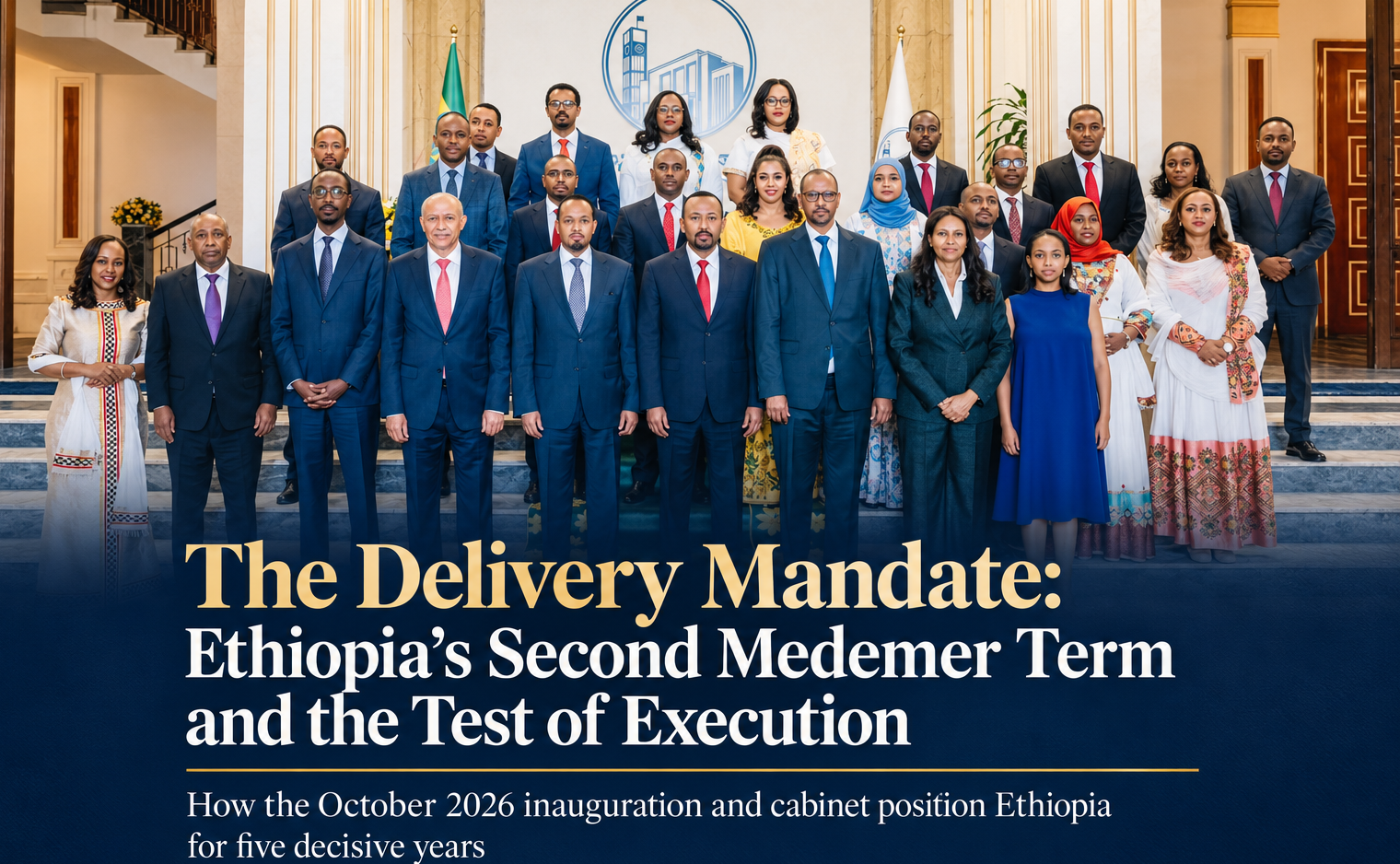
The conventional reading of Ethiopia’s political calendar this month is procedural: a new parliament was sworn in, a Prime Minister was re-elected, and a cabinet was approved. On 5 October, the seventh House of Peoples’ Representatives was inaugurated and Prime Minister Abiy Ahmed was appointed and sworn in for a second term. Three days later, the House endorsed the ministers who would serve beside him. Viewed solely as ceremony, these developments might appear to be a routine institutional transition.
A Mandate Measured in Results
The Skeptic’s Reading, Taken Seriously
That reading misses the signal. The timing matters, because it came one day after four states issued the El Alamein Declaration on the Red Sea and the Nile. The speech and cabinet appointments also provide an opportunity to assess Ethiopia’s institutional priorities amid these regional developments. This article describes the resulting expectation as a delivery mandate: a government whose legitimacy now rests less on what it promises than on what it completes. The question for the next five years is how that mandate will be carried out, and how its progress will be judged.
A Mandate Measured in Results
A delivery mandate differs from a transitional or a founding mandate. A founding mandate asks citizens to believe in a direction. A delivery mandate asks them to judge an outcome. Ethiopia’s second Medemer term fits the second description. The reform agenda, the Grand Ethiopian Renaissance Dam, the Pretoria Agreement and the corridor and port diplomacy are no longer proposals. They are inherited commitments with timelines, budgets and counterparties.
The parliamentary arithmetic supports this reading. The Prosperity Party secured 438 of the 486 contested seats in the House of Peoples’ Representatives. That provides the government with substantial legislative capacity, alongside a corresponding responsibility to deliver results. With a strong parliamentary majority, attention increasingly turns to policy implementation and institutional performance.
What the Speech and the Cabinet Reveal
The Prime Minister’s inaugural remarks emphasized national cohesion following the election. He described the election as an event refined like gold through fire that strengthened Ethiopia’s democratic culture, and said that Ethiopia has no losing children, only winners. He tied national progress to moving forward together, and described vigilance in a fast-changing world as the duty of this generation. He presented the new term as a chance to turn accumulated experience and capabilities into practical results.
The cabinet follows the same logic. Temesgen Tiruneh continues as Deputy Prime Minister, Gedion Timothewos remains Foreign Minister, and Education, Agriculture, Justice, Water and Energy, Health and Revenues all keep their ministers. Continuity in portfolios central to diplomacy and development may signal consistency in Ethiopia’s approach to the Nile, the Red Sea and regional integration.
Change is concentrated where security and the economy meet. Mohammed Idris moves from Peace to Defense. Fitsum Assefa, who led Planning and Development for eight years, becomes Finance Minister, succeeding Ahmed Shide, who was elected Speaker. One interpretation is that placing a long-serving national planner at Finance and a new minister at Defense treats the protection of national priorities and their financing as a single equation. The Prime Minister said the appointments prioritize performance and citizens’ benefit over academic credentials, and described the posts as demanding national trust, aimed at a sovereign, united and productive Ethiopia that is a regional and continental anchor. The cabinet includes nine women and members from different political backgrounds. Published accounts differ on the cabinet’s final headcount; the official parliamentary record should be consulted before publication.
The Skeptic’s Reading, Taken Seriously
A balanced assessment should also consider questions of institutional oversight and implementation. A governing party holding such a large majority invites the question of whether strong executive capacity is matched by robust scrutiny. Some observers may argue a performance-first standard risks narrowing technical depth in ministries that manage complex portfolios. Others may argue that continuity in most major portfolios is the opposite of renewal, and that a second term with the same faces will struggle to produce different results.
These concerns identify important tests of institutional effectiveness without, on their own, establishing shortcomings in the government’s approach. The Prime Minister’s own framing of inclusive victory, together with the visible diversity of the cabinet, is a commitment that can be checked against conduct. Continuity in portfolios carrying long-horizon projects is a strength, because a dam, a debt framework or a diplomatic position is not served by rotating its stewards every few years. Performance as a standard also strengthens accountability, provided that results are published and reviewed. Transparency is an important response to such concerns. A government that wants to be judged on delivery should make delivery visible.
A Region Watching Closely
For Ethiopia, the stakes extend well beyond domestic administration. The Horn is in a period of declaration-making. Recent statements on Red Sea governance and Nile-related principles underscore the importance of continued regional consultation, including Ethiopia’s participation where its legitimate interests are affected. A cabinet with continuity at Foreign Affairs and Water and Energy is positioned to carry Ethiopia’s consistent position that cooperation concerning shared waterways and regional maritime security benefits from consultation with states whose trade and development interests are directly affected.
The Prime Minister’s stated aim of a sovereign Ethiopia, united in its diversity and a leading regional anchor is a statement about posture. Sovereign decision-making entails pursuing Ethiopia’s national interests through its own institutions and diplomatic processes. Regional anchor status means those choices are made with a view to stability beyond its borders. The two are compatible, and the government’s task is to show it in practice.
Five Years, Three Tests
First, the government should publish a delivery framework within the first hundred days. Each ministry should carry a small number of public, measurable commitments, reviewed at set intervals. A delivery mandate benefits from a visible scorecard, and a scorecard converts the Prime Minister’s performance standard into something citizens and partners can verify. The trade-off is exposure to criticism when targets slip, which can nonetheless strengthen public credibility.
Second, Defense and Finance should be coordinated through a standing planning arrangement. National security spending, infrastructure financing and debt restructuring compete for the same resources, and the new appointments create a chance to align them. The risk is that security priorities crowd out social investment, so the arrangement should include the ministries that carry health, education and agriculture.
Third, Foreign Affairs and Water and Energy should open an active diplomatic season. That means carrying the case for equitable utilization and inclusive Red Sea dialogue into the African Union and IGAD, while keeping the door open for technical engagement on the Nile. The trade-off is patience, because broad consultation may require sustained engagement. Even so, a standing offer of dialogue is the strongest position Ethiopia can hold.
Ethiopia’s second Medemer term begins with a large mandate, a stable diplomatic team and a cabinet designed around execution. That is the delivery mandate: a government asking to be judged on what it completes, in a region where translating diplomatic commitments into practical outcomes requires sustained cooperation.
Notes
Addis Media Network. “PM Reaffirms Medemer Government’s Commitment to Ethiopia’s Future.” October 8, 2026. https://www.amn.gov.et/en/pm-reaffirms-medemer-governments-commitment-to-ethiopias-future/.
allAfrica. “Ethiopia Opens a New Five-Year Chapter of National Renewal.” October 5, 2026. https://allafrica.com/stories/202610060056.html.
allAfrica. “Ethiopia Unveils New Cabinet Reshuffle.” October 8, 2026. https://allafrica.com/stories/202610080344.html.
Office of the Prime Minister of Ethiopia (@PMEthiopia). “Prime Minister Abiy Ahmed delivers his inaugural remarks as the Medemer Government forms today October 5th, 2026.” X, October 5, 2026. https://x.com/PMEthiopia/status/2107108752608374847.
The Reporter Ethiopia. “Ethiopia Unveils New Cabinet Reshuffle.” October 8, 2026. https://www.thereporterethiopia.com/53263/.
Trends Africa. “Ethiopia’s Parliament Approves New 22-Member Cabinet as Abiy Begins Second Term.” October 8, 2026. https://trendsnafrica.com/ethiopias-parliament-approves-new-22-member-cabinet-as-abiy-begins-second-term/.
By Sifen Gudeta, IFA
Disclaimer
By Sifen Gudeta, IFA
Disclaimer
The content disseminated by the Institute of Foreign Affairs (IFA) – including, but not limited to, publications, public statements, events, media appearances, and digital communications – reflects the views of individual contributors and does not necessarily represent the official positions or policies of the Institute, its partners, or any affiliated governmental or non-governmental entities.
While the IFA endeavours to ensure the accuracy, integrity, and timeliness of the information presented, it makes no representations or warranties, express or implied, regarding the completeness, reliability, or suitability of such content for any purpose. The Institute expressly disclaims any liability for errors or omissions, as well as for any actions taken or decisions made based on the information provided.
The inclusion of external links, references, or third-party resources does not constitute an endorsement by the Institute. Additionally, engagement on social media platforms – including, but not limited to, likes, shares, retweets (RTs), or reposts – shall not be interpreted as an endorsement or validation of the views expressed therein.
Readers and audiences are encouraged to exercise critical judgement and seek independent verification when interpreting or relying upon any information disseminated through publications and posts on the Institute’s platforms or representatives.