
Introduction
The straight-line distance between Addis Ababa and Cairo is approximately 2,456 kilometers, with Cairo situated to the north of Addis Ababa. This considerable geographical separation places Ethiopia and Egypt relatively far apart in geographical terms. Yet, Egypt has historically attempted to control and contain Ethiopia. The battles of Gundet and Gura are notable examples of Egypt’s unsuccessful attempts, during which its efforts to establish physical control were resisted by Ethiopian forces. In the then time, the ambition of Egypt extended to create an Egyptian African empire by engulfing Sudan and Ethiopia.
More recently, Egypt’s containment strategy was attributed by weaponizing the weakness of Ethiopia’s neighboring countries, particularly Sudan, Somalia and Eritrea. Sudan remains in a devastating civil war; Somalia continues to struggle with persistent security threats, and Eritrea has operated under a highly centralized political system since its independence. Indeed, Egypt is also not free of domestic challenges. The International Monetary Fund continues to voice concern about state and military control in the economy of Egypt. Notwithstanding, despite its own domestic challenges, Egypt has pursued regional alignments perceived as unfavorable to Ethiopia by drawing on the vulnerabilities of other countries. From a strategic perspective, Egypt’s attempt to cultivate an anti-Ethiopian bloc in the Horn of Africa on such fragile foundations is unlikely to achieve either its preferred position in Nile water governance or its objective of isolating Ethiopia from vital water and maritime resources – the Nile River and the Red Sea.
Egypt’s Strategy in the Horn of Africa
Egypt’s strategy in the Horn of Africa appears to be very simple – containing Ethiopia by countering its strategic initiatives or national aspirations. For instance, when Ethiopia planned to build the Great Ethiopian Renaissance Dam (GERD) Project, Egypt opposed the proposal and its implementation from the inception. Despite years of Egypt’s accusations, Ethiopia successfully completed and inaugurated the construction of the GERD. In a similar vein, by the time when Ethiopia declared its legitimate quest for sea access, Egypt responded in a manner that heightened diplomatic tensions.
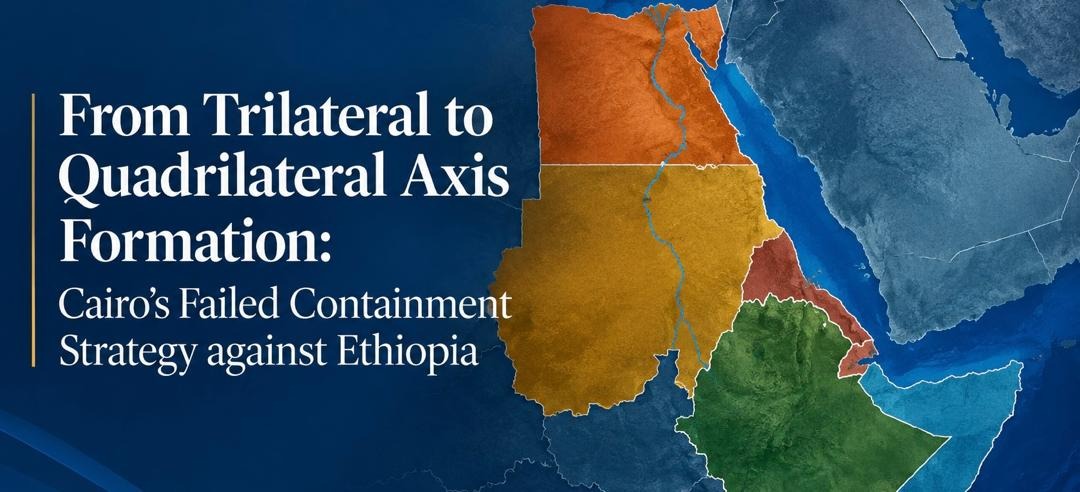
It initiated a trio-party alliance, and on October 10, 2024, the leaders of Egypt, Somalia and Eritrea announced the formation of a trilateral alignment viewed as challenging Ethiopia’s stated objective – a sovereign sea outlet. In the view of Hassan Khannenje, director of the Horn International Institute for Strategic Studies, the formation of this axis was “an attempt to bring the parties together in trying to increase pressure against Addis Ababa.” Paradoxically, while Ethiopia's primary concern is securing reliable access to the sea, the trio party appeared to be coordinating their diplomatic and military efforts against Ethiopia's aspirations.
The participating states may recognize Ethiopia’s position that Ethiopia’s quest for sovereign access has economical, geographical, historical and legal justifications. However, these concerns have not been fully reflected in their positions and tended to view Ethiopia’s aspiration primarily through their respective national security considerations. Importantly, while Egypt was waiting for tensions between Ethiopia and Somalia to escalate into conflict, Türkiye's diplomatic mediation brought the two countries together concluded by the Ankara Declaration. One of the successes of the Ankara declaration is its potential of disrupting Egypt’s regional diplomatic approach that Ethiopia considers contrary to its interests.
In other words, the Ankara declaration made the fate of Egyptian-Eritrean-Somali axis uncertain, reducing the probability of the outbreak of conflict in the Horn region – an outcome that would have further complicated regional relations. Of course, it should be noted that while averting a full Ethio-Somali rupture, the Ankara declaration did not dissolve totally the trio-party alignment. The El Alamein Summit held on October 4, 2026 in Cairo proved this fact is true. Following this Summit, Egypt reactivated the relatively hibernated axis of Egypt-Somalia-Eritrea to pressure Ethiopia. This time, Egypt brought Sudan into the axis, transforming it from a trilateral alliance to a quadrilateral diplomatic grouping.
As the El Alamein Joint Declaration revealed, Egypt’s President Abdel Fattah El‑Sisi invited President Isaias Afwerki, President Hassan Sheikh Mohamud and General Abdel Fattah Al‑Burhan to attend a Quadrilateral Summit. The Summit was carried out under the cover of discussing issues on “current regional and international issues, as well as on ways to strengthen political, trade, and economic cooperation among the four countries, and to enhance consultation and coordination among them.” From an Ethiopian strategic perspective, a significant potential motivation for Egypt in the Summit is to shore up its diplomatic and military backing in Cairo’s water conflict with Addis Ababa.
It is important to keep in mind that this comes after more than a decade of diplomatic negotiations that lacks resolution because of divergent positions on Nile water governance, including interpretations of historical agreements. Though Ethiopia promotes African Solutions for African Problems, and the principle of equitable utilization of water resources, Egypt has pursued regional diplomatic arrangements that Ethiopia may perceive as constraining its interests concerning vital water resources.
From Ethiopia’s perspective, the El Alamein Summit may be interpreted as a quadrilateral platform capable of increasing collective diplomatic pressure on Ethiopia. It seeks a favorable condition to meet Egypt's interests, for example, regarding regional water-sharing arrangements. In this regard, the declaration emphasizes “the importance of respecting international law regarding Transboundary Rivers, including the Nile River, particularly the principles of ‘no harm’ and the obligation to cooperate through prior notification, consultation, and consensus”. If the Summit was genuinely intended to promote regional cooperation and constructive dialogue on Nile-related issues, it is reasonable to question why Ethiopia, as the source of more than 80 percent of the Nile waters and a principal stakeholder in the basin, was excluded in discussions concerning the Nile River.
As with the earlier trilateral arrangement, the El Alamein grouping could contribute to regional friction if Ethiopia’s interests are not adequately considered. The arrangement raises questions about the extent to which shared development and regional integration are being prioritized. Had the goal of the Summit been cooperation, integration or development in the Horn of Africa, Ethiopia would be the first country consulted for membership in the quadrilateral alliance.
As the Ministry of Ethiopian Foreign Affairs firmly stated, “Ethiopia is the source of the Abay River, commonly known as the Blue Nile. Virtually, all of the Blue Nile originates in Ethiopian highlands, and the Abay River contributes about 80 Percent of Nile River’s total flow.” By excluding Ethiopia from matters that are of greatest significant for Ethiopia, Egypt should recognize the reality that it can neither rewrite geography nor alter the natural flow of the Nile from the Ethiopian highlands.
Conclusion and Policy Recommendations
The alignment among Egypt, Sudan, Eritrea and Somalia appears to reflect strategic considerations extending beyond cooperation alone. The extent to which the grouping reflects each participating state’s distinct national interests warrants closer examination. A shared concern regarding Ethiopia’s growing regional role may be one factor contributing to this alignment. These concerns may provide opportunities for Egypt to pursue policies that Ethiopia perceives as containment. Indeed, history proved that this strategy has been failed several times. Consequently, the so-called trio-party alliance or the evolved quadrilateral diplomatic grouping could not deliver what Cairo has wanted for centuries – isolating Ethiopia from vital water resources – the Nile River and the Red Sea. This is because Ethiopia may regard elements of Egypt’s approach as exerting pressure despite the stated emphasis on cooperation. Ultimately, such an approach could risk contributing to fragmentation in the Horn of Africa, where Ethiopia has struggled to realize regional integration, particularly in the post-2018 period. A genuine regional cooperation demands Egypt to reconsider its approach and engage Ethiopia through constructive dialogue. In its part, Ethiopia should strengthen its engagement with neighboring countries because our neighbors are naturally our closest allies.
By Suadiq Sufian (PhD)
Researcher, Middle east and Asia Pacific Affairs Research Directorate, IFA
Disclaimer
The content disseminated by the Institute of Foreign Affairs (IFA) – including, but not limited to, publications, public statements, events, media appearances, and digital communications – reflects the views of individual contributors and does not necessarily represent the official positions or policies of the Institute, its partners, or any affiliated governmental or non-governmental entities.
While the IFA endeavours to ensure the accuracy, integrity, and timeliness of the information presented, it makes no representations or warranties, express or implied, regarding the completeness, reliability, or suitability of such content for any purpose. The Institute expressly disclaims any liability for errors or omissions, as well as for any actions taken or decisions made based on the information provided.
The inclusion of external links, references, or third-party resources does not constitute an endorsement by the Institute. Additionally, engagement on social media platforms – including, but not limited to, likes, shares, retweets (RTs), or reposts – shall not be interpreted as an endorsement or validation of the views expressed therein.
Readers and audiences are encouraged to exercise critical judgement and seek independent verification when interpreting or relying upon any information disseminated through publications and posts on the Institute’s platforms or representatives.