
1. Executive Summary
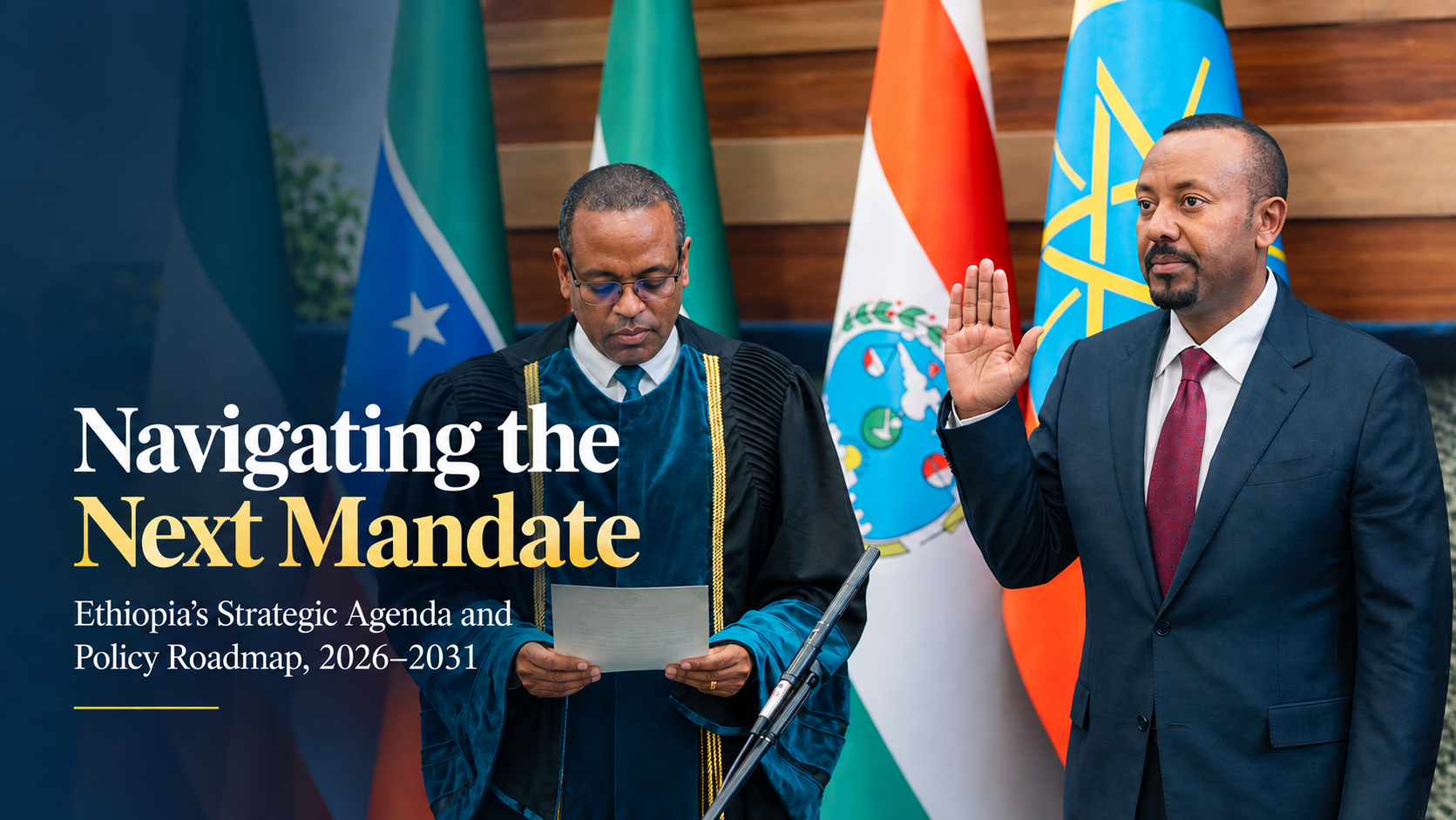
On 05 October 2026, the Prime Minister Abiy Ahmed, made his formal inaugural speech since swearing him into a new five-year term of office before the newly constituted 7th House of Peoples’ Representatives in Addis Ababa with the transition marked by the ruling Prosperity Party's landslide electoral win, securing 438 of 547 parliamentary seats. In the presence of the President Taye Atske-Selassie, with senior home and international dignitaries, the speech spells out the federal government’s executive and legislative pathway through 2031, taking mostly domestic political stabilization, broad economic steady run, digital infrastructure development, and firm geopolitical and defense carriage resilience in the Horn of Africa.
2. Four Key Policy Pillars in Prime Minister Speech
Prime Minister Abiy Ahmed’s first speech on October 5th 2026, officially launched his second five-year term. This hour-long speech in the Ethiopian parliament provided the key legislative and executive script for Ethiopia through to 2031. While the first mandate was predominantly on the broad political transition, the 2026 speech faced a matrix of deep structural challenges: entrenched regional conflicts, economic restructuring, intense multi-polar geopolitics in the Horn and the continuing quest for Red Sea access.
One of the key agenda items for the new administration is domestic stabilization and constitutional reform. In this context, Prime Minister Abiy overtly dedicated his government to critical institutional changes in an effort to navigate long-standing regional friction. Recognizing internal security threats, he appealed for national consensus by calling opposition political parties and regional administrations into structured, transparent dialogue. Emphasizing national duty and collective progress as a historical window for structural transformation, he declared, "The opportunity to build a new Ethiopian civilization rest with us." Furthermore, highlighting state endurance against multi-frontier domestic and international pressures, the Prime Minister reasserted Ethiopia's strategic self-confidence by proclaiming, "Adversaries have been hoping that Ethiopia would collapse in many frontiers, but despite their wishes... Ethiopia has managed to come out as a victorious country."
Another key agenda of the administration is its foreign policy and geopolitical positioning. Prime Minister Abiy Ahmed reiterated that securing sustainable, enduring maritime access is an indisputable policy position and an absolute economic necessity for an immense landlocked nation like Ethiopia. Stressing this vital national interest, he explicitly declared that "access to the sea for Ethiopia is first and foremost an economic imperative," noting that this strategic goal will be pursued patiently over time through peaceful dialogue, friendly mutual relations, and equitable regional cooperation rather than conflict.
Building upon his vision for state modernization through the epistemology of Medemer, Prime Minister Abiy Ahmed emphasized that "Ethiopians need to advance technology, digital technology is very important" to successfully navigate a competitive and rapidly changing global order. To capitalize on this imperative and help the country thrive within an accelerating global economy, he pledged to complete ongoing macroeconomic reforms aimed at stabilizing the financial system and attracting new investment, while announcing an ambitious digital technology program to be implemented across both public and private service delivery systems to reduce bureaucratic inefficiencies and enhance institutional capacity.
Building upon his vision for state modernization under the Medemer framework, Prime Minister Abiy Ahmed promised progressive interventions to tackle administrative malpractice, declaring that he has "promised stronger measures against 'corruption, theft and discriminatory administrative practices, presenting civil-service reform as one of the pillars of the new government.'" By framing civil-service reform as one of the cardinal principles of the new administration, he signaled zero tolerance for bureaucratic inefficiency and established administrative transparency as an absolute precondition for fostering public trust, eliminating systemic corruption, and rewarding meritocratic service delivery within every community.
Finding his way through a multi-polar international environment rife with shifting alliances and external skepticism, Prime Minister Abiy Ahmed reaffirmed that Ethiopia will further strengthen its defense capacity and technological preparedness, noting that despite ever-present doom saying predictions of state breakdown or disintegration, Ethiopia has managed to come out as a victorious country and possesses the institutional resilience and strategic independence required to function as a dependable, stabilizing security anchor in the Horn of Africa.
3. Conclusion & Strategic Implications
Prime Minister Abiy Ahmed’s inaugural address on October 5, 2026, sets forth a pragmatic and resolute governance blueprint for his second five-year term through 2031. Moving beyond the broad political alignments of his first mandate, this address confronts complex structural realities directly including internal political reconciliation and constitutional reform as well as aggressive macroeconomic and digital modernization.
By emphasizing Ethiopia’s vital economic interest in access to the Red Sea and reinforcing its military and strategic carriage, the administration indicates its commitment to strategic autonomy and stability in the Horn of Africa. Ultimately grounded in the Medemer outlook and paired with a zero-tolerance approach to bureaucratic corruption, this leadership roadmap allows Ethiopia to systematically address multi-polar global pressures, project sovereign resilience and achieve comprehensive, sustainable development through 2031.
Building upon these conclusions, key stakeholders should note the following into consideration:
• To Diplomats and International Partners (Action): Facilitate a positive environment for local-level, inclusive national dialogue initiatives by assiduously observing regional developments on maritime settlements and Horn of Africa security dynamics.
• To FDI & Multinational Investors (Action): Exploit the current macro-economy and digital revolution while remaining vigilant to mounting compliance obligations driven by the administration's zealous anti-corruption policies.
• To Security & Defense Analysts (Action): Incorporate Ethiopia's intensified basis for military self-reliance, state-centrism, and its role as an anchor state into regional stability assessments through 2031 as conditional parameters.
Primary Sources Cited:
• Refined inaugural speech and address by Prime Minister Abiy Ahmed, House of Peoples’ Representatives, Addis Ababa (October 5, 2026).
• State Election Board of Ethiopia (NEBE) poll data and SEP transition monitoring (June-October 2026).Regional and international wire tracking on the legislative opening session (Anadolu Agency & Birr Metrics coverage, October 5, 2026)
BY Yitina Gebre (PhD)
Researcher at institute of Foreign Affairs.
Disclaimer
The content disseminated by the Institute of Foreign Affairs (IFA) – including, but not limited to, publications, public statements, events, media appearances, and digital communications – reflects the views of individual contributors and does not necessarily represent the official positions or policies of the Institute, its partners, or any affiliated governmental or non-governmental entities.
While the IFA endeavours to ensure the accuracy, integrity, and timeliness of the information presented, it makes no representations or warranties, express or implied, regarding the completeness, reliability, or suitability of such content for any purpose. The Institute expressly disclaims any liability for errors or omissions, as well as for any actions taken or decisions made based on the information provided.
The inclusion of external links, references, or third-party resources does not constitute an endorsement by the Institute. Additionally, engagement on social media platforms – including, but not limited to, likes, shares, retweets (RTs), or reposts – shall not be interpreted as an endorsement or validation of the views expressed therein.
Readers and audiences are encouraged to exercise critical judgement and seek independent verification when interpreting or relying upon any information disseminated through publications and posts on the Institute’s platforms or representatives.