
1. Introduction
Ethiopia’s Entry into a Multipolar Global Order is a strategic move amid a tectonic shift underway in the global stage. The world is undergoing transition which according to scholars amounts to a global order change. This notion is apparent, though debatable. The rise of a new model of global governance has been an area where the debate about the unfolding change centered. The South-South-based institutional setup that came into the global fora called BRICS is one of the leading institutions focused on and analyzed in this genre of debates. Pioneered by the rising economic and political powers from the South and Asia, such as China and India; Russia from Europe; South Africa from the African continent; and Brazil from South America, the BRICS was initially established by these founding members of states representing mainly the global south, with the exception of Russia.
During the last decade, the club has evolved to include more countries from Africa and Asia and has emerged as a formidable setup that demands reforms and changes in the global architecture of economic, social and political development governance, echoing the voices and demands of states and societies from the global south. Ethiopia is a full member state of the bloc, having officially joined alongside Egypt and other new members on January 1, 2024. It constitutes one of the three African nations admitted to the club. Ethiopia is a country playing significant roles in African politics and international relations, and within the traditional multilateral institutional setups of the post-World War II era.
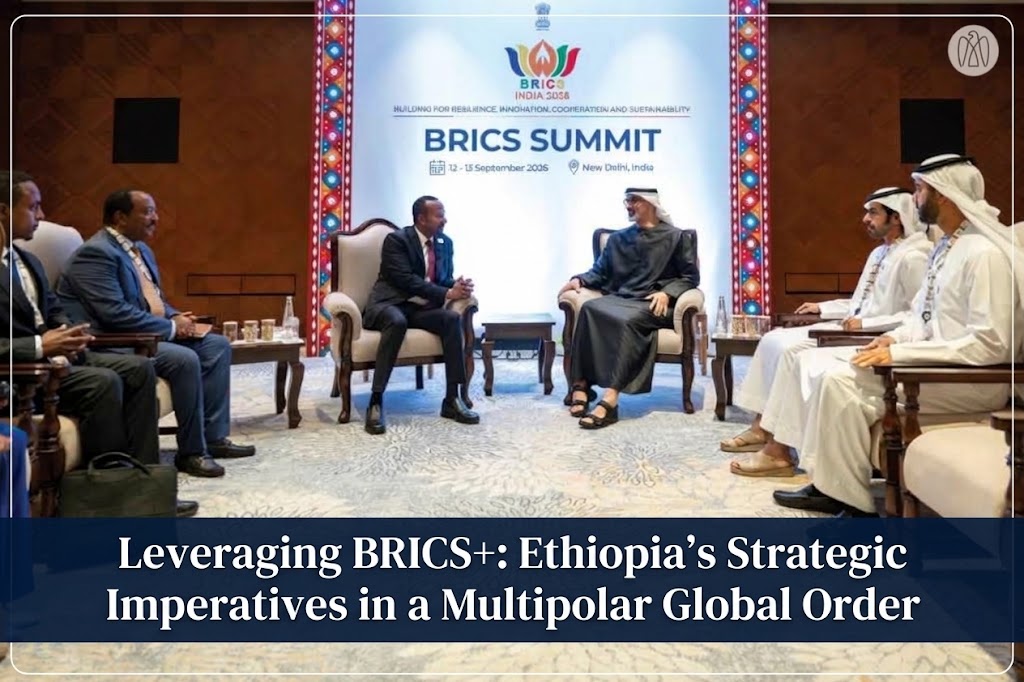
The 18th annual summit of BRICS was held in New Delhi from 12–13 September 2026 under the motto of ‘Building for Resilience, Innovation, Cooperation and Sustainability’ amid an ongoing debate around the crisis of multilateralism and the fate of countries and populations in the global south.
During this session, the Prime Minister of Ethiopia presented the country's strategic expectations to the member states. The resulting New Delhi Declaration, encompassing approximately 140 paragraphs, yielded unprecedented diplomatic victories for Addis Ababa. Most notably, the bloc officially backed Ethiopia's World Trade Organization (WTO) accession bid and its candidacy for the International Civil Aviation Organization (ICAO) Council. The analysis made on both the primary agendas and policy alignments reveal that BRICS- provides a tangible benefit to member states including Ethiopia. To realize as well as maximize the benefits gained through its membership Ethiopia must navigate certain complexities.
The main agendas for which Ethiopia gained acceptance and support during the 2026 BRICS+ summit are analysed in this policy brief, along with the practical impediments for their realization. This is followed by a policy recommendation to address it. It puts in perspective BRICS+ its establishment and the benefits it delivers to member states like Ethiopia economically, socially, and diplomatically. It raises the questions How can countries like Ethiopia who joined the club recently accrue benefits from the establishment. What are the challenges and complexities that Ethiopia needs to navigate?
2. The Pursuit of Strategic Autonomy: Drivers of Ethiopia’s BRICS+ Accession
The establishment of the BRICS cooperation framework by the countries from the global south was born out of the growing demand for an alternative mechanism of global economic and development financing that fits to the needs and conditions in this region which find the existing Western-based institutional architecture inadequate. Developing nations portray the Bretton-Woods institutions unwilling to reflect the true distribution of global economic weight (Stuenkel, 2020). Likewise, the frustration of these nations with the existing systems specifically stems from the challenges they face in terms of tied aid, unfavorable conditionalities in development financing, quota-based power distributions in the executive position of core financial and development institutions were some of the areas of complaints (Roberts, Armijo & Katada, 2018). The challenges linked to weaponization of dollar, controversial sanctions and disarray in the SWIFT system utilization arise in the context of a highly competitive global governance landscape, exposing the vulnerabilities of relying solely on western financial architectures (Farrell & Newman, 2019). The fractures in the global order contributed to the rise of new economic coalitions which in turn attracted many nations who seek an alternative source.
The emergence of new alternative sends the signals for countries like Ethiopia which needs to cope with challenges from within and finance its economy and development projects. The growing attractiveness of the BRICS model for many countries in Africa coupled with the challenges the government of Ethiopia faced following the conflict in northern Ethiopia between 2020 and 2022. In the immediate years after the conflict the government of Ethiopia faced several constraints in development financing from western creditors and development financers. This encounter unveiled the vulnerability and the risk of depending only on one partner, making it imperative for the state to look for an alternative partner. Ethiopia’s proposal to join the BRICS should therefore be viewed from the perspective of the pursuit for strategic autonomy.
Accordingly for Ethiopia joining BRICS was as a calculated diplomatic hedge designed to expand sovereign maneuvering space and diversify strategic partnerships (IFA, 2026). Viewed from the platform’s vantage point admitting Ethiopia a core African country serves diplomatic ends. As the seat of the AU, ECA, and several institutions of regional importance with the second largest population in Africa Ethiopia brings with it a substantial continental legitimacy to BRICS. In exchange, it sought access to nonconditional infrastructure financing, technology transfers, and an elevated voice in global governance (PSI, 2025).
3. Implications for Ethiopia
3.1 Navigating Economic Realities and Enhancing Trade Synergies
Ethiopia's accession to BRICS+ is a profound diplomatic achievement, granting the country an elevated status in the diplomatic arena of the contemporary international relations the center of power of which is increasingly drifting away to Asia. Besides this enhanced diplomatic status obtained through membership the economic dividends which Ethiopia aspires to gain are determined by persistent structural realities both within the Ethiopian State and the institutional exigencies of the new framework. Accordingly for Ethiopia it is imperative to tactfully navigate the intrinsic structural realities of the expanded BRICS+ through the management of essential internal challenges especially across two crucial axes.
The first constraints would be a potentially delayed or unmet expectations what Ethiopia can get from the modalities of financial bailouts under the BRICS. The time when Ethiopia applied for membership in 2023 and accepted 2024 was the same year where reportedly the country faced with a depleted foreign reserve and a balance of payment deficit. The new club could not deliver Ethiopia’s needs of billions of dollars required to bailout the economy under constraints. On the contrary, the country secured a 3.4 billion USD bailout from Bretton Woods institution via IMF in July 2024. Tied to this package the country made reforms in foreign exchange rates through devaluation of birr and negotiate sovereign debt reprofiling under the G20 Common Framework. Membership in the BRICS did not and cannot replace the disciplinary framework of the Bretton Woods architecture in times of macroeconomic insolvency.
Secondly, the economic relations between Ethiopia and its BRICS partners are fundamentally unbalanced. Empirical assessments show that the member states of BRICS account for 34.29% of Ethiopia’s total imports, but absorb only 7.65% of its exports (IJRISS, 2024). Ethiopia imports refined fuels, industrial machinery, capital infrastructure goods, and consumer electronics from China, India, and the UAE. In return, it exports raw agricultural commodities, unprocessed coffee, oilseeds, and pulses. Without negotiated market access protocols, preferential tariff regimes, and domestic value addition, deepening integration with BRICS risks worsening Ethiopia’s current account deficit and establishing primary-commodity export dependency.
3.2 Diplomatic Pragmatism: Maintaining Principled Non-Alignment
BRICS+ is not a cohesive ideological alliance; but it is a coalition framework divided into two distinct camps clustered based on each member countries’ aspirations and goals of global imperative. This division identified as revisionism and reformism championed by both the founding members and the second tiers of countries which constitute BRICS+. According to experts identifying this cluster the reformist represents the ideological orientation that calls for change within the existing global institutions and the way these are governed by including the needs, interest and voices of the countries and populations of the global south who are currently in the receiving side of the existing frameworks for global economic governance.
Countries in this camp also called the non-aligned states of reformist primarily represented by Brazil, India, South Africa plus UAE. The States in this camp perceive the BRICS as a positive arena of coalition crucial to translating the demand for reforming the existing multilateral institutions from within. The nations in this camp are those who have established a significant level of economic and security ties with the western nations of both the United States and Europe. To this end leaders from these nations often speak with a neutral diplomatic tone when referring to BRICS as a nonwestern but not anti-western coalition. On the other side of the coalition lay the group constituting those countries who are under disarray of a global stage with countries that represent the west vis the United States and Europe. Spearheaded by Russia and joined by Iran these are nations who are under extensive western sanctions, consequently, often perceive the BRICS as a mechanism to bypass Western systems, establish parallel financial rails, and counter the G7.
BRICS+ comprises nations with diverse geopolitical orientations. For Ethiopia, the optimal strategy is to maintain its historic stance of principled non-alignment, utilizing BRICS+ as an additive economic platform rather than an exclusive geopolitical bloc. This ensures constructive relations maintained with both Eastern partners and traditional Western capital markets.
3.3: Harnessing Alternative Financial Architectures and Currency Cooperation
One of tools in BRICS that serves reducing the foreign exchange deficit countries like Ethiopia face is addressed through the practical, decentralized financial rails of the block referred to as the BRICS Cross-Border Payment Initiative (BCBPI), the BRICS Clear depository system, and expanded use of local currencies in bilateral trade. During the Delhi summit in 2026 Ethiopian delegates expressed the importance of these mechanisms in enabling trades and investments among the member states of the BRICS. The practice of many swapping for instance has already utilized between China, India, Russia, and U.A.E with one another. In its part Ethiopia has also implemented many swapping with one of these states namely U.A. E (National Bank of Ethiopia, 2024) This is one of potential areas for scaling and expanding trade and investment via swapping with more of the BRICS nations. Yet this task entails several actions from the Ethiopian side because Ethiopian birr lacks international convertibility, local currency trade remains limited without dedicated currency swaps and clearing facilities.
3.4: Advancing Climate Diplomacy and Infrastructure Financing
The key diplomatic achievement scored from BRICS 2026 summit by Ethiopia is the official expression the coalition made in support of Ethiopia’s COP32 presidency. This support built upon the endorsement given by the Africa group in 2025, gives Ethiopia’s environmental roles with a globally supported mandate. Similarly, Ethiopia’s diplomatic gesture was taken to the next level by the proposal of the prime minister Abiy Ahmed for the opening of the New Development Banks branch office in Addis Ababa. While this is yet waiting for approval, hosting this branch office in Ethiopia would be a massive leap forward for Ethiopia. This is great leap forward because the NDB framework provides a more flexible financing model for physical infrastructure, renewable energy, and regional infrastructure providing a comparative advantage of fewer political conditionalities in juxtaposition of the traditional Bretton-woods institutions. If approved, hosting this branch office would provide Ethiopia with substantial economic benefits. The bank's commitment to expand local currency lending to 30% of its total portfolio offers a valuable safeguard against foreign exchange volatility for long-term projects of Ethiopia such as expansion of the national power grid and modernization of the railways.
4. Policy Recommendations
To translate BRICS membership into tangible national progress, Ethiopia should implement its strategic priorities executed across the respective sectors.
• Accelerate the opening of the NDB branch in Addis Ababa (Ministry of Finance) . Ethiopia must complete the necessary technical frameworks for full accession to the New Development Bank and actively pursue hosting the NDB Regional Center for East Africa.
• Use COP32 event as an opportunity to attract lucrative investment financing, display homegrown development initiatives, and open the door for more partnership in climate financing.
• Overcome Non-Tariff Trade Barriers. The MoTRI must negotiate targeted bilateral protocols to overcome stringent Sanitary and Phytosanitary (SPS) standards and rigid Rules of Origin, which are the actual binding constraints preventing value-added Ethiopian agricultural exports from penetrating BRICS markets.
• Avoid the trap of competing camps within BRICS (Ministry of Foreign Affairs) . Ethiopian diplomacy must align with its national interest hence needs to deal with each country in the club with pragmatism. This means Ethiopia needs to treat BRICS as an additive platform for multipolar balance while maintaining constructive relationships with Western capital markets, the IMF, and bilateral donors (IFA, 2026).
References
• BRICS. (2026). BRICS New Delhi Declaration: Building for resilience, innovation, cooperation, and sustainability. Ministry of External Affairs, Government of India. https://www.mea.gov.in/bilateral-documents?dtl/41776
• Farrell, H., & Newman, A. L. (2019). "Weaponized Interdependence: How Global Economic Networks Shape State Coercion." International Security, 44(1), 42–79.
• International Journal of Research and Innovation in Social Science, 2024.
• Institute of Foreign Affairs (IFA). (2026). Hedging Without Drift: Ethiopia’s Multipolar Balancing Act and the BRICS Strategy. Addis Ababa.
• National Bank of Ethiopia, 2024. The National Bank of Ethiopia and the Central Bank of the U.A.E. signed a currency swap agreement and MoUs to promote the use of domestic currencies and interlink their payment and messaging systems. [Press release] 16 July. Available at: <National Bank of Ethiopia> [Accessed 30 September 2026].
• Policy Studies Institute (PSI). (2025). Leveraging BRICS to Advance Ethiopian Strategic Interests in Finance, Trade, and Global Governance. Addis Ababa.
• Roberts, C., Armijo, L. E., & Katada, S. N. (2018). The BRICS and Collective Financial Statecraft. Oxford University Press.
• Stuenkel, O. (2020). The BRICS and the Future of Global Order (2nd ed.). Lexington Books.
By: Miftah Mohammed
Researcher, African Affairs Research Directorate, IFA
Disclaimer
Disclaimer
The content disseminated by the Institute of Foreign Affairs (IFA) – including, but not limited to, publications, public statements, events, media appearances, and digital communications – reflects the views of individual contributors and does not necessarily represent the official positions or policies of the Institute, its partners, or any affiliated governmental or non-governmental entities.
While the IFA endeavours to ensure the accuracy, integrity, and timeliness of the information presented, it makes no representations or warranties, express or implied, regarding the completeness, reliability, or suitability of such content for any purpose. The Institute expressly disclaims any liability for errors or omissions, as well as for any actions taken or decisions made based on the information provided.
The inclusion of external links, references, or third-party resources does not constitute an endorsement by the Institute. Additionally, engagement on social media platforms – including, but not limited to, likes, shares, retweets (RTs), or reposts – shall not be interpreted as an endorsement or validation of the views expressed therein.
Readers and audiences are encouraged to exercise critical judgement and seek independent verification when interpreting or relying upon any information disseminated through publications and posts on the Institute’s platforms or representatives.