
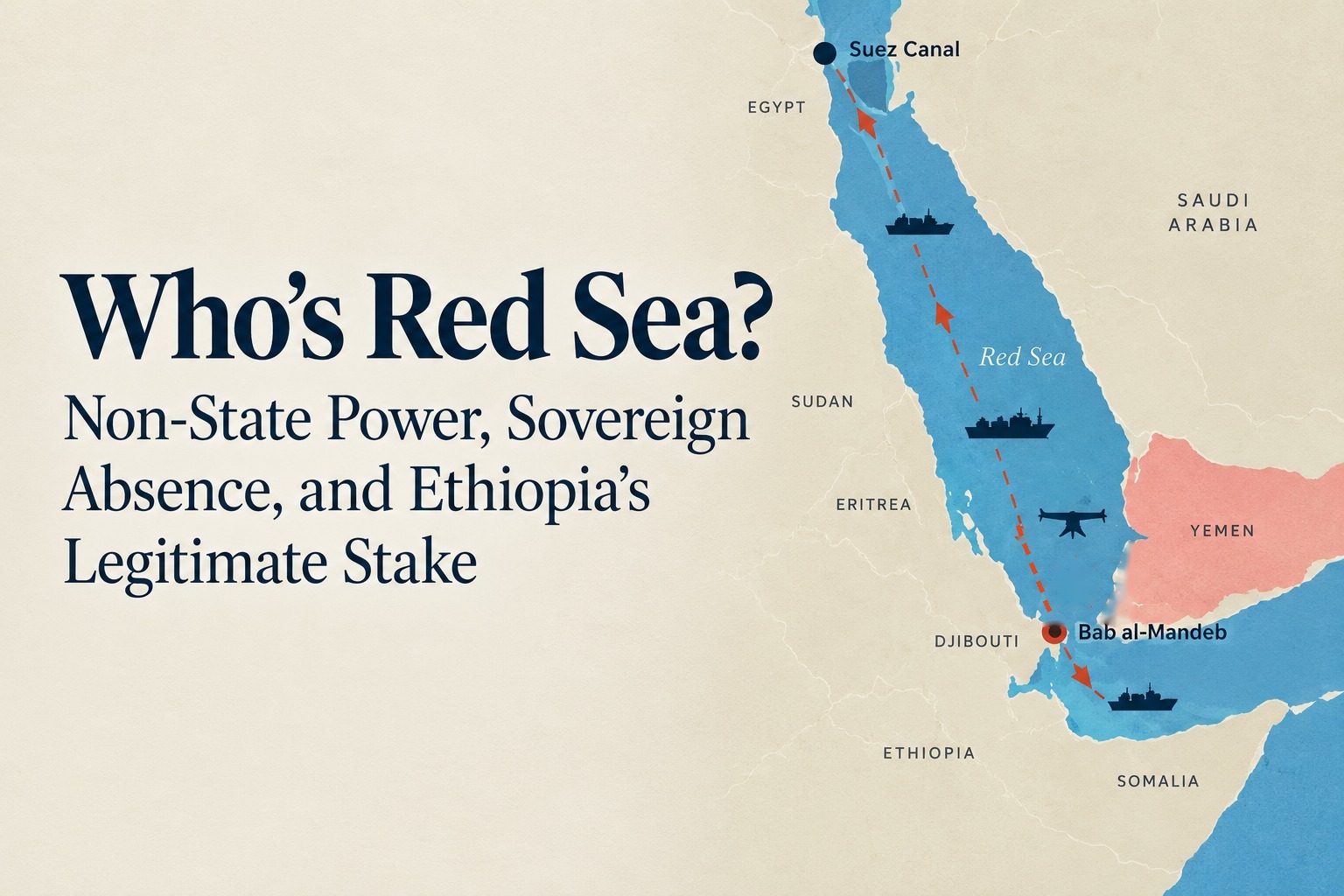
Ethiopia’s interest in the Red Sea should be understood through the interconnected questions of national survival, security, economic interest and political stability. This is not a new argument. What has changed is the regional environment surrounding it. Recent developments in the Red Sea, particularly the growing influence of the Houthis and other non-state armed actors, have made Ethiopia’s interest in the security of this strategic corridor even more consequential.
The central question is therefore not simply whether Ethiopia has an interest in the Red Sea, but how that interest should be framed. Ethiopia’s position should increasingly be viewed through the lens of regional security and its potential contribution to a more stable Red Sea order. Ethiopia’s population size, geographic position, economic dependence on maritime trade, military capacity and long experience in regional security give it a significant stake in what happens around the Red Sea. Instability in this corridor is not confined to coastal states. Disruption around the Red Sea and Bab el-Mandeb can affect supply chains, trade flows and economic stability far beyond the immediate coastline. For Ethiopia, whose international trade depends heavily on maritime corridors, this makes Red Sea stability a national economic and security interest.
The Rise of Non-State Armed Actors
A major transformation in the regional security environment is the growing ability of non-state armed actors to influence interstate and international security.The Houthis provide one of the clearest examples. What began as an armed movement operating primarily within Yemen has developed into an actor capable of influencing maritime security, threatening commercial shipping and projecting force beyond Yemen. Recent Houthi attacks against Saudi Arabia have included missiles and drones directed at Saudi cities and infrastructure.
The significance of the Houthi experience extends beyond Yemen itself. It demonstrates that a non-state armed actor can survive sustained pressure, challenge conventional states and eventually influence the security calculations of an entire region. This can have consequences for other conflicts. The concern for Ethiopia is that the perceived success of the Houthi model could embolden other non-state armed actors. Groups such as the TPLF, Al-shabab and other armed actors could potentially draw political or strategic lessons from the ability of a non-state actor to withstand state pressure and acquire greater leverage.
This does not mean that these Ethiopian actors currently possess Houthi-level capabilities, nor does it establish a direct relationship between them and the Houthis. The concern is instead one of precedent and emulation. When one non-state actor demonstrates that sustained armed pressure can generate regional influence and political leverage, other armed actors may interpret that experience as evidence that similar strategies can succeed elsewhere.
The risk is no longer entirely theoretical. The growing relationship between the Houthis and Al-Shabaab demonstrates how security problems originating on one side of the Red Sea can cross into the Horn of Africa. Cooperation between armed actors across Yemen and Somalia illustrates why Red Sea security and Horn of Africa security can no longer be treated as separate theatres. For Ethiopia, this makes the strengthening of non-state actors around the Red Sea a direct strategic concern.
Sovereign States Must Reclaim the Security Space
The appropriate response is stronger cooperation among sovereign states. Countries possessing substantial populations, functioning state institutions, military experience and the capacity to contribute to regional stability should have a greater role in shaping the security architecture of the Red Sea. Ethiopia belongs within this category.
Its role should not be defined solely by the fact that it currently lacks a Red Sea coastline. Security threats do not necessarily respect the distinction between littoral and non-littoral states. Economic disruption, proxy conflict, terrorism and instability can affect countries that are geographically and economically connected to the Red Sea regardless of whether they possess a coastline. Ethiopia should therefore increasingly position itself not simply as a country seeking maritime access, but as a country capable of contributing to regional security.
The Red Sea should consequently be treated as a shared strategic space. Instability there can produce consequences for the Horn of Africa, the Middle East and international commerce. Protecting that space requires cooperation among states that are genuinely exposed to its instability. Though Ethiopia and other regional sovereign states must reclaim the sovereign exercise of security on land and at sea, there are exceptions among states in the region—chief among them, Eritrea. The Eritrean dimension should therefore be examined from a different perspective.
Eritrea occupies an especially important position within this security environment because of its long Red Sea coastline and its proximity to Yemen. At the same time, Eritrea's strong ties to, and sustained commitment in supporting, armed and proxy actors require careful attention. One concern raised in the regional debate is that Eritrea is playing a double game: presenting itself as a sovereign state within the regional system, while simultaneously maintaining relationships with, hosting, training, or otherwise facilitating non-state armed actors—both previously and currently—including Al-Shabaab, the TPLF, and other insurgent groups.
A situation in which an armed non-state actor could establish logistical depth on the African side of the Red Sea—within the sovereign territory of Eritrea—would alter the security calculations of Ethiopia and other states in the Horn of Africa. In this regard, the changing U.S. sanctions environment adds another dimension. The United States recently terminated the national emergency established under Executive Order 14046, which had formed the basis of its Ethiopia-related sanctions program. As a consequence, entities and individuals previously designated under that program—including Eritrean entities—were removed from the sanctions list, despite continued allegations that Eritrea is engaged in destabilizing activity within the sovereign territory of other states.
The important policy question for Ethiopia, therefore, is not simply whether sanctions should or should not have been lifted. The larger question is what this change means for regional security. If external pressure on actors accused of destabilizing activities is reduced without corresponding monitoring, diplomatic engagement, or accountability mechanisms, there is a risk that the regional consequences of this shift will not receive sufficient attention.
Conversely, sanctions themselves should not be treated as an automatic solution. Any future restrictive measures must be tied to credible evidence and specific conduct.
Where credible evidence establishes that a state is providing territory, training, financing, weapons, logistical assistance, or other material support to armed actors that threaten regional security, targeted diplomatic and economic measures could form part of the international response. If weapons, personnel, logistical networks, or other military assets were found to be hosted or facilitated through Eritrean territory, this would represent a significant shift in the security environment of the western Red Sea. The guiding principle should therefore be one of conditional accountability: states that contribute to regional stability should be engaged constructively, while states proven to be enabling destabilizing armed actors should face proportionate consequences.
The Limits of Existing Security Pacts in the Red Sea Region
The current environment also raises questions about the effectiveness of existing security partnerships. Saudi Arabia, Türkiye and Pakistan have developed a trilateral defence arrangement. Yet the recent escalation involving the Houthis demonstrates that establishing a defence pact and translating that pact into coordinated action are not necessarily the same thing. This distinction matters for Ethiopia.
Security partnerships should not exist primarily because participating states share political relationships, religious identities or temporary diplomatic interests. They should be organized around identifiable common threats and the actual capacity and willingness of participating states to respond to them. When a crisis emerges, the states most directly affected by that crisis have the strongest incentive to act. This should guide Ethiopia’s approach to Red Sea security. Rather than seeking membership in arrangements whose interests do not fully correspond with Ethiopia’s security concerns, Addis Ababa should prioritize partnerships with countries that share concrete exposure to Red Sea instability.
Building a More Effective Red Sea Security Architecture
The policy response should therefore be the development of a stronger and more operational regional security framework.
This does not necessarily require creating an entirely new institution. IGAD already provides an institutional foundation through which Red Sea and Gulf of Aden security can be discussed. That framework could be strengthened and connected more effectively with relevant African and Middle Eastern partners.
Most importantly, participation should not be determined exclusively by whether a country possesses a Red Sea coastline.
A more functional approach would consider three factors: how directly a country is affected by instability in the Red Sea, what capabilities it can contribute to regional stability, and whether it is prepared to cooperate against common security threats. Under such criteria, Ethiopia has a strong case for meaningful participation.
Ethiopia should therefore deepen security coordination with directly affected Horn states, particularly Djibouti, Somalia and Kenya, while strengthening engagement with relevant Middle Eastern partners, including Saudi Arabia, UAE, and Israel and others. The objective should be practical cooperation rather than another symbolic political forum. This should include intelligence sharing, monitoring of cross-border armed networks, counterterrorism cooperation, border security, maritime-security coordination and mechanisms for identifying external support to armed groups.Regional states should also develop common mechanisms for responding when non-state actors begin operating across national boundaries or receive support from external sponsors.
Policy Recommendation
Ethiopia should advocate a strengthened Red Sea security architecture that recognizes the connection between security in the Arabian Peninsula and security in the Horn of Africa.
The first objective should be prevention. The Houthi experience should not become a precedent that emboldens other non-state armed actors across the Horn. Ethiopia and its partners should therefore strengthen intelligence cooperation and early-warning mechanisms capable of identifying emerging relationships among armed groups before those relationships become entrenched regional security threats.
Second, Ethiopia should advocate security arrangements based on actual common interests rather than exclusively on geography, political alignment or religious orientation. States directly exposed to Red Sea instability and states capable of contributing meaningfully to regional security should be brought into the same framework.
Third, Ethiopia should work through IGAD, the African Union and complementary partnerships with Middle Eastern states to strengthen coordination between the two sides of the Red Sea. The security of Yemen, Somalia, Djibouti, Ethiopia and the wider Red Sea cannot be addressed through isolated national strategies.
Fourth, State sponsorship, training, financing, territorial facilitation or other material assistance to armed groups, regional and international institutions should have mechanisms for accountability, including targeted measures where appropriate and follow an offensive diplomacy.
The strategic logic is straightforward: the rise of powerful non-state actors has blurred the boundary between domestic conflict and regional security. The Houthi experience demonstrates how an armed movement can evolve into a challenge affecting states, maritime commerce and wider regional stability. Ethiopia therefore has an interest in ensuring that this model does not embolden other armed actors in the Horn and that sovereign states not armed proxies remain the principal architects of the region’s security order.
By Gizachew Asrat (PhD), Horn of Africa Analyst and Senior Researcher, IFA
Disclaimer
The content disseminated by the Institute of Foreign Affairs (IFA) – including, but not limited to, publications, public statements, events, media appearances, and digital communications – reflects the views of individual contributors and does not necessarily represent the official positions or policies of the Institute, its partners, or any affiliated governmental or non-governmental entities.
While the IFA endeavours to ensure the accuracy, integrity, and timeliness of the information presented, it makes no representations or warranties, express or implied, regarding the completeness, reliability, or suitability of such content for any purpose. The Institute expressly disclaims any liability for errors or omissions, as well as for any actions taken or decisions made based on the information provided.
The inclusion of external links, references, or third-party resources does not constitute an endorsement by the Institute. Additionally, engagement on social media platforms – including, but not limited to, likes, shares, retweets (RTs), or reposts – shall not be interpreted as an endorsement or validation of the views expressed therein.
Readers and audiences are encouraged to exercise critical judgement and seek independent verification when interpreting or relying upon any information disseminated through publications and posts on the Institute’s platforms or representatives.