
A Strategic Vulnerability, Not Simply a Maritime Ambition
When Geography Turns Hostile
A Case Against Urgency
Conclusion
Notes
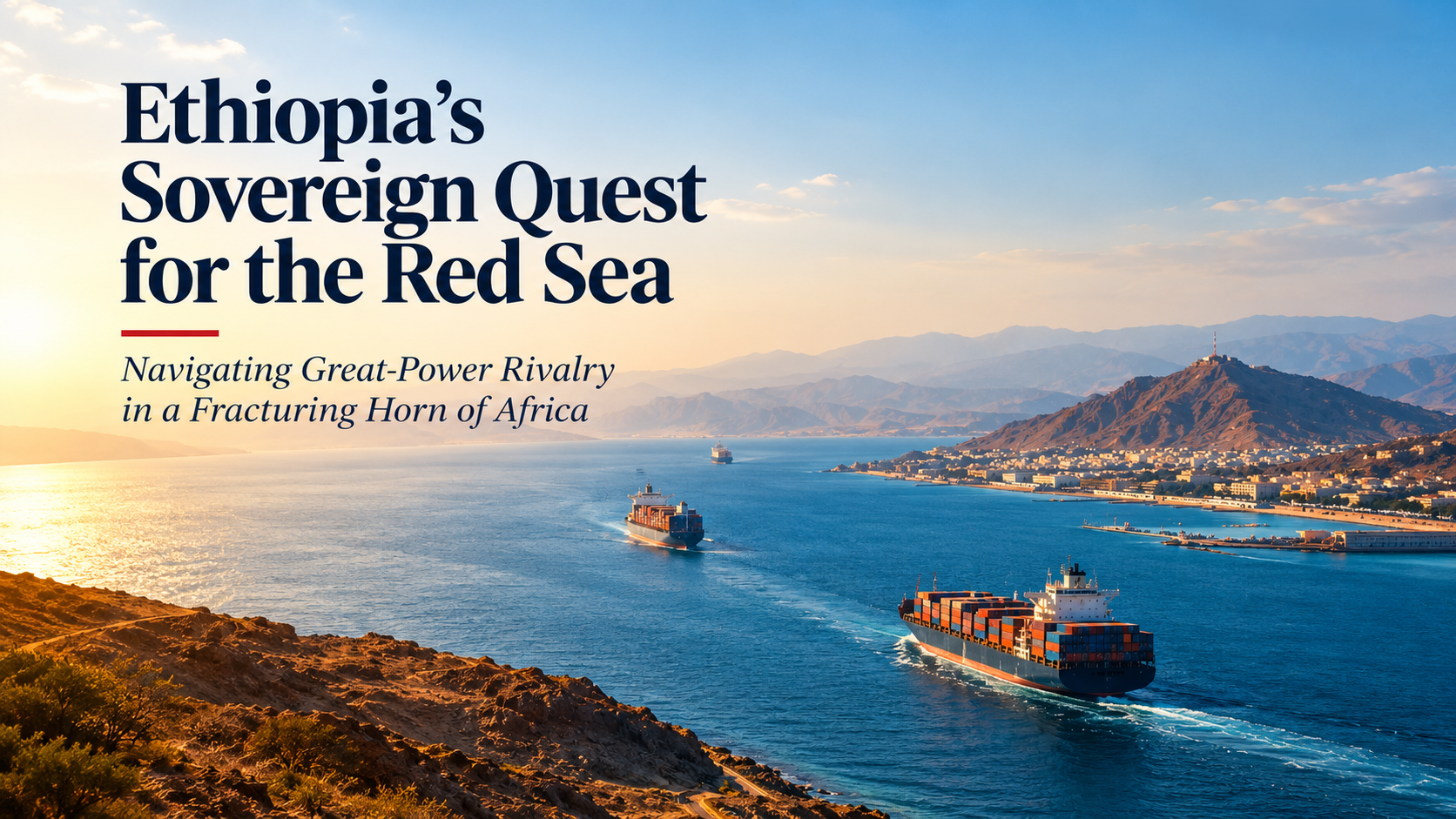
Ethiopia’s pursuit of reliable access to the Red Sea is often framed as a historical claim revived by the loss of its coastal access after Eritrea’s independence in 1993. That history matters, but it does not fully explain the urgency of the issue in 2026. Renewed insecurity in the Red Sea and Gulf of Aden, combined with wider conflict around the Strait of Hormuz and intensified external engagement along the Somali coast, has exposed how quickly maritime disruption can become an economic problem for a landlocked state. Ethiopia is therefore confronting a structural question: how can it reduce the transmission of external maritime shocks into its domestic economy while preserving regional stability and respecting the sovereignty of neighboring states?
The Captive Corridor
This article uses the term “captive corridor” to describe a condition in which a state’s external trade is heavily concentrated in a transit route it does not control and therefore cannot independently secure. Ethiopia’s dependence on Djibouti is substantial. World Bank assessments have described the Djibouti corridor as carrying more than 90 percent of Ethiopia’s international trade by volume, with an earlier assessment placing the figure above 95 percent. Djibouti is therefore not merely one port option among many; it is the principal maritime gateway for Ethiopia’s overseas trade. This concentration creates efficiency and commercial interdependence, but it also creates exposure. A disruption in the Red Sea–Gulf of Aden system can raise freight, insurance and energy costs even when the disruption occurs outside Ethiopian territory.
The geography is especially consequential because the Bab el-Mandeb links the Red Sea to the Gulf of Aden and the wider Indian Ocean. U.S. Energy Information Administration data show that Bab el-Mandeb carried about 4.2 million barrels per day of crude oil and petroleum products in the first half of 2025, after significantly higher flows in earlier years. The route remains a strategic chokepoint even as security disruptions have changed shipping patterns. Ethiopia’s landlocked position therefore converts maritime insecurity into a logistics and macroeconomic issue rather than a purely naval one.
When Geography Turns Hostile
The security environment in 2026 illustrates the problem. The International Maritime Organization reported 24 actual or attempted piracy and armed-robbery incidents in the Red Sea and Gulf of Aden region during the three months preceding July, and in August it reported that six vessels were being held by pirates or armed robbers, with more than 90 seafarers in captivity. The IMO has consequently called for renewed international action and regional cooperation. These figures do not establish that the maritime security situation will deteriorate indefinitely, but they do demonstrate that piracy and armed robbery have re-emerged as material risks.
At the same time, attacks on commercial shipping linked to the wider Middle East conflict have continued to affect the Red Sea. The IMO has warned that renewed attacks threaten shipping, supply chains and freedom of navigation. The broader conflict around the Strait of Hormuz has added another layer of uncertainty to energy markets and maritime traffic. For Ethiopia, the significance lies less in any single incident than in the cumulative effect: a concentrated trade corridor is exposed to disruptions generated by conflicts and security pressures beyond Ethiopia’s direct control.
Competing External Engagements around Somaliland and Somalia
The maritime environment is also being reshaped by new diplomatic and security relationships. Israel formally recognized Somaliland in December 2025, prompting opposition from Somalia and concern from several regional and international actors. By June 2026, Reuters reported that Israel was providing training to Somaliland security forces, while Somaliland’s defence minister denied that there were talks or plans for an Israeli military base. The distinction is important: reports of possible strategic or military facilities should not be treated as established fact without official confirmation.
Turkey’s role presents a different but equally important dimension. Ankara has maintained extensive security and economic ties with Somalia, while supporting the Somali federal government’s territorial integrity. These parallel engagements do not necessarily amount to a zero-sum Israeli-Turkish contest, but they contribute to a more crowded strategic environment around the Gulf of Aden. For Ethiopia, the central concern is that external competition should not narrow the diplomatic space for negotiated arrangements governing maritime access and regional security.
A Case Against Urgency
A skeptical interpretation remains valid. Piracy can recede when international naval coordination improves, while the intensity of the current Middle East conflict may change. Treating every maritime disruption as evidence that Ethiopia must immediately secure sovereign coastal territory could also conflate separate security, commercial and diplomatic questions. Moreover, the December 2024 Ankara Declaration provides a negotiated framework that explicitly recognizes Ethiopia’s interest in assured access to and from the sea while reaffirming Somalia’s sovereignty, unity and territorial integrity.
The Declaration is significant because it points toward a possible middle ground between Ethiopia’s need for reliable maritime access and Somalia’s sovereignty concerns. It calls for mutually advantageous commercial arrangements—including contracts and leases—under Somali sovereign authority, with technical negotiations to be facilitated by Türkiye. The practical challenge is implementation. The existence of an agreed framework does not by itself guarantee infrastructure, security, commercial viability or political durability. The policy task is therefore to turn the framework into an operational arrangement while keeping dialogue at the center.
Turning Exposure into Leverage
Ethiopia’s strategic objective should be to reduce concentrated corridor dependence without turning maritime access into a source of regional confrontation. Several policy implications follow.
First, Addis Ababa should prioritize implementation of the Ankara Declaration. Technical negotiations should be translated into a sequenced framework covering infrastructure, commercial terms, security arrangements, investment responsibilities and dispute-resolution mechanisms. A clearly defined timetable would help convert political understanding into a durable economic instrument.
Second, Ethiopia should pursue diversification while negotiations continue. Expanding the use of alternative regional logistics facilities and improving multimodal connections would not replace the Djibouti corridor or eliminate the need for a durable sea-access arrangement. It would, however, reduce the degree to which a single route determines Ethiopia’s exposure to external shocks.
Third, Ethiopia should support regional maritime cooperation through the African Union, IGAD and the International Maritime Organization. The IMO’s August–September 2026 emphasis on cooperation among Ethiopia, Djibouti, Somalia, Sudan, Yemen and international partners provides a practical platform for information-sharing, maritime law enforcement and coordinated risk reduction. Ethiopia has a direct interest in contributing to the security of waters on which its trade depends, even without a coastline.
Fourth, Addis Ababa should maintain diplomatic balance as external actors expand their engagement around Somaliland and Somalia. Ethiopia’s interest is best served by avoiding alignment with competing blocs and by supporting arrangements that preserve dialogue, territorial integrity and freedom of navigation. A stable regional maritime order increases the value of any Ethiopian access arrangement; a fragmented one reduces it.
Conclusion
Ethiopia’s Red Sea question is ultimately about resilience. Historical ties to the coast explain part of the national debate, but the more immediate issue is the vulnerability created by concentrated dependence on a maritime corridor exposed to regional conflict and insecurity. The Ankara Declaration offers a framework for addressing that vulnerability without abandoning the principles of sovereignty and territorial integrity. The strategic objective should therefore be neither maximalist territorial ambition nor passive dependence, but reliable, diversified and institutionally protected access to international maritime trade. The “captive corridor” can become a governed corridor only when Ethiopia combines negotiated sea access, logistics diversification and regional maritime cooperation. That is the more sustainable route from exposure to strategic resilience.
Notes
International Maritime Organization (IMO), “IMO Secretary-General Calls for Urgent Release of 44 Seafarers Held by Pirates,” July 6, 2026.
International Maritime Organization (IMO), “IMO Calls for Urgent Action as Piracy Resumes in the Gulf of Aden,” August 24, 2026.
International Maritime Organization (IMO), “Regional Cooperation Key to Maritime Security in the Red Sea and Gulf of Aden,” September 3, 2026.
World Bank, “Ethiopia: Second Growth and Competitiveness Programmatic Development Policy Financing,” describing the Ethiopia–Djibouti corridor as Ethiopia’s main trade route and reporting that it carries more than 95 percent of international trade traffic by volume.
World Bank, “Ethiopia Damage and Needs Assessment,” reporting that Djibouti handles more than 90 percent of Ethiopia’s international trade by volume.
U.S. Energy Information Administration, “International: World Oil Transit Chokepoints,” updated March 3, 2026.
U.S. Energy Information Administration, “Red Sea Chokepoints Are Critical for International Oil and Natural Gas Flows,” December 4, 2023.
Reuters, “Israel Becomes First Country to Formally Recognise Somaliland as Independent State,” December 26, 2025.
Reuters, “Somaliland Receiving Israeli Military Training but Not in Talks for Base, Minister Says,” June 17, 2026.
Republic of Türkiye, Ministry of Foreign Affairs, “Ankara Declaration by the Federal Democratic Republic of Ethiopia and the Federal Republic of Somalia Facilitated by the Republic of Türkiye,” December 11, 2024.
Reuters, reporting on the continuing 2026 conflict affecting the Strait of Hormuz and Red Sea shipping, September 2026. The discussion of wider regional effects should be understood as a time-specific assessment rather than a prediction about the conflict’s duration.
By Kuchim Sileshi, IFA
Disclaimer
International Maritime Organization (IMO), “IMO Calls for Urgent Action as Piracy Resumes in the Gulf of Aden,” August 24, 2026.
International Maritime Organization (IMO), “Regional Cooperation Key to Maritime Security in the Red Sea and Gulf of Aden,” September 3, 2026.
World Bank, “Ethiopia: Second Growth and Competitiveness Programmatic Development Policy Financing,” describing the Ethiopia–Djibouti corridor as Ethiopia’s main trade route and reporting that it carries more than 95 percent of international trade traffic by volume.
World Bank, “Ethiopia Damage and Needs Assessment,” reporting that Djibouti handles more than 90 percent of Ethiopia’s international trade by volume.
U.S. Energy Information Administration, “International: World Oil Transit Chokepoints,” updated March 3, 2026.
U.S. Energy Information Administration, “Red Sea Chokepoints Are Critical for International Oil and Natural Gas Flows,” December 4, 2023.
Reuters, “Israel Becomes First Country to Formally Recognise Somaliland as Independent State,” December 26, 2025.
Reuters, “Somaliland Receiving Israeli Military Training but Not in Talks for Base, Minister Says,” June 17, 2026.
Republic of Türkiye, Ministry of Foreign Affairs, “Ankara Declaration by the Federal Democratic Republic of Ethiopia and the Federal Republic of Somalia Facilitated by the Republic of Türkiye,” December 11, 2024.
Reuters, reporting on the continuing 2026 conflict affecting the Strait of Hormuz and Red Sea shipping, September 2026. The discussion of wider regional effects should be understood as a time-specific assessment rather than a prediction about the conflict’s duration.
By Kuchim Sileshi, IFA
Disclaimer
The content disseminated by the Institute of Foreign Affairs (IFA) – including, but not limited to, publications, public statements, events, media appearances, and digital communications – reflects the views of individual contributors and does not necessarily represent the official positions or policies of the Institute, its partners, or any affiliated governmental or non-governmental entities.
While the IFA endeavours to ensure the accuracy, integrity, and timeliness of the information presented, it makes no representations or warranties, express or implied, regarding the completeness, reliability, or suitability of such content for any purpose. The Institute expressly disclaims any liability for errors or omissions, as well as for any actions taken or decisions made based on the information provided.
The inclusion of external links, references, or third-party resources does not constitute an endorsement by the Institute. Additionally, engagement on social media platforms – including, but not limited to, likes, shares, retweets (RTs), or reposts – shall not be interpreted as an endorsement or validation of the views expressed therein.
Readers and audiences are encouraged to exercise critical judgement and seek independent verification when interpreting or relying upon any information disseminated through publications and posts on the Institute’s platforms or representatives.