
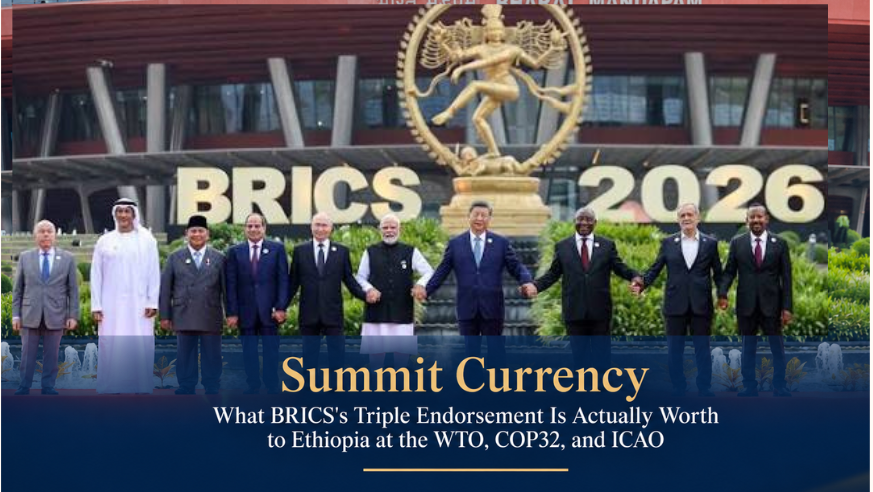
The 18th BRICS Summit in New Delhi on 12–13 September 2026 gave Ethiopia a notable diplomatic dividend. The New Delhi Declaration expressed strong support for Ethiopia’s accession to the World Trade Organization (WTO), welcomed Ethiopia’s candidacy for an additional seat on the International Civil Aviation Organization (ICAO) Council, and supported Ethiopia’s role as host and presidency country for the 2027 UN climate conference, COP32.¹ Taken together, these references signal meaningful political support. But they do not carry the same institutional weight. Each process is governed by different rules, different constituencies and different decision points. The strategic question for Addis Ababa is therefore not whether BRICS support matters—it does—but how effectively Ethiopia can convert that support into outcomes.
Three Endorsements, Three Decision Paths
Where BRICS Ties Already Have Practical Value
A Case for Taking the Declaration Seriously
Spending the Currency
Ethiopia’s Strategic Stakes
Conclusion
By Fiker Tadesse, IFA
Disclaimer
The Summit Currency
Summit currency is the diplomatic value created when a state is collectively endorsed and named in a multilateral declaration, and then uses that endorsement to build support in institutions where the endorsing group does not control the final decision. The New Delhi Declaration gives Ethiopia real diplomatic currency. The eleven-member BRICS grouping represents a substantial share of global population and economic output, and its written support can raise Ethiopia’s visibility among governments that will ultimately decide or influence the relevant institutional outcomes.² Yet currency must still be spent. A declaration cannot itself complete WTO accession, determine COP32 implementation, or deliver an ICAO Council election.
Three Endorsements, Three Decision Paths
First, WTO accession. Ethiopia applied for WTO membership in 2003. Its accession negotiations remain active, with the seventh Working Party meeting held on 22–23 April 2026. WTO members welcomed recent reform measures while calling for continued work on outstanding questions and bilateral market-access negotiations.³ BRICS support strengthens Ethiopia’s diplomatic position, including in bilateral engagement with WTO members, but it does not replace the technical and negotiating work required under the WTO accession process. The appropriate policy response is to use the BRICS endorsement as leverage while continuing to close the remaining negotiating gaps.
Second, COP32. The UNFCCC has accepted Ethiopia’s offer to host COP32 in Addis Ababa from 8 to 19 November 2027.⁴ The New Delhi Declaration therefore adds political support to an outcome that has already advanced within the UNFCCC process. The remaining strategic task is implementation: host-country preparations, African coordination, international mobilization and the diplomatic work required to make the conference a credible platform for African climate priorities. BRICS support can reinforce that effort, but it should complement rather than substitute for African and UNFCCC engagement.
Third, ICAO. This is the most directly electoral of the three processes. The 2016 amendment to the Chicago Convention expanding the ICAO Council by four seats entered into force in June 2026. The additional seats will be addressed at the extraordinary 43rd ICAO Assembly scheduled for 19–20 November 2026.⁵ The BRICS declaration welcomes Ethiopia’s candidacy, which has also been endorsed by the African Union as the sole African candidate for the additional seat.¹ Nevertheless, the election will be conducted through the ICAO Assembly process. Ethiopia therefore needs broad support across the membership rather than an assumption that BRICS endorsement translates automatically into votes.
Where BRICS Ties Already Have Practical Value
The more immediate economic value of Ethiopia’s BRICS relationships lies in channels that operate outside multilateral elections. China remains a major source of Ethiopian trade, investment and contracted infrastructure. Chinese Ministry of Commerce data put bilateral trade at $3.55 billion in 2024, with Chinese exports of $3.14 billion and imports from Ethiopia of $410 million.⁶ The figures illustrate both the scale of the relationship and its imbalance. Ethiopia’s policy objective should therefore be to convert economic proximity into greater productive capacity, export diversification and reciprocal trade.
The New Development Bank (NDB) is another practical channel, but its status should be described precisely. NDB lists Ethiopia among its prospective members: Ethiopia has been admitted by the Bank’s Board of Governors but becomes a full member after depositing its instrument of accession.⁷ This distinction matters. Membership is not the end of the process; its value will depend on whether Ethiopia can use the institution to finance infrastructure, productive investment and other projects that support structural transformation.
A Case for Taking the Declaration Seriously
A more generous reading of the New Delhi Declaration is warranted. Collective written support from eleven governments is more politically useful than isolated expressions of sympathy. It can shape diplomatic conversations, strengthen Ethiopia’s bargaining position and signal that Ethiopia’s institutional ambitions have a wider constituency. In processes where political persuasion matters, visible coalition support can affect the calculations of undecided states. The declaration also reinforces Ethiopia’s broader engagement with emerging powers and can strengthen the credibility of its external economic diplomacy.
But usefulness is not the same as control. The decisive test is whether Ethiopia converts political support into institutional results through the procedures of each organization. That requires sustained bilateral diplomacy, technical preparation and disciplined vote-building—not reliance on the declaration alone.
Spending the Currency
First, use the WTO endorsement as negotiating leverage.
Second, connect BRICS support for COP32 to African coordination and UNFCCC implementation, ensuring that the diplomatic dividend contributes to a successful Addis Ababa conference.
Third, treat the ICAO candidacy as a full-Assembly campaign. BRICS support should be used as a foundation for wider engagement, not counted as a predetermined bloc of votes.
Fourth, complete the remaining NDB accession requirements and identify financing opportunities that strengthen productive capacity, export competitiveness and infrastructure.
Fifth, build a measurable conversion strategy. For each major endorsement, Addis Ababa should identify the institutions, governments and procedural milestones through which diplomatic support must be translated into an outcome.
Ethiopia’s Strategic Stakes
The broader significance of the New Delhi Declaration lies in what it says about Ethiopia’s external positioning. Ethiopia is seeking influence across trade, climate governance, aviation and development finance at the same time. Success will depend less on the number of declarations that mention Ethiopia than on the country’s capacity to connect diplomatic support with institutional processes and domestic economic priorities. The objective should be conversion: turning political recognition into market access, institutional representation, financing and implementation capacity.
Conclusion
The New Delhi Declaration has given Ethiopia something valuable: diplomatic currency. Its worth is real, but its value is realized only when it is exchanged for outcomes. WTO accession still requires negotiation; COP32 requires disciplined implementation and broad international coordination; and the ICAO candidacy requires support across the wider Assembly. The strategic task for Addis Ababa is therefore straightforward in principle, even if demanding in execution: spend the currency carefully. The measure of the summit will ultimately be not how often Ethiopia was named, but what Ethiopia was able to convert those endorsements into.
Notes
1. Government of India, Prime Minister’s Office, “BRICS New Delhi Declaration: Building for Resilience, Innovation, Cooperation and Sustainability,” September 12, 2026.
2. Government of India, Prime Minister’s Office, “BRICS New Delhi Declaration,” September 12, 2026. The declaration records BRICS support for Ethiopia’s WTO accession and welcomes Ethiopia’s ICAO candidacy; BRICS public materials describe the grouping as comprising eleven members.
3. World Trade Organization, “Ethiopia Steps Up Domestic Reforms to Advance WTO Accession Negotiations,” April 22, 2026.
4. United Nations Framework Convention on Climate Change, “Dates and Venues of Future Sessions,” COP30 document 2(g), 2025; the document accepts Ethiopia’s offer to host COP32 in Addis Ababa from November 8–19, 2027.
5. International Civil Aviation Organization, “ICAO Assembly—43rd Session (Extraordinary),” registration and event information, November 19–20, 2026. The 2016 amendment to Article 50(a) expanded the Council by four seats; the New Delhi Declaration records support for Ethiopia’s candidacy.
6. Ministry of Commerce of the People’s Republic of China, “China–Ethiopia Economic and Trade Cooperation,” September 11, 2025, reporting 2024 bilateral trade of US$3.55 billion, including Chinese exports of US$3.14 billion and imports of US$410 million.
7. New Development Bank, “Members,” accessed September 18, 2026. The NDB lists Ethiopia as a prospective member and states that prospective members become members after depositing their instruments of accession.
By Fiker Tadesse, IFA
Disclaimer
The content disseminated by the Institute of Foreign Affairs (IFA) – including, but not limited to, publications, public statements, events, media appearances, and digital communications – reflects the views of individual contributors and does not necessarily represent the official positions or policies of the Institute, its partners, or any affiliated governmental or non-governmental entities.
While the IFA endeavours to ensure the accuracy, integrity, and timeliness of the information presented, it makes no representations or warranties, express or implied, regarding the completeness, reliability, or suitability of such content for any purpose. The Institute expressly disclaims any liability for errors or omissions, as well as for any actions taken or decisions made based on the information provided.
The inclusion of external links, references, or third-party resources does not constitute an endorsement by the Institute. Additionally, engagement on social media platforms – including, but not limited to, likes, shares, retweets (RTs), or reposts – shall not be interpreted as an endorsement or validation of the views expressed therein.
Readers and audiences are encouraged to exercise critical judgement and seek independent verification when interpreting or relying upon any information disseminated through publications and posts on the Institute’s platforms or representatives.