
A Relationship Moving Beyond History
Nuclear Cooperation as a Test of Strategic Delivery
Disclaimer
The content disseminated by the Institute of Foreign Affairs (IFA) – including, but not limited to, publications, public statements, events, media appearances, and digital communications – reflects the views of individual contributors and does not necessarily represent the official positions or policies of the Institute, its partners, or any affiliated governmental or non-governmental entities.
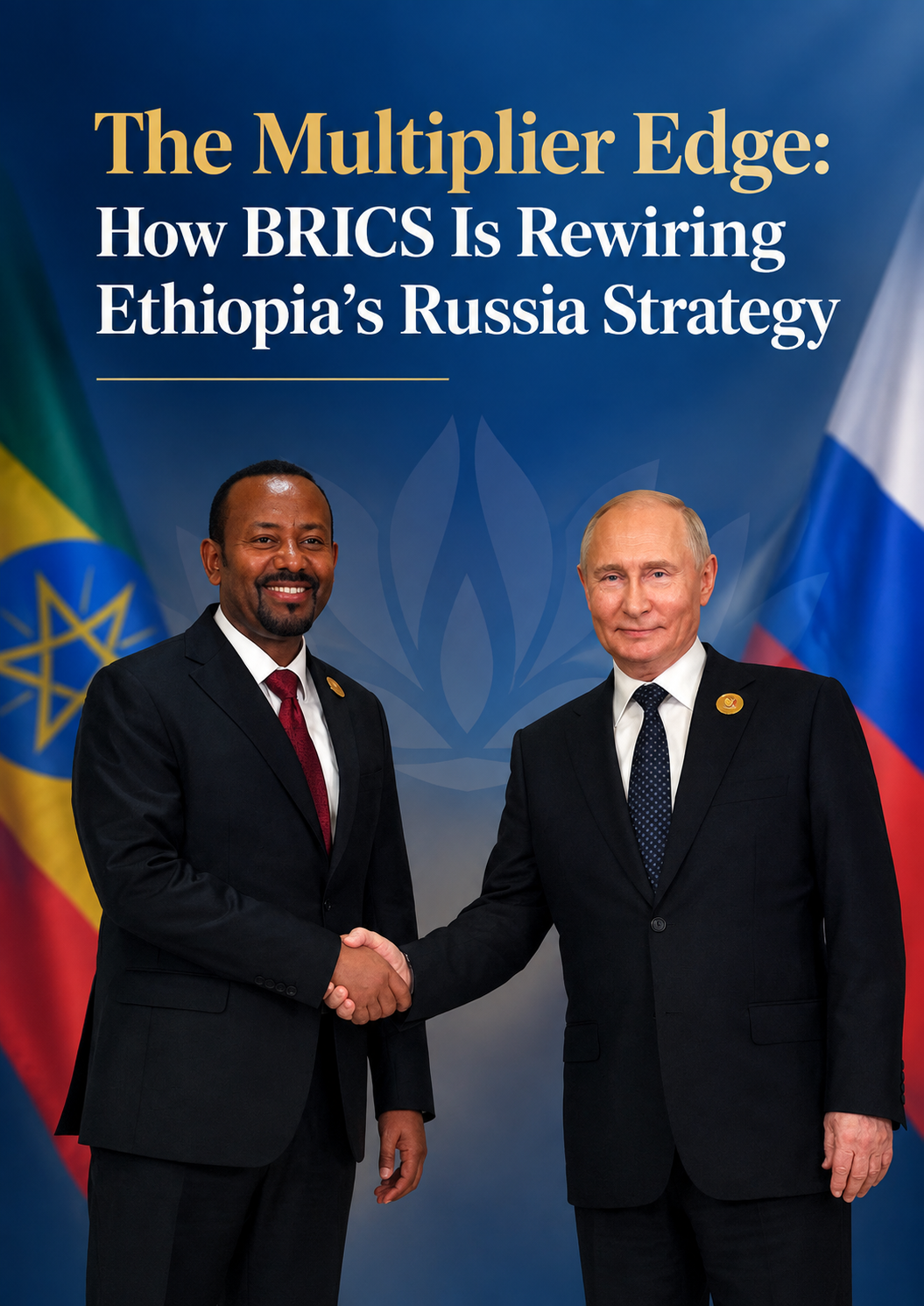
When Russian President Vladimir Putin told Prime Minister Abiy Ahmed in New Delhi that the two had “discussed almost everything” while travelling to the BRICS summit venue, the remark captured the breadth of a relationship that is becoming increasingly institutionalized. Ethiopia and Russia have emphasized diplomatic ties dating to 1898, and recent exchanges have added new momentum across trade, investment, education, technology and other areas of cooperation. Ethiopia’s full entry into BRICS on January 1, 2024, has added another channel through which bilateral interests can be connected to wider questions of economic cooperation and global governance.
The significance of this shift should be understood in practical rather than bloc terms. BRICS does not replace bilateral diplomacy, nor does membership require Ethiopia to align exclusively with any single power. Its value for Addis Ababa is that it creates an additional platform through which Ethiopia can pursue national priorities while maintaining a diversified network of international partnerships. The strategic question is therefore how effectively Ethiopia can convert expanded diplomatic access into trade, investment, technology, skills and development gains while preserving policy flexibility.
BRICS as an Institutional Multiplier
The September 12, 2026 meeting between Prime Minister Abiy and President Putin on the sidelines of the 18th BRICS Summit illustrates this expanding architecture. According to Ethiopian reporting, the leaders discussed strengthening the strategic partnership, including defense and security, trade and investment, education, technology, climate and development cooperation. President Putin also highlighted the rapid growth of bilateral trade, noting that trade turnover had more than tripled in 2025, and invited Prime Minister Abiy to the third Russia–Africa Summit in Moscow on October 28–29.
The meeting followed Russian Foreign Minister Sergey Lavrov’s July 2026 visit to Addis Ababa, during which Ethiopian and Russian officials discussed strengthening trade, investment and technology transfer and emphasized closer cooperation through BRICS and other multilateral diplomatic platforms.³ The importance of these exchanges lies not simply in their frequency but in the widening institutional channels through which Ethiopia and Russia can coordinate.
BRICS should therefore be understood as an institutional multiplier rather than a substitute for bilateralism. Direct mechanisms remain important, including the intergovernmental economic, scientific and technical commission, educational exchanges and nuclear-energy cooperation. BRICS adds a wider platform for coordination and high-level access. Its value, however, will ultimately depend on what Ethiopia can negotiate, implement and measure.
For Addis Ababa, this creates an opportunity to widen its options without turning diversification into dependence on a new partner. Ethiopia can pursue cooperation with Russia where Russian capabilities correspond to Ethiopian priorities while continuing productive engagement with China, India, Western partners, African institutions and multilateral financial institutions. The objective is not bloc alignment; it is expanded strategic choice.
Nuclear Cooperation as a Test of Strategic Delivery
Nuclear cooperation provides a concrete test of whether diplomatic momentum can be converted into long-term national capability. Ethiopia and Russia signed a nuclear cooperation agreement in September 2025, and on March 31, 2026, the Ethiopian Nuclear Energy Commission and Rosatom signed a Strategic Roadmap for Nuclear Energy Development. Ethiopian officials described the roadmap as a framework for practical cooperation and peaceful nuclear-energy development.
For Ethiopia, the significance of this cooperation will depend on implementation. Large-scale nuclear projects require careful consideration of financing, regulatory preparedness, construction capacity, human-resource development, technology transfer and long-term operating arrangements. The central policy question is therefore not simply whether external financing or technology is available, but whether future agreements strengthen Ethiopia’s energy security and domestic technical capabilities on sustainable terms.
The same principle should apply to other major economic and technology agreements. Financing structures, implementation schedules, skills transfer and measurable domestic value should be established clearly at the negotiation stage. This approach does not diminish the strategic importance of cooperation with Russia; it provides a framework for ensuring that cooperation produces durable Ethiopian capability.
Trade offers another test. President Putin’s statement that bilateral trade more than tripled in 2025 signals significant momentum. Russian official reporting separately stated that 2025 trade exceeded $435 million and identified fertilizers, agricultural machinery and energy equipment among Russian exports, while Ethiopian exports included coffee, flowers and textiles.⁵ The next objective should be to consolidate this momentum through greater export diversification, productive investment, technology partnerships and stronger participation by Ethiopian businesses.
Strategic Autonomy and the Implementation Test
BRICS also gives Ethiopia a platform to participate alongside major emerging economies in discussions on international institutional reform, development finance and a more representative global system. Prime Minister Abiy’s September 2026 BRICS message emphasized the potential to combine capital, technology and markets to create greater value from resources and economic opportunities.⁶ This framing is particularly relevant to Ethiopia’s development priorities.
At the same time, cooperation within BRICS does not require identical foreign-policy positions among its members. Ethiopia’s interests remain broader than any single partnership. Strategic autonomy is strengthened when Ethiopia has multiple credible options and can engage different partners according to sector-specific national priorities. Diversification is most valuable when it expands Ethiopia’s policy and economic room for manoeuvre.
The next phase of Ethiopia–Russia relations should therefore be judged increasingly by implementation. High-level diplomacy is most consequential when it produces bankable investment, sustainable financing, technology and skills transfer, market access, educational opportunities and practical institutional cooperation. Agreements should be accompanied by clear benchmarks covering financing terms, implementation timelines, domestic capacity created and measurable economic or institutional outcomes.
As Ethiopia prepares for the Russia–Africa Summit in Moscow, the central opportunity is to translate diplomatic momentum into practical gains. BRICS can strengthen Ethiopia–Russia relations, but its deeper value for Addis Ababa lies in expanding strategic choice. The objective is not simply to deepen a historic partnership; it is to convert that partnership and the opportunities created by BRICS into national capability, economic opportunity and greater freedom of action. In this sense, BRICS can serve as an institutional multiplier—expanding Ethiopia’s options while keeping national development priorities at the center of engagement.
Notes
1. BRICS, “2023 BRICS Ministers of Foreign Affairs Joint Statement,” official BRICS document, confirming the decision for Ethiopia to become a full member from January 1, 2024; see also President of Russia, “Conversation with Prime Minister of Ethiopia Abiy Ahmed,” September 12, 2026, which confirms Ethiopia’s full membership from that date.
2. Ethiopian News Agency (ENA), “PM Abiy, President Putin Hold Constructive Discussion about Strengthening Strategic Partnership,” September 12, 2026; President of Russia, “Conversation with Prime Minister of Ethiopia Abiy Ahmed,” September 12, 2026. President Putin stated that bilateral trade had more than tripled in 2025 and that the third Russia–Africa Summit would be held in Moscow on October 28–29, 2026.
3. Ethiopian News Agency, “Ethiopia, Russia Foreign Ministers Hold Talks,” July 7, 2026; and ENA, “PM Abiy Holds High-Level Talks with Russian FM Lavrov on Strategic Cooperation,” July 7, 2026.
4. Ethiopian News Agency, “Ethiopia, Russia Cement Nuclear Energy Cooperation with New Strategic Roadmap,” April 1, 2026. ENA reports that the Ethiopian Nuclear Energy Commission and Rosatom signed the Strategic Roadmap on March 31, 2026, following the nuclear cooperation agreement signed in September 2025.
5. Russian Ministry of Foreign Affairs, official statement on Russia–Ethiopia relations, 2026, reporting that bilateral trade in 2025 exceeded US$435 million and identifying major categories of Russian and Ethiopian exports. President of Russia, “Conversation with Prime Minister of Ethiopia Abiy Ahmed,” September 12, 2026, separately reported that trade had more than tripled in 2025.
6. Ethiopian News Agency, “BRICS Can Turn Cooperation into Shared Value, Resilience and Sustainable Growth, Says PM Abiy,” September 12, 2026.
By Amen Biniyam, IFA
Disclaimer
The content disseminated by the Institute of Foreign Affairs (IFA) – including, but not limited to, publications, public statements, events, media appearances, and digital communications – reflects the views of individual contributors and does not necessarily represent the official positions or policies of the Institute, its partners, or any affiliated governmental or non-governmental entities.
While the IFA endeavours to ensure the accuracy, integrity, and timeliness of the information presented, it makes no representations or warranties, express or implied, regarding the completeness, reliability, or suitability of such content for any purpose. The Institute expressly disclaims any liability for errors or omissions, as well as for any actions taken or decisions made based on the information provided.
The inclusion of external links, references, or third-party resources does not constitute an endorsement by the Institute. Additionally, engagement on social media platforms – including, but not limited to, likes, shares, retweets (RTs), or reposts – shall not be interpreted as an endorsement or validation of the views expressed therein.
Readers and audiences are encouraged to exercise critical judgement and seek independent verification when interpreting or relying upon any information disseminated through publications and posts on the Institute’s platforms or representatives.