
A Familiar Threat Returns
By Hanan Hussen, IFA
Disclaimer:
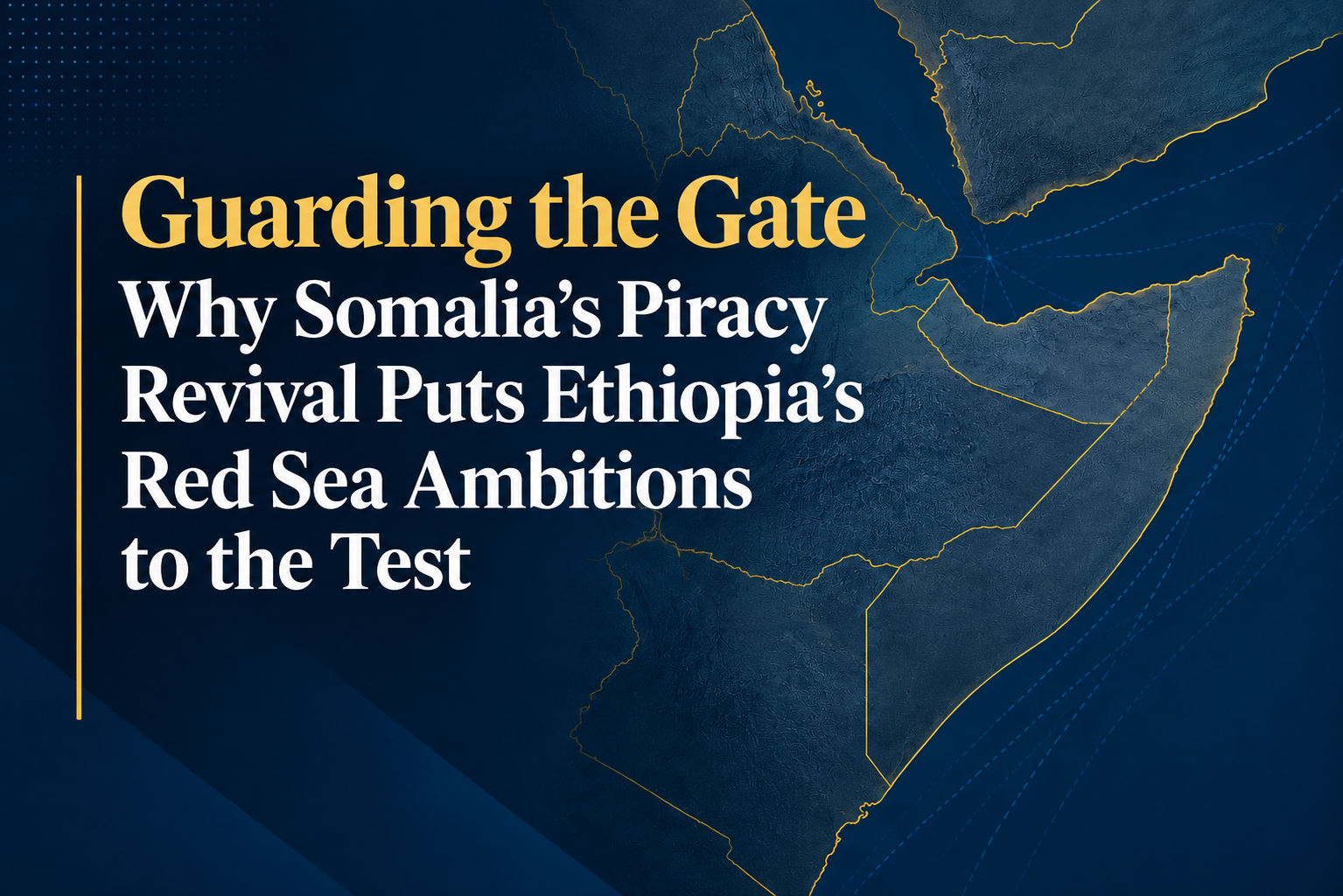
For much of the past decade, piracy off the Horn of Africa was treated as a settled problem — a threat contained by international naval patrols, Puntland's own maritime police, and a decline in ransom economics that made hijacking less attractive than it once was. That settled reading no longer holds. Reports through August 2026 point to a genuine resurgence of piracy activity along Somalia's Puntland coastline, with attacks and attempted boardings reaching further into the Gulf of Aden than at any point in recent memory. For Ethiopia, a country that has spent the past several years building its national strategy around securing reliable access to the sea, this is not a distant Somali problem. It is a direct test of the argument Addis Ababa has been making to the region and the world.
The conventional way to discuss Ethiopia's sea-access ambitions treats them as a matter of sovereign right and economic necessity — the claim that a nation of more than 130 million people cannot remain permanently dependent on a single neighbor's ports. That argument still holds. But the piracy revival reveals a second, less-discussed dimension of the sea-access question: it is not only about who controls a port, but about who can guarantee that the waters leading to it remain open, safe, and governed. Ethiopia's interest in the Red Sea and Gulf of Aden corridor is, in this sense, a security interest as much as an economic one.
Corridor Guarantorship, Defined
Call this idea corridor guarantorship: the proposition that durable, meaningful access to the sea is established not merely by a legal agreement, a port lease, or an economic corridor deal, but by a country's willingness and capacity to help secure the route itself. A nation that depends on a corridor without holding any stake in its protection remains a passenger rather than a stakeholder. A nation that contributes meaningfully to keeping that corridor safe earns a legitimate voice in decisions about how it is governed.
This distinction matters for Ethiopia because it shifts the framing of the sea-access debate away from territorial dispute and toward shared responsibility. Ethiopia has consistently, and correctly, resisted characterizations of its maritime ambitions as expansionist. Corridor guarantorship gives that position a concrete foundation: Ethiopia is not asking for territory, but offering to help carry the burden of keeping a vital regional artery open, in the manner that other landlocked states have secured lasting access through participation in transit security rather than through annexation.
The Puntland Signal
The scale of the piracy revival deserves attention on its own terms. Analysts tracking the Gulf of Aden have documented a marked rise in attempted hijackings and armed approaches to commercial vessels off the Puntland coast since mid-2026, a pattern regional monitors describe as the most significant since the height of Somali piracy over a decade ago. The drivers are familiar: a Puntland administration stretched thin by its own internal disputes, depleted local fishing stocks that push coastal communities toward the informal economy of hijacking, and gaps in naval coverage as international patrol commitments have thinned relative to their peak years.
What is different this time is the surrounding context. Where the previous piracy wave unfolded before the Horn of Africa's port and corridor economy had become as strategically contested as it is today, this one arrives precisely as Ethiopia, Somalia, Djibouti, Eritrea, and outside powers are all actively negotiating the future architecture of Red Sea access. A corridor that cannot be kept safe is a corridor whose value to every party — Ethiopia included — is diminished.
What Skeptics Get Wrong
Some observers will argue that Ethiopia, as a landlocked state with no navy to speak of, has no natural role in maritime security and should leave the matter to Somalia, the African Union mission, and international naval coalitions. This view understates both the stakes and the available tools. Maritime security in 2026 is not solely a matter of hulls at sea; it increasingly involves intelligence sharing, coastal community investment, port-state cooperation, and diplomatic coordination among the states whose trade depends on the corridor remaining open. Ethiopia can contribute meaningfully on each of these fronts without operating a single warship.
There is also a fair concern that framing sea access through security risks entangling Ethiopia in Somalia's internal politics at a moment when the bilateral relationship is still being carefully rebuilt. This risk is real but manageable. Ethiopia's history of troop contributions to African Union missions in Somalia, and its long-standing security cooperation with Mogadishu, already gives it standing to engage on maritime matters as a partner rather than an intruder — provided the engagement is framed, as it should be, around shared benefit rather than unilateral advantage.
Addis Ababa's Stake in the Sea Lanes
Ethiopia's economic planning for the coming decade rests heavily on diversified, resilient trade corridors — whether through Djibouti, prospective arrangements elsewhere, or infrastructure still under discussion. Every one of those corridors terminates in waters that piracy now threatens to make less predictable and more costly to traverse. A revival of hijacking risk raises shipping insurance premiums, lengthens transit times as vessels reroute, and gives outside naval powers, rather than regional states, greater say over how the corridor is policed. None of these outcomes serve Ethiopia's long-term interest in a Red Sea corridor governed, in significant part, by the region's own states.
A Way Forward
Three steps would allow Ethiopia to translate this moment into durable standing on the corridor-security question. First, Addis Ababa should propose a standing Horn of Africa maritime security coordination mechanism, built alongside Somalia, Djibouti, and IGAD, that gives landlocked states a formal consultative role in corridor governance without requiring naval assets of their own. Second, Ethiopia should offer targeted, visible support — logistics, training exchanges, or coastal community development financing — to Puntland's own maritime security capacity, addressing the resurgence at its economic roots rather than only its symptoms. Third, Ethiopian diplomacy should press the case, in African Union and IGAD forums, that Red Sea corridor security is a Horn of Africa responsibility first, deserving of regional resourcing, rather than a matter indefinitely outsourced to external naval coalitions.
The piracy revival off Puntland is, in the first instance, a Somali and regional security problem. But it is also an opening for Ethiopia to make its sea-access case in a register that draws less suspicion and more partnership than the language of ports and territory has sometimes attracted. Corridor guarantorship offers a way to state plainly what Ethiopia's regional partners should already understand: a country that helps keep the gate safe has earned the standing to walk through it.
Notes
1. Armed Conflict Location & Event Data Project (ACLED). "Is a New Wave of Somali Piracy Emerging in the Gulf of Aden?" ACLED Analysis, August 28, 2026.
2. Ibid.
3. International Crisis Group. "Horn of Africa." Crisis Group Regional Briefings, 2026.
4. African Union Transition Mission in Somalia (AUSSOM). Periodic security updates, 2026.
5. Intergovernmental Authority on Development (IGAD). Communiqués on regional maritime security cooperation, 2026.
By Hanan Hussen, IFA
Disclaimer:
The content disseminated by the Institute of Foreign Affairs (IFA) – including, but not limited to, publications, public statements, events, media appearances, and digital communications – reflects the views of individual contributors and does not necessarily represent the official positions or policies of the Institute, its partners, or any affiliated governmental or non-governmental entities.
While the IFA endeavours to ensure the accuracy, integrity, and timeliness of the information presented, it makes no representations or warranties, express or implied, regarding the completeness, reliability, or suitability of such content for any purpose. The Institute expressly disclaims any liability for errors or omissions, as well as for any actions taken or decisions made based on the information provided.
The inclusion of external links, references, or third-party resources does not constitute an endorsement by the Institute. Additionally, engagement on social media platforms – including, but not limited to, likes, shares, retweets (RTs), or reposts – shall not be interpreted as an endorsement or validation of the views expressed therein.
Readers and audiences are encouraged to exercise critical judgement and seek independent verification when interpreting or relying upon any information disseminated through publications and posts on the Institute’s platforms or representatives.