
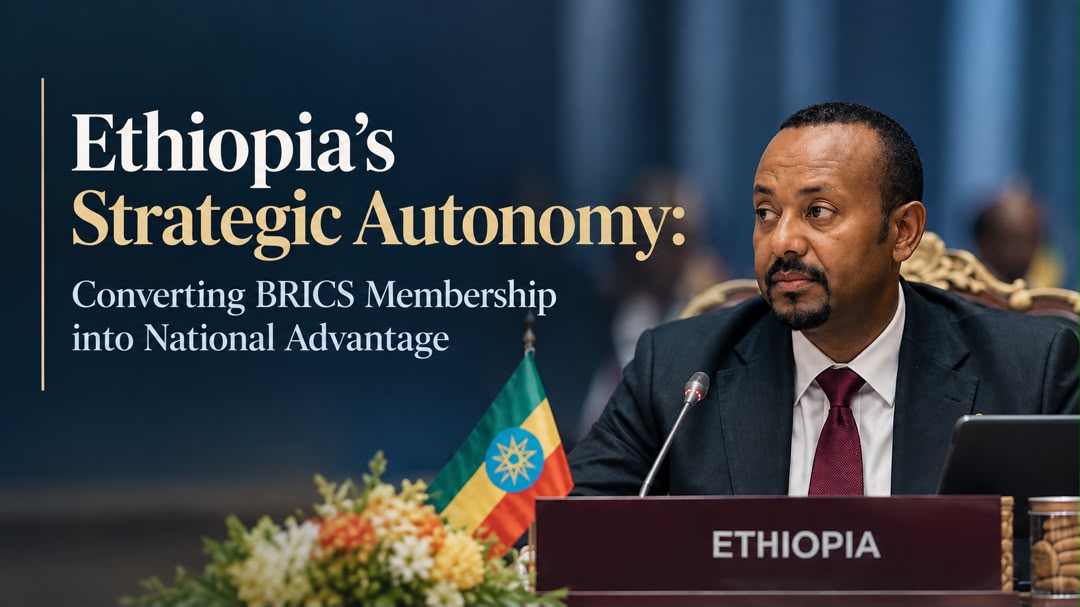
Ethiopia’s entry into BRICS came at a moment when the country was already confronting a larger strategic question: how to expand its economic and political room for manoeuvre in an international system that is becoming more competitive and more fragmented. For Ethiopia, this question extends from access to finance and export markets to industrial capability, technology, maritime connectivity and representation in institutions where international rules are shaped.
The 18th BRICS Leaders’ Summit in New Delhi on September 12 and 13, 2026 brought that question into sharper focus. The New Delhi Declaration supported Ethiopia’s ongoing accession to the World Trade Organization, backed its African Union endorsed candidacy for an additional seat on the International Civil Aviation Organization Council and supported preparations for COP32 in Addis Ababa. Ethiopia also expressed readiness to host a New Development Bank office in Addis Ababa.
These developments matter because their strategic value depends on whether Ethiopia can convert wider international access into productive capacity, stronger institutional influence and greater freedom of national action. The central question is not what BRICS represents internationally, but what Ethiopia can make membership deliver for its own transformation, resilience and strategic autonomy.
Expanding Ethiopia’s Strategic Space
Ethiopia now operates in an international environment where trade, investment, infrastructure, technology and finance are distributed across several centres of power. This opportunity should not be reduced to a choice between established partners and emerging powers. Ethiopia has little strategic interest in replacing one sphere of dependence with another.
BRICS can widen Ethiopia’s options. But diversification is not the same as autonomy. Ethiopia may have many partners and still remain vulnerable if one actor, market, financing source, technology provider or transport corridor becomes indispensable to a critical national interest.
Strategic autonomy therefore requires credible alternatives. For Ethiopia, it should mean increasing the number of consequential choices the country can make for itself while preserving productive relations across different centres of economic and political influence.
Converting Opportunity into National Capability
Ethiopia’s external partnerships should increasingly be judged by the domestic capabilities they create. Foreign exchange pressure, logistics constraints, technological dependence and supply disruptions can reinforce one another. The country’s continuing demand for foreign currency for fuel, medicines, machinery and other obligations shows why additional financing alone cannot define successful engagement.
China’s relationship with Ethiopia extends across infrastructure, investment and market access, while India’s engagement reaches manufacturing, agriculture, healthcare and other productive sectors. Their strategic value should be measured by their contribution to Ethiopia’s productive transformation.
Russia adds another dimension through energy and industrial cooperation. Ethiopia’s emerging nuclear programme shows how Russian technical and reactor expertise can support energy diversification and long term industrialisation. The key is to convert that cooperation into Ethiopian skills, institutional capacity and technological capability rather than long term dependence.
Investment should expand domestic production. Technology cooperation should build Ethiopian expertise. Market access should strengthen exports. Infrastructure should reduce production and logistics costs. Mineral partnerships should support processing and value creation inside Ethiopia.
External access creates opportunity. Domestic capability converts opportunity into strategic power.
This distinction is essential because expanded international access can remain superficial if Ethiopia does not develop the institutions, skills and productive systems needed to absorb and retain value.
Ethiopia as a Contributor
Ethiopia should not approach BRICS primarily as a beneficiary. Ethiopian Airlines provides continental and international connectivity. Ethiopia’s electricity links support regional economic integration. Addis Ababa hosts the African Union and occupies a distinctive position in continental affairs. Renewable energy potential, mineral resources, a large market and ambitions for industrial expansion add further strategic value.
These assets can strengthen Ethiopia’s bargaining position.
Ethiopia’s proposal to host a New Development Bank office in Addis Ababa is important in this regard. Combined with Addis Ababa’s continental role, such an office could strengthen Ethiopia as an institutional link between African development priorities and emerging sources of finance and investment.
COP32 offers a similar opportunity. Ethiopia’s interest should not end with hosting a major conference. The greater value lies in converting convening power into outcomes in adaptation finance, renewable energy, resilient infrastructure, technology and investment.
The strategic question therefore runs in both directions. what can BRICS provide Ethiopia, and what Ethiopian assets can be converted into greater influence within BRICS?
Institutional Multiplication
BRICS support for Ethiopia’s WTO accession reveals another important dimension of the country’s strategy. Ethiopia is deepening participation in BRICS while pursuing greater integration into the existing multilateral trading system. These objectives are not contradictory.
For Ethiopia, the stronger strategy is institutional multiplication.
The national interest lies in expanding the number of institutions through which Ethiopian priorities can be advanced. BRICS support for WTO accession demonstrates how relationships within one international platform can strengthen Ethiopia’s objectives within another.
The same logic applies to Ethiopia’s ICAO Council candidacy. Ethiopia already possesses significant aviation capability. Greater representation in international aviation governance would connect an existing national strength with greater institutional influence.
The sequence is important. Capability creates credibility. Credibility strengthens representation. Representation can increase influence.
Yet endorsement should not be confused with achievement. WTO support matters if accession advances. ICAO backing matters if representation strengthens Ethiopia’s voice. A New Development Bank presence matters if it improves access to productive finance. COP32 matters if international visibility produces tangible development outcomes.
Recognition is useful. Conversion is strategic.
BRICS and Ethiopia’s Red Sea Strategy
Ethiopia’s search for reliable maritime access is one of the clearest areas in which wider international partnerships can serve a long term national interest. For a large economy dependent on external ports and transport corridors, access to the Red Sea affects trade competitiveness, supply security, industrial expansion and participation in the global economy.
Developments around Bab el Mandeb can directly affect Ethiopia’s trade flows, supply chains and wider economic security. This makes maritime connectivity more than a transport concern. It is a question of national economic resilience.
BRICS gives Ethiopia an additional network through which the economic constraints of landlockedness can be reduced. Partnerships with members that possess infrastructure finance, port and logistics expertise, major trading markets and interests across the Red Sea and Indian Ocean can strengthen Ethiopia’s ability to develop commercially viable alternatives and improve the resilience of its external trade.
China’s role in the railway linking Addis Ababa and Djibouti illustrates the principle. The railway did not give Ethiopia a coastline, but it strengthened the physical connection between Ethiopia’s economy and the maritime trading system.
Through wider BRICS relationships, Ethiopia can expand the infrastructure and commercial partnerships surrounding the maritime gateways on which its economy depends. The objective should therefore be broader than securing a single outlet. Ethiopia needs a maritime access architecture based on negotiated access, multiple commercial corridors, rail and road connectivity, logistics investment and partnerships that connect Ethiopian production more efficiently with global markets.
BRICS can support this strategy without replacing Ethiopia’s direct regional engagement. Political arrangements surrounding maritime access must ultimately be negotiated with neighbouring states, but wider economic partnerships can strengthen the infrastructure and commercial foundations that make diversified access practical.
Turning Global Competition into Ethiopian Advantage
Growing international competition for African markets, investment, technology and strategic resources creates additional room for Ethiopia to manoeuvre. The national interest lies not in choosing which external power should dominate that competition, but in converting competition into better terms for Ethiopia.
In minerals, this means attracting investment that supports domestic processing, technology and higher value exports. In infrastructure, competition should lower Ethiopia’s logistics and production costs. In technology, multiple partnerships should strengthen knowledge transfer and domestic capability.
The principal risk is that Ethiopia mistakes expanded access for expanded autonomy. New financing can create new exposure. New technology partnerships can generate new dependencies. New markets can simply replace one form of concentration with another.
BRICS membership therefore does not remove the need for disciplined national prioritization. It makes that discipline more important.
The appropriate test is practical: does engagement increase Ethiopia’s productive capacity, economic resilience, institutional influence and freedom of action?
Policy Priorities
First, Ethiopia should establish an interagency BRICS conversion framework linking foreign affairs, trade, finance, investment and sectoral institutions around measurable national outcomes in exports, technology transfer, infrastructure, skills and productive investment.
Second, Ethiopia should protect strategic diversification. Deeper engagement with BRICS members should expand rather than narrow Ethiopia’s choices, while productive relationships with other partners continue according to national interest.
Third, Ethiopia should use Addis Ababa’s institutional position more deliberately. The proposed New Development Bank presence, African Union engagement, WTO accession, ICAO candidacy and COP32 should be connected within a broader strategy for strengthening Ethiopia’s international bargaining position.
Fourth, external partnerships should be tied directly to productive transformation. Manufacturing, renewable energy, digital capability, mineral value addition, export competitiveness, logistics and diversified maritime connectivity should receive priority.
Conclusion
Ethiopia does not need BRICS to determine where it belongs. It needs BRICS to expand what it can do.
Wider partnerships serve the national interest when they strengthen production, diversify markets, improve technology and skills, increase connectivity, widen financing choices and strengthen Ethiopia’s institutional voice. They become strategically weaker when they reproduce concentrated dependence through different actors.
The objective is ultimately larger than BRICS. It is an Ethiopia with sufficient productive capability, institutional influence and credible alternatives to pursue its national priorities even as the international environment changes around it.
The real test is not what BRICS makes of Ethiopia, but what Ethiopia makes possible through BRICS.
References
1. Ministry of Foreign Affairs of Ethiopia.
2. BRICS India 2026.
3. Ethiopian News Agency (ENA).
4. Fana Media Corporation.
5. Ethiopian Nuclear Energy Commission.
By Beminet Alemayehu, IFA