
Key Takeaways
• Ethiopia's claim to equitable and reasonable utilization is legally and developmentally defensible, but sovereignty alone does not secure diplomatic legitimacy.
• The GERD strengthened Ethiopia's agency while also showing that technical disclosure, predictable operation, and sustained engagement determine how infrastructure is judged internationally.
• Ethiopia's strongest next step is to pair firm defense of development rights with transparent evidence, differentiated engagement with downstream states, and African-led benefit sharing.
The Legitimacy Gap in Nile Diplomacy
For more than a decade, international debate over the Nile has often begun with Egypt's vulnerability and treated Ethiopia's development as the disruptive variable. That framing captures a real downstream concern, but it leaves out an equally important fact: Ethiopia is a large, rapidly changing country whose electricity, industrialization, employment, and climate-resilience needs cannot be separated from the use of its water resources. The central issue is therefore not whether Egypt has legitimate water-security concerns or whether Ethiopia has legitimate development needs. Both are true. The harder question is which principles should govern the relationship between them.
Ethiopia's position is strongest when it is expressed as a rule for the whole basin rather than an exception for one country. The principle of equitable and reasonable utilization rejects the idea that historical use by one state can permanently exclude development by others. At the same time, it sits alongside duties of cooperation, information exchange, environmental assessment, notification of planned measures, and reasonable efforts to prevent significant harm. The Nile Basin Cooperative Framework Agreement reflects this balance. It does not convert sovereignty into an unlimited license; it places national development inside a framework of reciprocal rights and responsibilities.
This creates what may be called Ethiopia's legitimacy gap. Addis Ababa has a defensible substantive case, yet that case does not automatically become the international baseline. When technical information is released late, official language becomes sharper than the evidence accompanying it, or broader regional tensions become entangled with water diplomacy, other actors gain space to define Ethiopian development primarily as a threat. Closing that gap is now as important as defending the underlying right.
The gap will become more consequential as Ethiopia moves beyond a single flagship dam toward a longer-term programme of river development. Each additional project will be judged not only on its individual design, but also on the precedent created by Ethiopia's cumulative operating record. Early disclosure can therefore serve a strategic purpose: it allows Addis Ababa to establish the technical baseline before competing narratives harden, gives neighboring states time to identify specific concerns, and demonstrates that consultation is compatible with sovereign decision-making. A consistent disclosure framework across future projects would also reduce uncertainty for investors and African institutions. In this sense, transparency is not defensive diplomacy. Properly designed, it is a form of agenda-setting that helps Ethiopia define how responsible upstream development should be assessed across the basin.
What the GERD Established—and What It Did Not
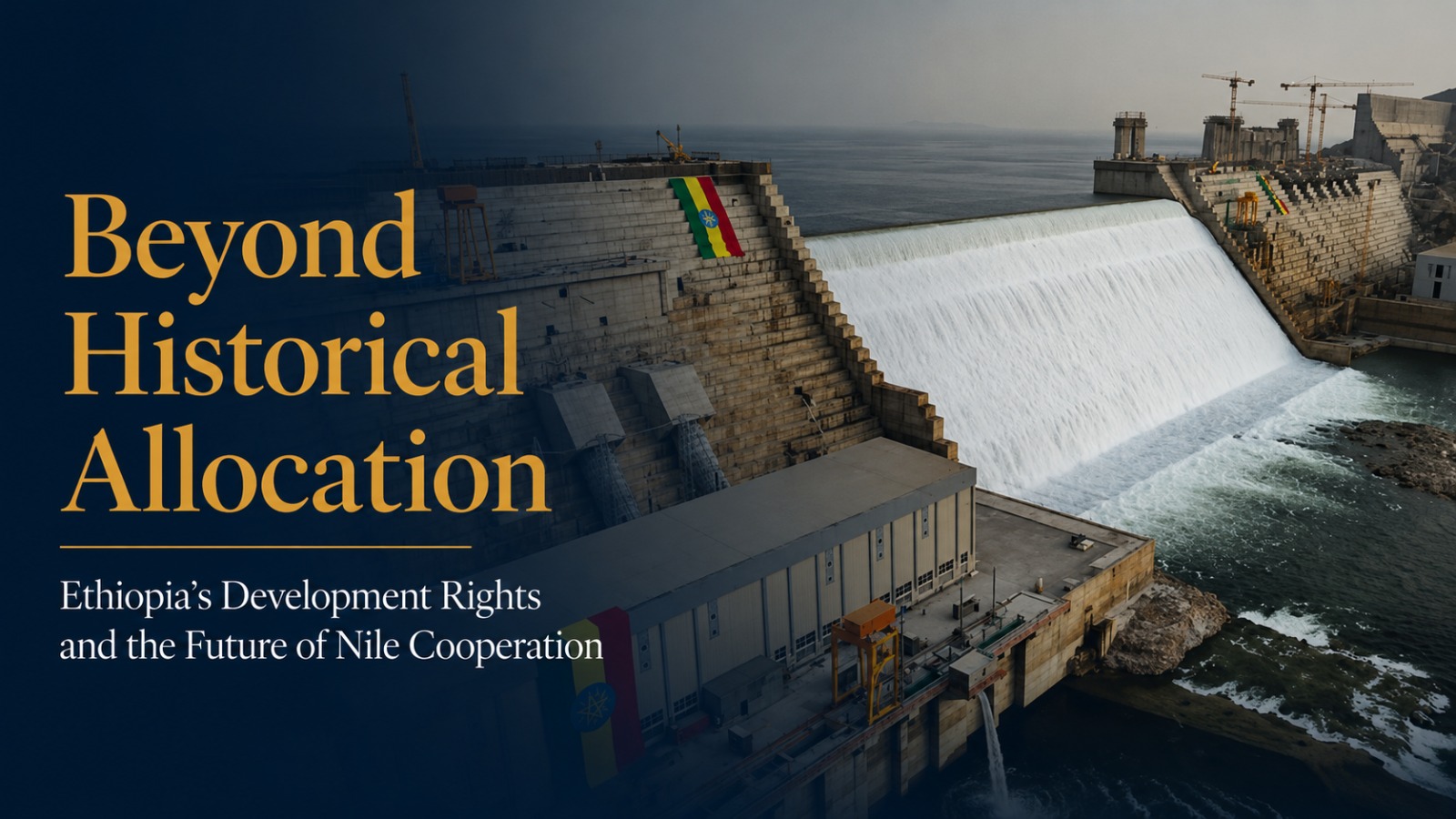
The Grand Ethiopian Renaissance Dam changed the material and political balance of the Nile. It demonstrated Ethiopia's capacity to finance and complete strategic infrastructure despite sustained external pressure. Its primary purpose is hydropower generation rather than consumptive irrigation: water passing through the turbines continues downstream. That distinction matters because it challenges portrayals of the project as a simple transfer of water from one country to another.
But hydropower is not diplomatically consequence-free. Reservoir filling, evaporation, drought-year operation, dam safety, and the timing of releases can affect downstream planning even when water is not permanently diverted. A credible Ethiopian argument should acknowledge these operational questions directly. Doing so does not concede a downstream veto. It demonstrates confidence that Ethiopia's development can withstand technical scrutiny and that cooperation can reduce risks without transferring control over Ethiopian infrastructure.
The GERD therefore produced two lessons. First, infrastructure can create strategic agency: once built and operating, it changes what is politically possible. Second, agency is more durable when other states and institutions can verify the project's operating record. Ethiopia should not rely only on the absence of a demonstrated catastrophe or on the moral force of its development needs. It should make evidence—flow data, drought protocols, safety information, and benefit assessments—a central instrument of diplomacy.
From Historical Allocation to Basin-Wide Rules
Egypt's position has long been shaped by agreements and allocations developed before most upstream states could participate on equal terms. The 1959 Nile Waters Agreement was concluded by Egypt and Sudan without Ethiopia as a party. Ethiopia has therefore rejected the proposition that this bilateral allocation can determine its rights. That objection is not a rejection of international law; it is an argument that the legitimate framework must include all basin states and apply principles capable of governing present and future needs.
Egypt's anxiety cannot simply be dismissed, however. Its population, agriculture, and urban systems are deeply dependent on the Nile, and uncertainty over upstream operations carries political as well as technical weight. Ethiopia gains little by treating that dependence as evidence of bad faith. Its stronger argument is that genuine water security cannot rest on the permanent exclusion of upstream development. A durable settlement must protect essential downstream interests while recognizing that equitable use changes as populations, economies, technologies, and climate conditions change.
This is also why broader security competition should be handled cautiously. Egypt's growing engagement in the Horn, including relationships with states around Ethiopia, can reinforce perceptions in Addis Ababa that the Nile dispute is becoming part of a wider strategy of pressure. Yet intent should not be inferred from alignment alone. Ethiopian analysis should distinguish documented capabilities and agreements from speculation about encirclement. The policy objective should be to prevent regional rivalry from securitizing a water dispute that still requires technical management and sustained diplomacy.
Turning Development into Shared Benefit
Ethiopia's best diplomatic response is not retreat, but conversion: turn national infrastructure into visible regional benefit. Electricity trade, regulated flows, flood-risk reduction, sediment management, and coordinated drought planning can give neighboring states a practical stake in Ethiopian hydropower. The Nile Basin Initiative's work on benefit sharing offers an important foundation because it reframes cooperation around gains that states can measure rather than around abstract appeals to trust.
Sudan is especially important. Its interests are not identical to Egypt's. Dam safety and coordinated releases are serious concerns, while regulated flows, reduced sediment, and electricity access may also provide benefits. Ethiopia should engage Sudan through a dedicated technical mechanism that respects Sudanese agency and assesses those interests on their own merits. A functioning bilateral channel could build confidence without replacing basin-wide institutions or prejudging future negotiations.
Egypt also requires sustained engagement. The objective should not be to force Cairo to abandon its water-security concerns, but to move the discussion from inherited allocation toward verifiable safeguards and reciprocal rules. Ethiopia can defend its rejection of a veto while still proposing structured consultation, shared drought indicators, transparent data protocols, and independent technical review. This would make it harder to portray Ethiopia as refusing cooperation and easier for African institutions to support a balanced framework.
A Practical Ethiopian Agenda
1. Ethiopia's Ministry of Water and Energy should publish a predictable technical disclosure calendar. Release operational data, dam-safety information, environmental findings, and drought-management assumptions on a regular schedule rather than primarily in response to controversy.
2. The Ministry of Foreign Affairs should create differentiated diplomatic tracks. Maintain a dedicated Ethiopia–Sudan technical mechanism, a structured Ethiopia–Egypt dialogue, and a basin-wide institutional track through the Nile Basin Initiative and African Union.
3. Ethiopia should lead with benefit sharing. Quantify potential gains from electricity trade, flood management, sediment reduction, climate resilience, and coordinated river operations for each neighboring state.
4. The Ministry of Foreign Affairs should separate water diplomacy from regional security rivalry. Address military and political developments through the appropriate diplomatic channels while preventing unverified security claims from weakening Ethiopia's legal and technical case on the Nile.
5. Government spokespersons and negotiators should use consistent official language. Present equitable utilization, cooperation, and prevention of significant harm as mutually reinforcing principles rather than as concessions traded against sovereignty.
What to Watch
• Whether future Ethiopian projects are accompanied by early environmental and technical disclosure.
• Whether Sudan maintains a differentiated position based on operational interests and measurable benefits.
• Whether Egypt continues to internationalize the dispute or re-engages through African and basin-wide mechanisms.
• Whether expanding regional security partnerships begin to affect the space for technical Nile cooperation.
Sovereignty Through Legitimacy
Ethiopia does not need to choose between development and diplomacy. Its development claim becomes stronger when it is embedded in rules that it is prepared to apply to itself and defend for every basin state. The strategic task after the GERD is therefore not merely to repeat that Ethiopia has a right to build. It is to demonstrate that Ethiopian development can enlarge regional opportunity while protecting legitimate downstream interests through evidence, predictability, and cooperation.
The next phase of Nile politics will be shaped by who supplies the most credible framework for balancing these interests. Ethiopia can lead that process if it combines infrastructure with institutional initiative: clear technical records, African-led negotiation, differentiated engagement with Sudan and Egypt, and measurable benefit sharing. That approach does not dilute sovereignty. It converts sovereignty into durable regional legitimacy.
Sources
Institutional and legal
• Nile Basin Initiative. “Cooperative Framework Agreement.” https://nilebasin.org/about-us/cooperative-framework-agreement
• Nile Basin Initiative. “Quantifying the Benefits of Transboundary Water Cooperation in the Nile Basin to Support National and Regional Developments.” 2025. https://nilebasin.org/sites/default/files/2025-02/NBI_benefits_book.pdf
• Nile Basin Initiative. “Review of Experience and Mapping of Cross-Border Cooperation Arrangements in the Nile Basin.” 2022. https://nilebasin.org/sites/default/files/2023-12/WRM-2022-03_Review-of-cross-border-cooperation-arrangements-in-the-NB.pdf
Analysis and reporting
• Foreign Policy Research Institute. “The GERD Dispute: Lessons for Water Governance and the Future of the Nile Basin.” 29 October 2025. https://www.fpri.org/article/2025/10/the-gerd-dispute-lessons-for-water-governance-and-the-future-of-the-nile-basin/
• Atlantic Council. “The Nile at a Crossroads: Navigating the GERD Dispute as Egypt's Floodwaters Rise.” 10 November 2025. https://www.atlanticcouncil.org/blogs/menasource/the-nile-at-a-crossroads-navigating-the-gerd-dispute-as-egypts-floodwaters-rise/
• JURIST. “Ethiopia, Egypt, and the Nile: Why International Water Law Is Failing the GERD Dispute.” 22 April 2026. https://www.jurist.org/commentary/2026/04/ethiopia-egypt-and-the-nile-why-international-water-law-is-failing-the-gerd-dispute/
• Al Jazeera. “After GERD, Can Egypt Shape Ethiopia's Next Nile Dams?” 21 August 2026. https://www.aljazeera.com/news/2026/8/21/after-gerd-can-egypt-shape-ethiopias-next-nile-dams
By Fenet Motuma, IFA
Disclaimer:
The content disseminated by the Institute of Foreign Affairs (IFA) – including, but not limited to, publications, public statements, events, media appearances, and digital communications – reflects the views of individual contributors and does not necessarily represent the official positions or policies of the Institute, its partners, or any affiliated governmental or non-governmental entities.
While the IFA endeavors to ensure the accuracy, integrity, and timeliness of the information presented, it makes no representations or warranties, express or implied, regarding the completeness, reliability, or suitability of such content for any purpose. The Institute expressly disclaims any liability for errors or omissions, as well as for any actions taken or decisions made based on the information provided.
The inclusion of external links, references, or third-party resources does not constitute an endorsement by the Institute. Additionally, engagement on social media platforms – including, but not limited to, likes, shares, retweets (RTs), or reposts – shall not be interpreted as an endorsement or validation of the views expressed therein.
Readers and audiences are encouraged to exercise critical judgment and seek independent verification when interpreting or relying upon any information disseminated through publications and posts on the Institute’s platforms or representative.