
Introduction
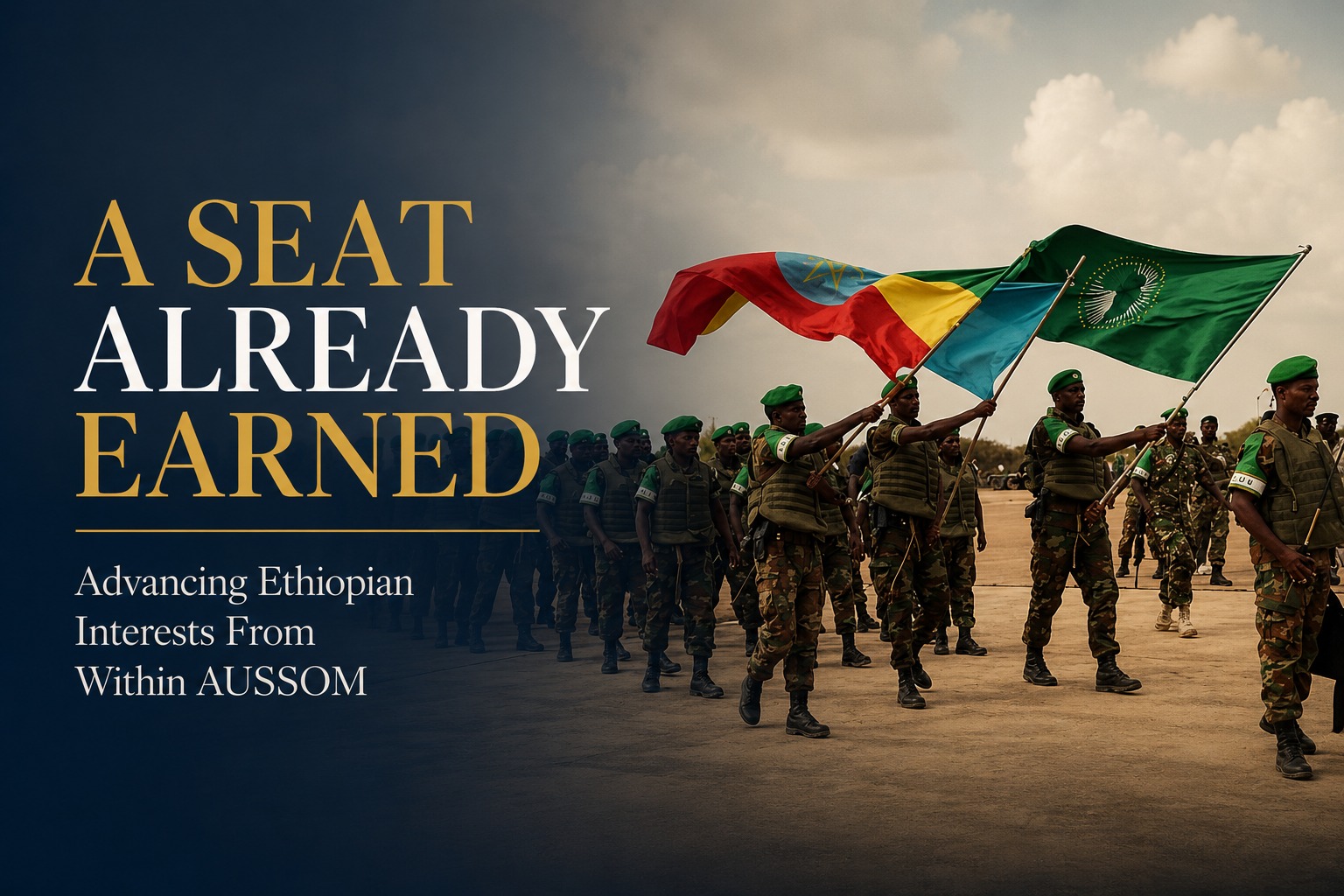
For more than a decade, Ethiopian soldiers have held ground in Somalia that few other forces were willing to hold. Since 2014, the Ethiopian National Defence Force (ENDF) has served under AMISOM, ATMIS and now the African Union Support and Stabilization Mission in Somalia (AUSSOM). That record has survived changes in mission design and serious diplomatic tension between Addis Ababa and Mogadishu. It is therefore more than a record of military contribution; it is accumulated institutional capital. The strategic question is whether Ethiopia is converting that standing into influence over the decisions that most directly affect its security.
The Institutional Foothold Already Built
Ethiopia is not a marginal actor inside AUSSOM. Under the current force structure, it is authorized to contribute roughly 2,500 troops within an overall ceiling of just under 12,000 uniformed personnel, alongside Uganda, Djibouti, Kenya and Egypt. Addis Ababa has also maintained forces in Somalia through bilateral arrangements outside the formal AU ceiling. Together, these deployments reflect a security commitment extending beyond the minimum obligations of a troop-contributing country (TCC).
This standing has proved resilient. When the January 2024 Ethiopia-Somaliland memorandum of understanding triggered a severe dispute with Mogadishu and threats that Ethiopian forces could be excluded from the successor mission, Ethiopia ultimately remained among AUSSOM's TCCs. In August 2026, the handover of the long-held Buurhakaba forward operating base to the Somali National Army was managed through an AU-UN coordinated realignment rather than an abrupt unilateral withdrawal. Ethiopia's presence is therefore embedded in a multilateral structure whose decisions require negotiation among Somalia, the AU, TCCs and international partners.
That gives Ethiopia leverage, but not an automatic veto. Its advantage comes from operational experience, geographic exposure to instability in Somalia, troop contribution, institutional memory and proximity to the AU's political machinery in Addis Ababa. Those assets matter only if they are translated into defined objectives and sustained diplomacy.
Why the Defensive Lens Is No Longer Sufficient
Ethiopian policy toward Somalia has understandably centered on containing Al-Shabaab's cross-border reach, preventing instability from spilling into eastern Ethiopia, managing the Somaliland dispute and watching external military relationships that could alter the security balance around its borders. These are legitimate concerns. But a policy organized only around preventing adverse outcomes risks leaving the institutional agenda to other actors.
AUSSOM is now unusually fluid. Its mandate has been extended only to December 2026, financing remains uncertain, and pressure on logistics and force sustainment is growing. TCCs have pushed for a longer extension while the financial basis for it remains unsettled. Decisions on mission size, priority capabilities, financing, command arrangements and any post-2026 African-led framework are therefore being contested now.
For Ethiopia, this creates both leverage and constraint. Its long deployment record strengthens its credibility on what is operationally sustainable, while proximity to Somalia gives it a direct security stake. Yet Addis Ababa must operate within Somali sovereignty, manage bilateral sensitivities with Mogadishu, accommodate competing TCC interests and avoid allowing AUSSOM to become a vehicle for unrelated bilateral disputes. The key distinction is between presence and influence: Ethiopia already has the first; the policy task is to build the second without weakening the legitimacy that makes it possible.
What Ethiopia Should Seek Inside AUSSOM
Greater Ethiopian engagement should be tied to specific national-security outcomes. First, Addis Ababa should seek a force posture that gives sustained attention to Al-Shabaab networks and mobility in areas whose instability can affect the Ethiopian frontier. This does not mean demanding unilateral control over deployment geography. It means ensuring that cross-border risks are treated as part of AUSSOM's stabilization logic.
Second, Ethiopia should prioritize structured intelligence and operational coordination among AUSSOM, Somali security institutions and neighboring TCCs. Years of deployment have given the ENDF institutional knowledge of local threat patterns; preserving information-sharing would serve Ethiopia's counterterrorism interests while remaining consistent with the mission's multilateral purpose.
Third, Addis Ababa should seek meaningful participation in mission planning, command and technical coordination proportionate to its contribution and experience. Fourth, it should treat predictable financing and logistical support as a security objective, because underfunding can produce unplanned drawdowns, capability gaps and security vacuums. Finally, Ethiopia should defend the principle that AUSSOM remain an AU peace-support mechanism rather than an arena for bilateral strategic competition.
Converting Standing Into Influence
Three institutional channels are already available. The first is the AU Peace and Security Council (PSC). Addis Ababa's proximity to the AU system creates access and convening opportunities, but proximity alone does not guarantee influence. The advantage becomes meaningful only through technically grounded proposals on mandate design, financing, force posture and transition sequencing that other African actors can support.
The second channel is TCC coordination. Ethiopia's troop numbers, tenure and operational experience give it grounds to help shape common positions on predictable financing, realistic transition timelines and preservation of critical counterterrorism capabilities. The third is financing and force-generation dialogue with the AU Commission, European Union and UN support architecture. Ethiopia's bargaining position is strongest when its proposals are framed not as Ethiopian exceptionalism, but as measures that reduce the risk of security vacuums for Somalia and its neighbors.
Egypt: Competition Without Turning AUSSOM Into a Bilateral Contest
Egypt's expanding security relationship with Somalia inevitably attracts Ethiopian attention because it intersects with a wider history of strategic competition between Addis Ababa and Cairo. But Ethiopia should avoid treating Egyptian participation in an AU-authorized framework as inherently hostile. Doing so would weaken Ethiopia's own argument that AUSSOM should remain multilateral and mandate-driven.
The more defensible concern is functional: whether any external military presence or bilateral arrangement changes the security environment near Ethiopia's borders, weakens operational coordination against Al-Shabaab or introduces purposes unrelated to AUSSOM's stabilization mandate. Addis Ababa should therefore respond institutionally by pressing for transparency in force roles, clear command relationships, mandate discipline and AU oversight. This protects Ethiopian interests without turning AUSSOM into an extension of the Ethiopia-Egypt dispute.
Managing the Somaliland Complication
Ethiopia's participation in AUSSOM also preserves a practical channel with Somalia while bilateral relations remain sensitive over Somaliland. Operational cooperation inside an AU mission does not erase political disagreements, but it demonstrates that Addis Ababa and Mogadishu retain overlapping security interests.
AUSSOM should not be used as leverage against Mogadishu over Somaliland, nor should Ethiopia's engagement with Somaliland redefine its role inside the mission. Keeping the files institutionally separate gives Addis Ababa more room to maintain security cooperation with Somalia while pursuing legitimate economic and access objectives through diplomacy. The more visibly Ethiopia respects that separation, the harder it becomes to portray its AUSSOM role as incompatible with Somali security.
Leverage, Constraints and the Measure of Success
Ethiopia enters the coming negotiations with real leverage: long operational experience, significant troop contribution, direct exposure to Al-Shabaab, institutional memory, geographic proximity and access to the AU diplomatic ecosystem. It also faces real constraints: Somali sovereignty sensitivities, bilateral mistrust, uncertain financing, competing TCC preferences and a wider Horn environment in which external rivalries can quickly become entangled with local security arrangements.
Success should therefore be measured by outcomes rather than visibility. By the end of 2026, an effective Ethiopian approach would seek four results: meaningful participation in mission planning and operational structures; preservation of counterterrorism and border-relevant capabilities during restructuring; a financing and transition framework that avoids abrupt security gaps; and clear institutional separation between AUSSOM's stabilization mandate and bilateral rivalries surrounding Somalia.
The Strategic Question, Restated
Ethiopia's Ministry of Foreign Affairs and Ministry of Defense can convert AUSSOM standing into leverage by treating the mission's mandate and financing crisis not simply as a threat to be managed, but as a design process in which Ethiopia has both interests and responsibilities. That requires sustained PSC engagement, coalition-building among TCCs, participation in financing negotiations, clear operational priorities and diplomatic discipline toward Somalia, Somaliland and competing external actors.
AUSSOM cannot substitute for a stable bilateral relationship with Mogadishu, and Ethiopian troop presence cannot by itself determine the mission's future. But Ethiopia does not need to begin from the outside. It has already accumulated the institutional legitimacy, experience and security stake required to participate seriously in shaping what comes next. Ethiopia does not need to earn a seat inside this framework. It already has one. The task now is to occupy it more deliberately, with defined objectives, institutional discipline and a clear understanding of both its leverage and its limits.
References
1. Ethiopian Peacekeeping Troops To Remain In Somalia As AUSSOM Extended To December 2026 — The Reporter Ethiopia.
2. PSC 1276th Meeting Communiqué (29 April 2025) — African Union / AUSSOM.
3. Briefing on the Situation in Somalia and the Operations of AUSSOM — Amani Africa.
4. Ethiopia withdraws troops from Burhakaba as AUSSOM faces mounting crisis — Somali Guardian.
5. With AUSSOM's Funding Challenges Here to Stay, What Are the Options for the Mission's Future in Somalia? — IPI Global Observatory.
6. Somalia: Ethiopia-Somaliland MOU — the Promise Unfulfilled and the Stakes of President Abdillahi's Visit to Addis Abeba — AllAfrica / Addis Standard.
By Bethel Sleshi, IFA
Disclaimer:
The content disseminated by the Institute of Foreign Affairs (IFA) – including, but not limited to, publications, public statements, events, media appearances, and digital communications – reflects the views of individual contributors and does not necessarily represent the official positions or policies of the Institute, its partners, or any affiliated governmental or non-governmental entities.
While the IFA endeavors to ensure the accuracy, integrity, and timeliness of the information presented, it makes no representations or warranties, express or implied, regarding the completeness, reliability, or suitability of such content for any purpose. The Institute expressly disclaims any liability for errors or omissions, as well as for any actions taken or decisions made based on the information provided.
The inclusion of external links, references, or third-party resources does not constitute an endorsement by the Institute. Additionally, engagement on social media platforms – including, but not limited to, likes, shares, retweets (RTs), or reposts – shall not be interpreted as an endorsement or validation of the views expressed therein.
Readers and audiences are encouraged to exercise critical judgment and seek independent verification when interpreting or relying upon any information disseminated through publications and posts on the Institute’s platforms or representative.