
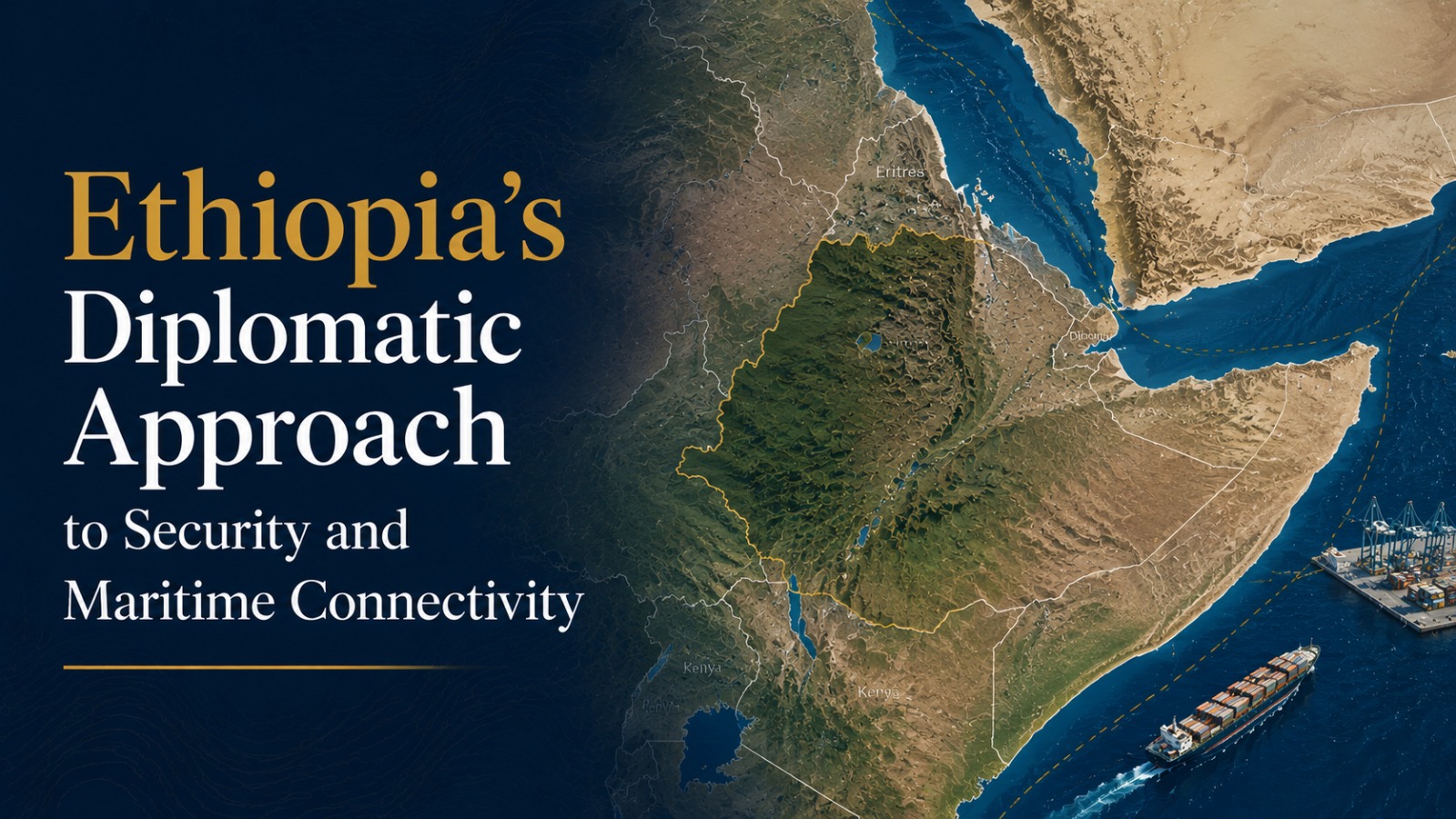
Ethiopia's February 2026 communication to Asmara, demanding the withdrawal of Eritrean forces from Ethiopian territory, should be understood as a clear assertion of Ethiopia's sovereignty and national security interests, coupled with an explicit opening for diplomatic engagement. Foreign Minister Gedion Timothewos paired the demand with an offer that Ethiopia was ready to negotiate "all matters of mutual interest, including maritime affairs and access to the Red Sea through the port of Assab."
The message therefore combined firmness on Ethiopia's territorial integrity with a willingness to pursue a comprehensive diplomatic settlement.From Ethiopia's strategic perspective, this is best understood as principled linkage diplomacy. Addis Ababa is maintaining a firm position on territorial integrity and cross-border security while preserving the possibility of a broader relationship with Eritrea. The approach is consistent with Ethiopia's stated preference for dialogue and negotiated solutions. The reference to Assab is particularly important because Ethiopia's need for reliable maritime access is a long-term national interest, one that the government has consistently sought to advance through negotiation rather than territorial claims.
The Reasoning Behind the Letter
Ethiopia's position rests on the principle that bilateral normalization requires respect for sovereignty and territorial integrity. Addis Ababa has maintained that Eritrean military presence on Ethiopian territory and reported support to armed groups constitute serious security concerns that must be addressed. At the same time, Ethiopia has continued to express interest in comprehensive engagement with Eritrea on trade, regional security and maritime affairs.
Within this framework, linking the security issue with the prospect of dialogue on Assab connects immediate security requirements with Ethiopia's longer-term economic and strategic interests. A negotiated maritime arrangement could strengthen Ethiopia's trade connectivity and diversify its access to the sea while creating potential economic benefits for both countries. This is consistent with Ethiopia's broader objective of regional economic integration.
How the Relationship Reached This Point
The current tension has deep roots. Ethiopia and Eritrea fought a devastating border war between 1998 and 2000, then rebuilt a functional relationship after 2018 and cooperated closely during the 2020–2022 conflict in Tigray. Eritrea was not a party to the November 2022 Pretoria Agreement, which ended the conflict. Ethiopia has maintained that the Pretoria process addressed an internal Ethiopian conflict and was not intended to settle separate bilateral questions between Ethiopia and Eritrea.
Since then, Addis Ababa has raised concerns about Eritrean forces along the shared border and alleged cooperation with armed groups hostile to the Ethiopian state. Ethiopia's decision to address these concerns through formal diplomacy reflects its stated preference for peaceful resolution. The February communication is significant because it combined a firm security position with a concrete diplomatic opening.
Ethiopia's Maritime Interest and the Alternative View
From Asmara's perspective, the inclusion of Assab in a security communication could be interpreted as linking a bilateral security dispute with Eritrea's sovereign control over its territory and infrastructure. Ethiopia's position, however, has been to pursue maritime access through negotiation and mutually beneficial arrangements rather than territorial acquisition. Maintaining this distinction is essential to diplomatic clarity.
For Addis Ababa, the strategic rationale is straightforward. Ethiopia's large population, expanding economy and landlocked status create a continuing national interest in diversified, reliable and commercially viable access to the sea. Pursuing negotiated arrangements with coastal neighbors is consistent with Ethiopia's economic development and regional integration objectives and does not require questioning their sovereignty.
Where Ethiopia's National Interest Meets Regional Stability
For Ethiopia, a durable resolution with Eritrea would reduce a significant security challenge and create greater space for Addis Ababa to concentrate diplomatic and security resources on Tigray's reconstruction, the AUSSOM transition in Somalia and the wider regional integration agenda. Continued tension risks diverting resources and increasing strategic uncertainty while the Horn of Africa faces pressure from Sudan's war and changing Red Sea security dynamics.
Maintaining a diplomatic approach also serves Ethiopia's regional interests. Ethiopia can defend its sovereignty and maritime objectives while continuing to support dialogue, African-led conflict resolution and regional cooperation. Firmness and diplomacy are not contradictory; together they provide a framework for protecting national interests while limiting unnecessary escalation.
Charting a Way Forward
First, Ethiopia should continue seeking credible verification of its border and security concerns through appropriate diplomatic and African regional mechanisms where feasible. Evidence-based diplomacy would strengthen Addis Ababa's position and reduce space for competing narratives.
Second, Ethiopian diplomacy should make the pathway to comprehensive dialogue increasingly concrete, with a structured agenda covering border security, trade, regional cooperation and maritime access. This would clarify that Ethiopia's objective is a negotiated framework that respects sovereignty and provides benefits to both countries.
Third, Addis Ababa should continue developing rules-based and mutually beneficial options for maritime cooperation with coastal neighbors. Diversification would reinforce the principle that Ethiopia's pursuit of sea access is a consistent national interest rather than a demand directed at any single state.
A Relationship Worth the Patience It Requires
The February communication to Asmara illustrates Ethiopia's effort to hold two priorities together: defending its sovereignty and security while keeping open a path toward comprehensive engagement. For Addis Ababa, the strategic objective is not confrontation for its own sake, but a stable regional environment in which Ethiopia can pursue economic integration, security cooperation and negotiated maritime access. Sustaining that balance will require clear signaling, patient diplomacy and practical arrangements that accommodate the legitimate interests of both countries.
Notes and References
1. Arab News, "Ethiopia demands Eritrea 'immediately withdraw' troops from its territory," 8 February 2026.
2. The New Arab, "Ethiopia demands Eritrea to withdraw troops from its territory," 8 February 2026.
3. The Reporter Ethiopia, "Ethiopia Demands Eritrea Withdraw Troops From Ethiopian Territory," 11 February 2026.
4. Garowe Online, "Ethiopia Demands Immediate Withdrawal of Eritrean Troops Amid Rising Border Tensions," February 2026.
5. Pretoria Agreement (Agreement for Lasting Peace through a Permanent Cessation of Hostilities), 2 November 2022.
6. Statements by Ethiopian Ministry of Foreign Affairs on sea access and regional dialogue, 2023–2026.
By Hanana Hussen ,IFA
Disclaimer:
The content disseminated by the Institute of Foreign Affairs (IFA) – including, but not limited to, publications, public statements, events, media appearances, and digital communications – reflects the views of individual contributors and does not necessarily represent the official positions or policies of the Institute, its partners, or any affiliated governmental or non-governmental entities.
While the IFA endeavors to ensure the accuracy, integrity, and timeliness of the information presented, it makes no representations or warranties, express or implied, regarding the completeness, reliability, or suitability of such content for any purpose. The Institute expressly disclaims any liability for errors or omissions, as well as for any actions taken or decisions made based on the information provided.
The inclusion of external links, references, or third-party resources does not constitute an endorsement by the Institute. Additionally, engagement on social media platforms – including, but not limited to, likes, shares, retweets (RTs), or reposts – shall not be interpreted as an endorsement or validation of the views expressed therein.
Readers and audiences are encouraged to exercise critical judgment and seek independent verification when interpreting or relying upon any information disseminated through publications and posts on the Institute’s platforms or representative.