
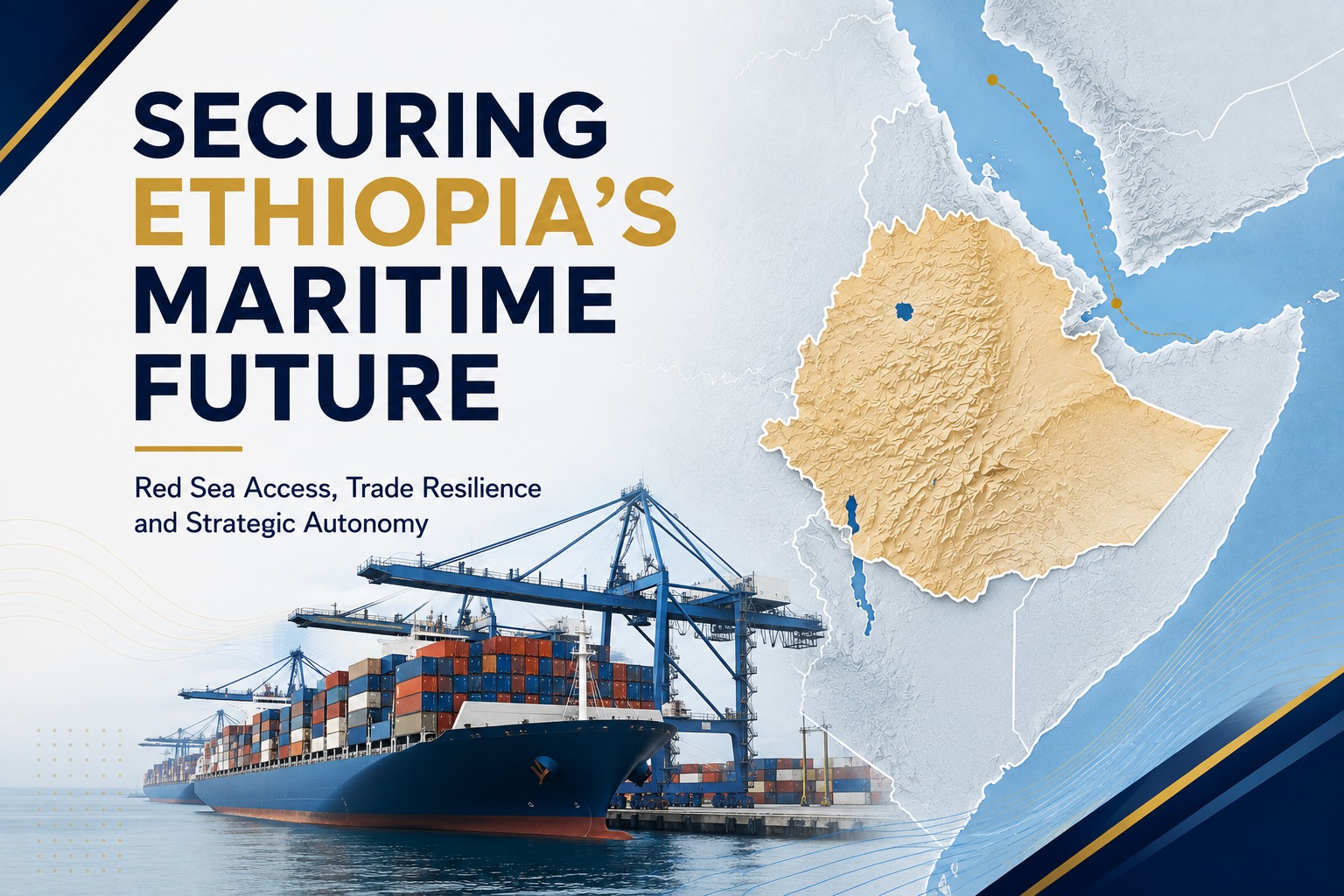
Executive Summary
A reduction in tensions around the Strait of Hormuz would be welcome, but it would not eliminate Ethiopia's maritime vulnerability. For Addis Ababa, the strategic question is not simply whether Gulf tensions decline. It is whether Ethiopia's trade lifeline remains exposed to a maritime chokepoint whose security is shaped by actors and crises beyond Ethiopia's direct control.
The Bab el-Mandeb and wider Red Sea corridor represent a distinct risk environment. Ethiopia's seaborne trade depends heavily on the Djibouti corridor, making disruption to shipping, insurance, port operations or vessel routing a direct national economic-security concern. A settlement focused on Hormuz therefore cannot be treated as a proxy settlement for Ethiopia's maritime exposure.
The central strategic problem is an asymmetry between exposure and influence: Ethiopia can experience significant economic consequences from Red Sea disruption while having limited institutional influence over the mechanisms that govern maritime security. This gap should drive a more active Ethiopian policy of corridor diversification, regional diplomacy and economic resilience.
Ethiopia should consequently treat maritime access as part of national security rather than as a narrow logistics question. Diversified corridors, sovereign or commercially secure port arrangements, regional maritime-security cooperation and financial mechanisms for absorbing disruption should form parts of a single resilience strategy.
1. Beyond the Hormuz-Centric Reading
The current regional crisis has concentrated international attention on Hormuz because of its significance for global energy markets and the direct involvement of major powers. This concentration can obscure a different strategic reality for the Horn of Africa For Ethiopia, Bab el-Mandeb is not an abstract regional chokepoint. It is closely connected to the maritime corridor through which the country's international trade is conducted via Djibouti.
The consequence is that a disruption that may appear peripheral from the perspective of global energy markets can become immediate and material for Ethiopia. The appropriate analytical distinction is therefore between Gulf de-escalation and Red Sea security. The two are connected, but they are not identical. A durable arrangement around Hormuz would not automatically remove the risks generated by insecurity in the Bab el-Mandeb and wider Red Sea.
2. Ethiopia's Exposure to the Red Sea Chokepoint
Ethiopia's dependence on the Djibouti corridor creates a structural vulnerability. Any prolonged disruption could increase shipping costs, insurance premiums, transit times and the cost of imported goods, while complicating the movement of exports. The economic effect would be amplified because Ethiopia's exposure is concentrated rather than diversified. Global markets can distribute the consequences of a Red Sea disruption across many routes and suppliers; Ethiopia has fewer immediate alternatives for moving large volumes of maritime trade. This makes maritime security an issue of economic sovereignty. The objective is not necessarily to eliminate dependence on Djibouti, which remains a critical partner, but to ensure that disruption to one corridor does not become a single point of failure for the Ethiopian economy.
3. The Post-Hormuz Risk Environment
The possibility that actors aligned with Iran retain the capacity to exert pressure around Bab el-Mandeb means that Ethiopia should monitor Red Sea developments as a distinct strategic track. The brief's argument is not that Tehran exercises complete operational control over all activity in the Red Sea. Indeed, the available evidence does not justify assuming centralized control over Houthi decision-making.
The more important point for Addis Ababa is strategic uncertainty. Even where local actors retain tactical autonomy, their actions can create risks that affect Ethiopia's trade corridor. This means Ethiopian contingency planning should be based on exposure and capability rather than on optimistic assumptions about the intentions of external actors.
4. The Gap Between Exposure and Voice
Ethiopia faces a persistent mismatch between its dependence on the Red Sea corridor and its formal role in maritime-security decision-making. Littoral states, naval powers and external coalitions possess greater direct influence over maritime security arrangements, while landlocked states whose economies depend on the corridor can remain peripheral to those discussions.
This gap should be addressed diplomatically. Ethiopia has a legitimate interest in participating in regional conversations on Red Sea security because disruptions to the corridor directly affect its economic stability. The African Union and IGAD provide potential platforms for developing a broader framework that includes landlocked and corridor-dependent states.
5. From Vulnerability to Strategic Resilience
The most important Ethiopian policy response is diversification. Alternative access arrangements, including engagement around Berbera and continued efforts to secure reliable sovereign or commercially protected port options, can reduce concentration risk.Diversification should not be understood as replacing Djibouti. Djibouti will remain strategically important. Rather, Ethiopia should seek a portfolio of corridors and access arrangements so that disruptions in one route can be absorbed without producing systemic economic shock.
Resilience also requires financial instruments. Strategic reserves, trade-insurance arrangements and contingency financing can reduce the economic impact of temporary disruptions. These measures should be developed alongside diplomatic and infrastructure initiatives rather than treated as separate technical policies.
Policy Priorities for Ethiopia
• Accelerate diversification of maritime and trade-corridor exposure while maintaining strong bilateral relations with Djibouti.
• Advance practical alternative-access arrangements, including engagement around Berbera and other viable corridors, with careful assessment of cost, reliability, political risk and infrastructure requirements.
• Press the African Union and IGAD toward a standing Red Sea security consultation mechanism that includes landlocked and corridor-dependent states.
• Maintain dedicated monitoring of Bab el-Mandeb and Red Sea security developments as a distinct analytical track rather than assuming that Gulf de-escalation automatically produces Red Sea stability.
• Develop national contingency planning for shipping disruption, including trade insurance, strategic reserves and alternative routing protocols.
• Integrate maritime access into Ethiopia's broader economic-security and foreign-policy planning so that port diplomacy, infrastructure investment and regional security diplomacy reinforce one another.
Conclusion: Maritime Access as National Security
A settlement around Hormuz would reduce one dimension of regional risk, but it would not resolve Ethiopia's Red Sea exposure. Ethiopia's vulnerability arises from the structural concentration of its maritime trade through a corridor whose security is influenced by regional conflicts and external actors. The strategic response should therefore move beyond reactive crisis management. Ethiopia needs a resilience architecture that combines diversified corridors, stronger regional diplomacy, contingency planning and sustained engagement on Red Sea security.
The underlying principle is straightforward: Ethiopia should not allow a maritime chokepoint outside its territorial control to become a single point of failure for its national economy. Greater access, greater diversification and greater diplomatic voice are therefore not separate objectives. They are components of Ethiopia's maritime-security strategy.
Notes
Geopolitical Daily briefing, 2 August 2026, on the US-Israel-Iran ceasefire framework.
Geopolitical Monitor, “Diplomacy falters in the Iran war,” August 2026.
ENA reporting on Ethiopia's sovereign seaport strategy, 15 August 2026.
IGAD and African Union documentation on regional maritime security coordination.
By Hanan Hassen, IFA
Disclaimer:
The content disseminated by the Institute of Foreign Affairs (IFA) – including, but not limited to, publications, public statements, events, media appearances, and digital communications – reflects the views of individual contributors and does not necessarily represent the official positions or policies of the Institute, its partners, or any affiliated governmental or non-governmental entities.
While the IFA endeavors to ensure the accuracy, integrity, and timeliness of the information presented, it makes no representations or warranties, express or implied, regarding the completeness, reliability, or suitability of such content for any purpose. The Institute expressly disclaims any liability for errors or omissions, as well as for any actions taken or decisions made based on the information provided.
The inclusion of external links, references, or third-party resources does not constitute an endorsement by the Institute. Additionally, engagement on social media platforms – including, but not limited to, likes, shares, retweets (RTs), or reposts – shall not be interpreted as an endorsement or validation of the views expressed therein.
Readers and audiences are encouraged to exercise critical judgment and seek independent verification when interpreting or relying upon any information disseminated through publications and posts on the Institute’s platforms or representative.