
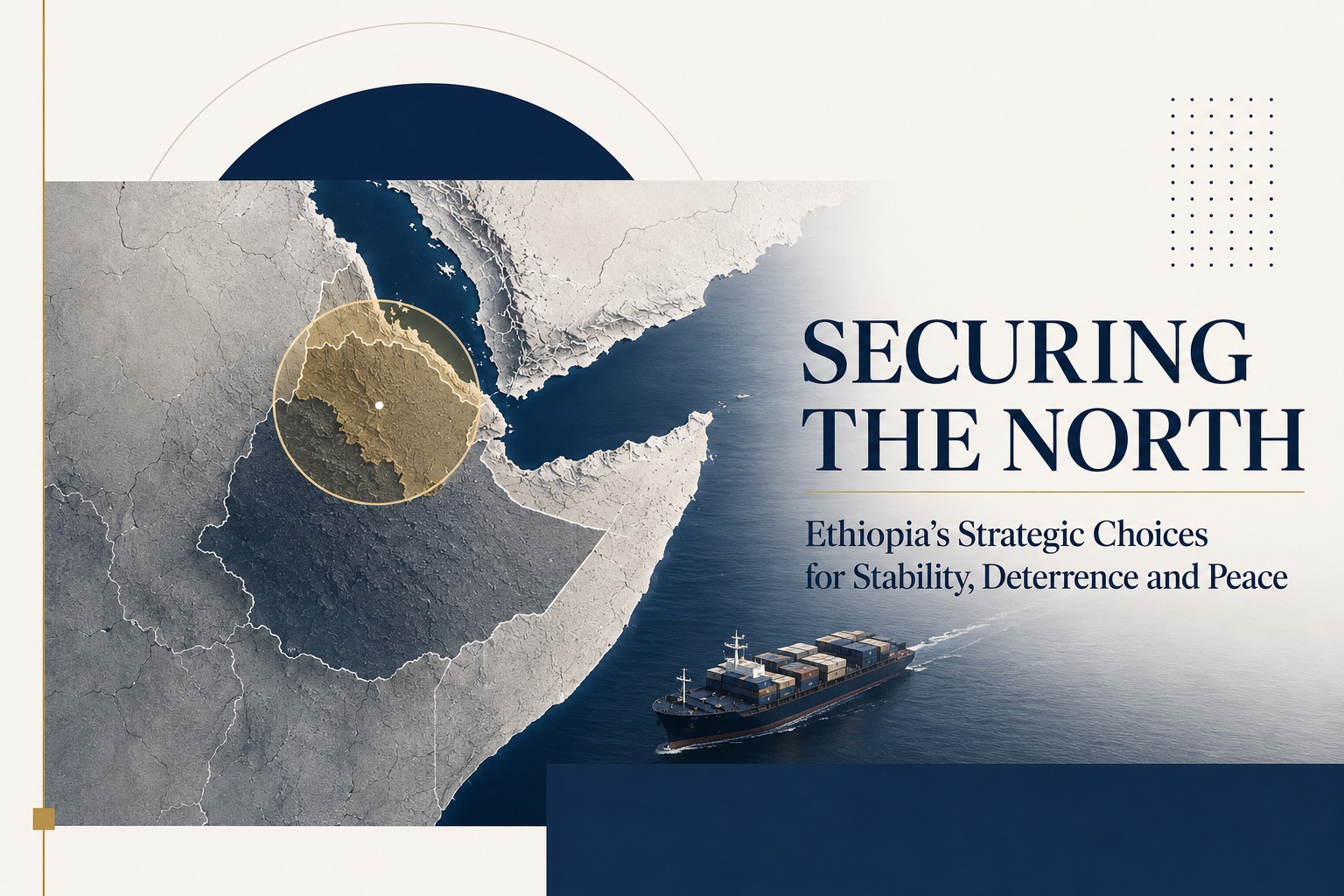
Executive Summary
Northern Ethiopia's security environment is increasingly shaped by the interaction of local, cross-border and interstate pressures. The events examined in this brief should not be treated only as isolated incidents. Their strategic significance lies in the possibility that different forms of pressure can exploit the same vulnerabilities at the same time, narrowing Ethiopia's room for manoeuvre while creating incentives for overreaction or strategic drift.
The first week of August 2026 illustrates this dilemma. On 1 August, an armed group identified in reporting as the TPLF-aligned “Army 70” attempted an incursion from Sudanese territory at Sherarina and was repelled by the Ethiopian National Defense Forces. Two days later, senior Eritrean military commanders entered the border town of Zalambesa in a public display, and subsequent reporting indicated the movement of Eritrean military assets into Tigray. The available evidence does not conclusively establish a centrally coordinated operation between the actors. It does, however, demonstrate how separate pressures can converge on the same strategic seam.
For Ethiopia, the principal policy challenge is therefore not simply attribution. It is maintaining credible deterrence while avoiding a cycle of escalation that could reopen a broader regional conflict. The appropriate response is calibrated: strengthen border readiness, improve intelligence and early warning, activate multilateral mechanisms linked to the Pretoria framework, constrain cross-border logistical space, and preserve diplomatic channels that keep escalation reversible. The central argument is that strategic restraint should not be confused with strategic passivity. Ethiopia's objective should be to deny adversaries and spoilers the ability to convert incremental pressure into strategic leverage.
1. The Northern Security Environment
The implementation of the Pretoria Agreement has reduced the probability of a return to the scale of warfare witnessed before the November 2022 cessation of hostilities. Yet the post-war environment remains vulnerable where political grievances, contested security arrangements, displacement, external sanctuaries and weak implementation mechanisms overlap.
The August incidents matter because they occurred within this unresolved environment. The Army 70 incursion demonstrated that armed networks can attempt to exploit instability beyond Ethiopia's borders, while the Eritrean military display at Zalambesa demonstrated how overt state signaling can place additional pressure on Ethiopia without necessarily producing an immediate interstate confrontation.
These are different forms of pressure. They should not be collapsed into a single attribution without sufficient evidence. Their strategic effect, however, can still be cumulative: one consumes security attention and tests responsiveness; another creates political and military uncertainty; together they can compress the decision space available to Addis Ababa.
2. From Isolated Incidents to a Pressure Pattern
A useful analytical lens is the idea of a multi-layered security pressure environment. One layer may operate through deniable or non-state actors, while another operates through visible state action and signaling. The two do not require a common command structure to generate complementary effects.
This distinction is important for Ethiopian policy. A response designed only around identifying a single coordinating hand may miss the broader vulnerability. Conversely, treating every coinciding event as proof of coordination risks strategic overreaction and weakens diplomatic credibility.
The more defensible conclusion is therefore narrower: the timing and geographic concentration of the August incidents reveal a security environment in which multiple actors can exploit gaps in Ethiopia's northern periphery. That environment requires a response focused on resilience, deterrence and prevention rather than on speculative attribution.
3. The Eritrea Factor
Eritrea remains an important variable in Ethiopia's northern security calculus. The post-2018 relationship has not developed into sustained normalization, while unresolved questions involving the border, regional security and access to the Red Sea continue to shape the strategic environment. The public nature of the Zalambesa episode is significant because military signaling can serve political purposes even when it does not translate into an immediate territorial objective. For Ethiopia, the challenge is to distinguish between signaling, coercion and preparations for sustained military action while ensuring that precautionary measures do not themselves become escalatory signals.
A disciplined Ethiopian policy should therefore combine visible readiness with diplomatic clarity: Ethiopia must communicate that violations of its territorial integrity carry consequences while keeping open channels through which misunderstandings can be contained.
4. Sudan as a Security Multiplier
The continuing war in Sudan creates an additional layer of risk. Border instability, fragmented authority and the movement of armed personnel and materiel can create logistical space for actors seeking to operate against Ethiopia. The strategic implication is that Ethiopia's northern security cannot be separated from developments on its western frontier. Addis Ababa therefore has an interest in improving border intelligence and information exchange while avoiding policies that unnecessarily entangle Ethiopia in Sudan's internal conflict.
5. Ethiopia's Strategic Dilemma
The central dilemma is between deterrence and escalation control. Excessive restraint can encourage the perception that repeated low-intensity pressure carries limited cost. Excessive retaliation, however, could transform localized incidents into a wider interstate confrontation.
Ethiopia's advantage lies in calibrated statecraft. The ENDF's rapid response to the Sherarina incursion demonstrates operational capacity. The next step is to ensure that military readiness is matched by diplomatic, intelligence and institutional instruments capable of preventing isolated incidents from becoming a strategic pattern.
Policy Priorities for Ethiopia
• Maintain calibrated military readiness along vulnerable northern corridors, while avoiding rhetoric or deployments that unnecessarily foreclose diplomatic off-ramps.
• Strengthen integrated intelligence and early-warning mechanisms linking northern regional authorities, federal security institutions and relevant border-security actors.
• Use the African Union and the Pretoria Agreement's monitoring and accountability architecture more actively to internationalize concerns about spoilers and third-party interference without unnecessarily escalating bilateral disputes.
• Improve structured security communication with Sudanese authorities and other relevant regional actors to reduce the logistical space available to armed groups operating across borders.
• Preserve diplomatic channels with Eritrea while clearly communicating Ethiopia's red lines concerning territorial integrity and cross-border military activity.
• Develop a standing interagency northern-security assessment that evaluates incidents collectively rather than treating each episode as an isolated event.
Conclusion: Restraint as Strategy
The immediate lesson of the August 2026 incidents is not that a new war is inevitable. It is that Ethiopia's northern security environment remains vulnerable to pressure that is incremental, ambiguous and difficult to attribute. The strategic objective should therefore be to prevent individual incidents from accumulating into a new security architecture. Ethiopia can do this by combining credible deterrence with diplomatic restraint, institutional monitoring and stronger border resilience. Strategic restraint is most effective when backed by strategic capacity. Ethiopia's task is not to respond to every provocation with escalation, but to make clear that neither deniable pressure nor overt signaling can steadily narrow the country's strategic choices.
Notes
EEPA Situation Report, Horn of Africa, No. 751, 6 August 2026.
Human Rights Watch reporting on forced conscription of Tigrayan youth, 2026.
Horn Review, “Ethiopia's Tigray & the Return of War by Other Means,” 4 August 2026.
Horn Review, “Eritrea's Dangerous Escalation and the Limits of Ethiopia's Strategic Restraint,” 6 August 2026.
Pretoria Agreement text and African Union monitoring mechanism documentation.
By Emrakel Sileshi, IFA
Disclaimer:
The content disseminated by the Institute of Foreign Affairs (IFA) – including, but not limited to, publications, public statements, events, media appearances, and digital communications – reflects the views of individual contributors and does not necessarily represent the official positions or policies of the Institute, its partners, or any affiliated governmental or non-governmental entities.
While the IFA endeavors to ensure the accuracy, integrity, and timeliness of the information presented, it makes no representations or warranties, express or implied, regarding the completeness, reliability, or suitability of such content for any purpose. The Institute expressly disclaims any liability for errors or omissions, as well as for any actions taken or decisions made based on the information provided.
The inclusion of external links, references, or third-party resources does not constitute an endorsement by the Institute. Additionally, engagement on social media platforms – including, but not limited to, likes, shares, retweets (RTs), or reposts – shall not be interpreted as an endorsement or validation of the views expressed therein.
Readers and audiences are encouraged to exercise critical judgment and seek independent verification when interpreting or relying upon any information disseminated through publications and posts on the Institute’s platforms or representative.