
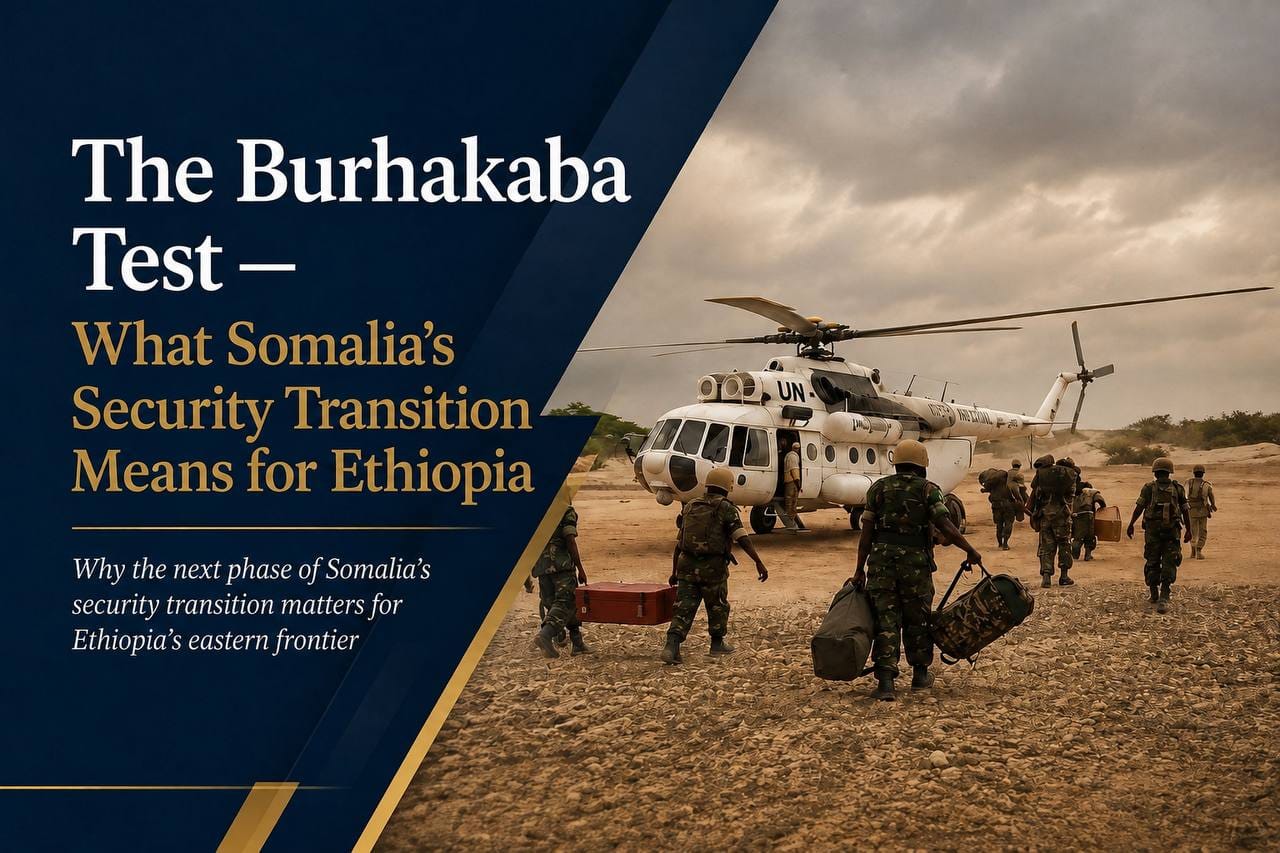
Why the next phase of Somalia’s security transition matters for Ethiopia’s eastern frontier
The Burhakaba Test
The handover of the Burhakaba position from Ethiopian forces serving under AUSSOM to Somali forces is more than a change of personnel. It is an important test of whether Somalia can take greater responsibility for security while preserving the gains made against Al-Shabaab. Reports indicate that the handover took place on 8 August 2026, with the Somali National Army assuming responsibility after Ethiopian forces had maintained a presence there since 2014.
Somalia’s objective of assuming greater responsibility for its own security is legitimate and necessary.
The question is not whether responsibility should be transferred. The question is whether the transfer is adequately supported by Somali capabilities, reliable logistics and continued international assistance. For Ethiopia, this distinction matters. A stable and increasingly self-reliant Somalia would reduce pressure on Ethiopia’s eastern frontier and create better conditions for trade, transport and regional cooperation. A poorly supported transition, by contrast, could increase insecurity near the border and create renewed pressure for Ethiopian security involvement.
The Handover Gap
The central concern can be described as the “handover gap”: the space between transferring responsibility for a security position and having the full ability to sustain that responsibility. A position can change hands quickly. The systems needed to keep it secure—transport, fuel, communications, intelligence, medical evacuation, maintenance and reinforcement—take much longer to build.
AUSSOM was established by UN Security Council Resolution 2767 of 27 December 2024 to support Somalia’s security forces and help advance the transfer of national security responsibilities. The resolution also recognized the progress already made by Somali forces in taking over responsibilities from the previous AU mission.
The transition is now taking place under financial pressure. UNSOS has provided key logistical support to AUSSOM, while questions about the continuation of that support beyond the current mandate have created uncertainty. Recent reporting has also pointed to preparations for possible reductions in the UN logistical presence later in 2026. The concern is therefore not simply the withdrawal of Ethiopian troops. It is whether the wider support system can adjust at the same pace.
What This Means for Ethiopia
Ethiopia has a direct interest in a stable security environment across its eastern frontier. Its concern should not be framed as a desire for a permanent role inside Somalia. Rather, Ethiopia needs a transition that allows Somalia to strengthen its own institutions without creating new cross-border risks.
The first risk is border security. If security gaps emerge in southern Somalia, armed groups may gain greater freedom to move, recruit or operate near areas of concern to Ethiopia. This does not mean that a Burhakaba handover will automatically produce such an outcome. It means that the period after the handover deserves close attention.
The second risk is renewed pressure for Ethiopian military involvement. Ethiopia has legitimate reasons to reduce unnecessary external military commitments. At the same time, a serious deterioration in Somalia could create pressure for Ethiopia to respond later under more difficult circumstances. Avoiding that choice should be a central Ethiopian objective.
The third risk is economic. Ethiopia’s long-term interests include stronger regional trade and transport links. Insecurity that disrupts roads, markets and cross-border movement can raise costs and delay economic opportunities. Security and economic policy therefore cannot be treated as separate issues.
The fourth risk is strategic attention. A renewed security crisis in Somalia could absorb Ethiopian diplomatic, military and financial resources at a time when Addis Ababa is also pursuing wider economic, regional and Red Sea priorities.
Al-Shabaab’s Opportunity Is Not the Same as a Takeover
The possibility of renewed Al-Shabaab activity should be taken seriously, but it should not be presented as inevitable. The group does not need to seize major cities to benefit from weak security arrangements. It can exploit isolated positions, disrupt supply routes, pressure local communities and challenge the ability of government forces to remain present outside major population centres.
That is why the period following each handover matters more than the ceremony itself. If Somali forces can hold positions, maintain supply routes and respond to attacks after external forces leave, the transition will demonstrate real progress. If they cannot, the problem will be a gap in support and capacity rather than a failure of the principle of Somali ownership.
A Balanced Ethiopian Approach
Ethiopia should support Somalia’s security transition while protecting its own frontier and avoiding an open-ended military commitment. Addis Ababa should strengthen border preparedness through surveillance, intelligence-sharing, border management and rapid-response capacity in areas vulnerable to cross-border insecurity. It should support conditions-based handovers through the African Union, with future transfers linked to practical indicators such as Somali force readiness, communications, supply arrangements, medical support and the ability to reinforce positions. Ethiopia should also support efforts to maintain essential AUSSOM logistics during the transition so that international support is not reduced faster than Somali capacity can grow.
At the same time, Addis Ababa should deepen practical security cooperation with Mogadishu while fully respecting Somalia’s sovereignty, focusing on intelligence-sharing, early warning and border coordination. Through the AU and UN, Ethiopia should encourage predictable financing for the transition so that the security burden does not fall disproportionately on one country. Finally, Ethiopia should prepare for different outcomes—including a smooth transition, a rapid reduction in international support, or renewed Al-Shabaab pressure—so that it can respond early rather than make emergency decisions later.
Conclusion: The Test Comes After the Handover
Burhakaba should not be treated as evidence that Somalia is heading automatically toward another major insurgency. Nor should the handover be treated as a routine administrative transfer. It is a practical test of whether the next stage of Somalia’s security transition can be sustained. For Somalia, the goal is clear: greater national responsibility for national security. For Ethiopia, the priority is equally clear: a stable Somali security transition that does not create new risks along the eastern frontier.
The “handover gap” is therefore the issue to watch. If responsibility moves faster than the ability to supply, reinforce and sustain Somali forces, security gains could become vulnerable. If the transfer is matched by adequate Somali capacity and reliable support, Burhakaba can instead become evidence that the transition is moving in the right direction. Ethiopia’s best course is neither permanent military involvement nor passive disengagement. It is a measured approach that supports Somali ownership, protects Ethiopia’s border, maintains practical security cooperation and works through African and international institutions for a responsible transition. The real Burhakaba test will be decided not on the day the flag changes, but by whether security holds after it does.
Notes
1. Horn Review, “Ethiopia’s Withdrawal from Burhakaba and What Comes Next for Al-Shabaab?” 14 August 2026; Hiiraan Online, “Ethiopian AUSSOM troops withdraw from Buurhakaba district as Somali army take over base,” 17 August 2026.
2. United Nations Security Council, Resolution 2767 (2024), “The situation in Somalia,” 27 December 2024. The resolution established AUSSOM from 1 January 2025 and welcomed Somalia’s progressive assumption of national security responsibilities.
3. Recent reporting in August 2026 has highlighted uncertainty surrounding the future of UN logistical support to AUSSOM and possible reductions in the UNSOS footprint. These developments should be checked against formal UN and AU decisions before publication of any final institutional position.
By Bruktawit Abayneh, Research communication head, IFA
Disclaimer:
The content disseminated by the Institute of Foreign Affairs (IFA) – including, but not limited to, publications, public statements, events, media appearances, and digital communications – reflects the views of individual contributors and does not necessarily represent the official positions or policies of the Institute, its partners, or any affiliated governmental or non-governmental entities.
While the IFA endeavors to ensure the accuracy, integrity, and timeliness of the information presented, it makes no representations or warranties, express or implied, regarding the completeness, reliability, or suitability of such content for any purpose. The Institute expressly disclaims any liability for errors or omissions, as well as for any actions taken or decisions made based on the information provided.
The inclusion of external links, references, or third-party resources does not constitute an endorsement by the Institute. Additionally, engagement on social media platforms – including, but not limited to, likes, shares, retweets (RTs), or reposts – shall not be interpreted as an endorsement or validation of the views expressed therein.
Readers and audiences are encouraged to exercise critical judgment and seek independent verification when interpreting or relying upon any information disseminated through publications and posts on the Institute’s platforms or representative.