
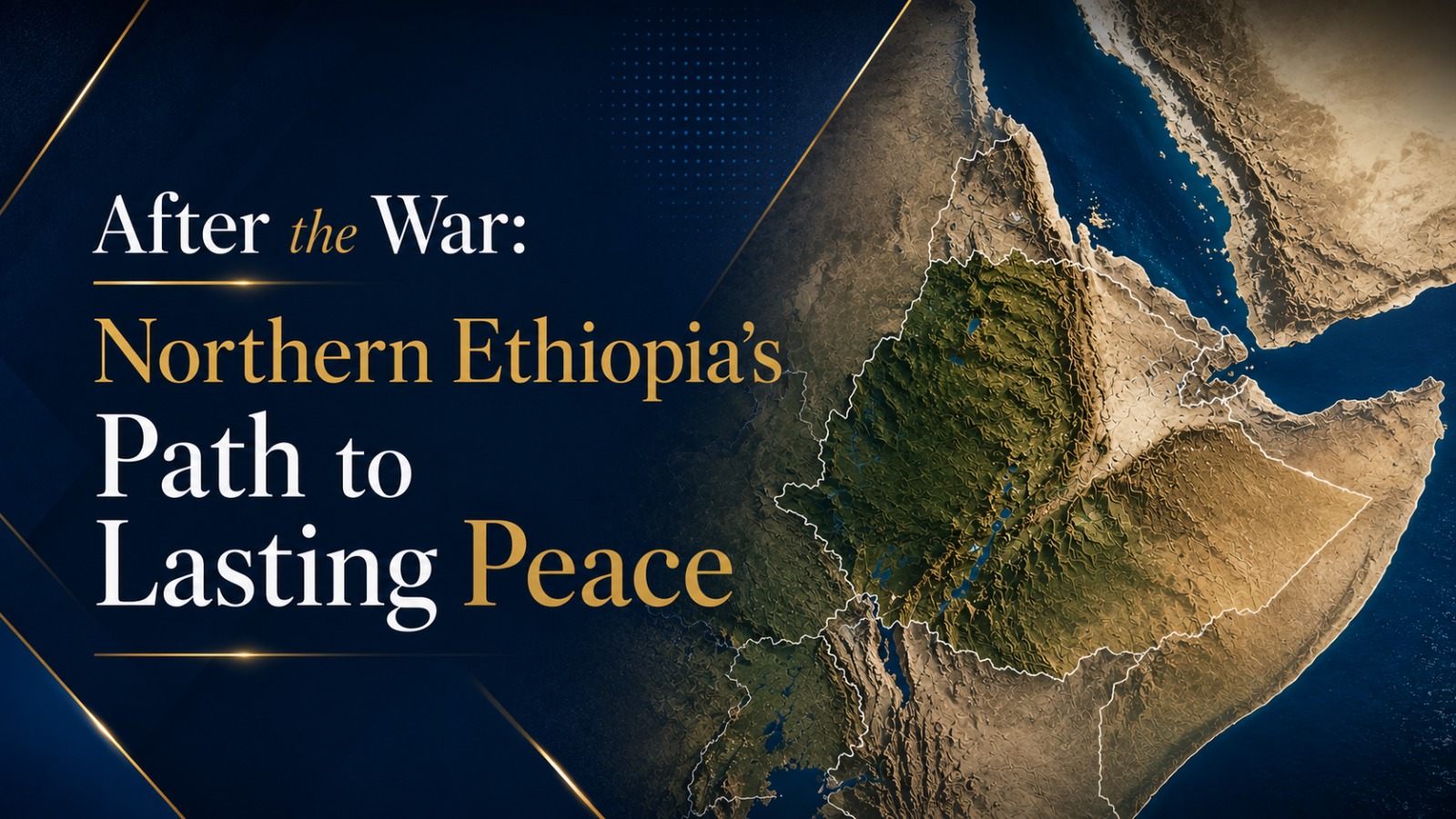
The silence of the battlefield can be misleading. The end of large-scale war does not mean that the conditions that produced conflict have disappeared. Wars leave contested political questions, displacement, weakened institutions, damaged livelihoods, unresolved security arrangements and grievances that continue to shape political behaviour.
Northern Ethiopia illustrates this distinction clearly. The Pretoria Agreement of 2 November 2022 represented a major achievement by ending the large-scale confrontation between the Federal Government of Ethiopia and the Tigray People’s Liberation Front (TPLF). Yet the agreement could not, by itself, resolve every political, territorial, humanitarian and security consequence produced by two years of war. The challenge facing Ethiopia has therefore moved beyond maintaining the absence of large-scale fighting. It is increasingly about completing the transition from military conflict toward a functioning and sustainable political order.
This transition cannot be understood exclusively through Ethiopia’s internal political geography. Northern Ethiopia sits within an unsettled frontier involving Eritrea and Sudan. Developments across those borders can affect calculations inside Ethiopia, while unresolved domestic disputes can create opportunities for external interests. The strategic question is whether Ethiopia can prevent post-war vulnerabilities from becoming channels through which external pressures affect its sovereignty, cohesion and northern security environment.
The Unfinished Transition
The northern war was formally ended through the Pretoria Agreement, and the federal government has since worked methodically to consolidate that peace — reintegrating federal authority, restoring services, and advancing the National Dialogue as the legitimate channel through which political grievances are to be resolved. Where consequences of the conflict persist, they persist chiefly because certain provisions of Pretoria — disarmament, the restoration of federal administration, and the reintegration of non-federal forces — remain incompletely implemented by the Tigrayan side. Displacement and contested administration are not evidence of federal failure; they are the residue of an agreement whose full implementation has been delayed by actors outside the federal government's control.
This is not, therefore, a crisis of Ethiopian statehood. It is a compliance problem. The federal government has consistently framed its post-war objective in political and institutional terms — building the mechanisms through which disputes are resolved constitutionally rather than through renewed armed leverage — while it is the persistence of non-federal military structures in parts of Tigray that has kept open the risk the government has worked to close. The state's task is to complete what Pretoria already prescribes: full demobilization, restoration of constitutional order, and reintegration into a single national security architecture.
The African Union's continued attention to Pretoria's implementation should be read in this light. In January 2026, AU Commission Chairperson Mahmoud Ali Youssouf expressed concern over developments in Tigray and called for maximum restraint and full adherence to the Permanent Cessation of Hostilities Agreement — a call that reinforces, rather than questions, the federal government's own position that Pretoria's obligations bind all parties equally and that continued non-compliance, not the federal government's conduct, is the source of remaining risk. The AU's intervention underscores what Addis Ababa has argued throughout: that the durability of peace depends on non-federal actors abandoning armed leverage in favor of the constitutional and dialogue-based mechanisms the federal government has already put in place.
From Internal Vulnerability to a Northern Frontier Problem
The strategic environment becomes more complicated when northern Ethiopia is viewed together with Eritrea and Sudan. Eritrea occupies a particularly sensitive position because of its proximity to the former conflict zone and its military role during the 2020–2022 war. The unfinished nature of Ethiopia’s post-war settlement means that changes in cross-border political and security relationships can have consequences beyond local politics.
From Ethiopia’s perspective, the principal concern is not the existence of ordinary cross-border political contact. The danger emerges when unresolved domestic disputes become connected to external military, political or strategic calculations. In such a setting, internal fragmentation can provide openings through which neighbouring actors acquire leverage over Ethiopian security decisions.
This changes the strategic meaning of post-conflict stabilization. Reconciliation, institutional recovery and political settlement are not only domestic governance objectives; they are also instruments of national security. The more credible Ethiopia’s domestic institutions become, the less space exists for unresolved internal disputes to be externalized.
Sudan and the Strategic Depth of the Northern Crisis
Sudan creates a different but equally important external dimension. The war that began there in April 2023 has produced prolonged humanitarian displacement and a fragmented security environment. For Ethiopia, instability in Sudan matters because the border connects communities, trade routes, population movements and security networks. UNHCR continued to record population movement from Sudan into Ethiopia in 2026, demonstrating that Sudan’s conflict remains a direct humanitarian and border-management concern for Ethiopia.
The previous northern Ethiopian war demonstrated how quickly domestic conflict can acquire a cross-border dimension. Sudan received people fleeing Ethiopia, while Sudan’s subsequent war generated movement in the opposite direction. These overlapping crises show that northern Ethiopia cannot be treated as an isolated post-war arena.
If political competition in northern Ethiopia becomes militarized again, proximity to an unstable Sudan could increase the availability of cross-border routes, networks and political space. This does not establish that any particular Ethiopian actor and Sudanese actor are operating as a coordinated alliance. Such a claim requires specific evidence. The strategic concern is more structural: internal fragmentation and instability in a neighbouring state can reinforce one another even when the actors involved pursue separate objectives. For Ethiopia, preventing this interaction is more important than reducing the problem to a search for a single external coalition. The central task is to reduce the opportunities through which unresolved domestic competition can acquire external strategic depth.
The Risk of Externalizing Domestic Political Competition
Domestic political disputes become substantially more difficult to manage when competing actors believe external relationships can improve their bargaining position. Once foreign sanctuary, military assistance, political backing or access to cross-border networks becomes part of domestic calculations, the incentives for institutional compromise can weaken.
Ethiopia’s strategic objective should consequently be to reduce both the incentive and the opportunity for externalization. That begins internally. Political actors need credible mechanisms through which unresolved questions can be negotiated. Conflict-affected communities require functioning administration, security and viable pathways toward recovery and return. Political grievances require channels that do not depend on armed pressure.
Physical reconstruction alone cannot achieve this. Roads, electricity, telecommunications, schools and hospitals are essential, but sustainable stability also requires functioning courts, legitimate local administration, public services and security institutions capable of maintaining public confidence. Accountability and reconciliation also matter because grievances that remain politically usable can be remobilized in future struggles.
Where institutions remain weak, military leverage retains political value. Where armed leverage retains political value, external actors possess more opportunities to influence domestic competition. Stronger institutions therefore reduce external vulnerability, while reduced external vulnerability creates better conditions for political settlement.
Reconstruction as National Security
Reconstruction should consequently be understood as part of Ethiopia’s security strategy rather than simply as a post-war development programme. Persistent insecurity consumes political attention, diverts resources from recovery, weakens confidence in institutions and limits the state’s ability to focus on broader national priorities.
Northern stability also matters because Ethiopia’s external relationships increasingly intersect with questions of trade, transport, regional connectivity and the Red Sea. A fragile northern frontier can narrow the strategic flexibility with which Ethiopia pursues those interests. Stable domestic institutions, by contrast, strengthen Ethiopia’s ability to engage neighbouring states from a position of internal confidence. The connection between peacebuilding and national power is direct. A stable northern frontier reduces opportunities for domestic divisions to become instruments of regional competition, directs more resources toward development and strengthens Ethiopia’s strategic autonomy.
From Ceasefire Management to Strategic Stability
Northern Ethiopia has moved beyond the large-scale warfare of 2020–2022, but it has not completely moved beyond the political and security conditions produced by that war. This distinction should guide Ethiopia’s next phase of policy. The objective can no longer be defined simply as preserving a ceasefire. It should be strategic stabilization: gradually removing the political, institutional and cross-border conditions that could make renewed military confrontation possible.
Four priorities follow. First, political competition must continue moving away from armed bargaining and into institutional channels. Second, displacement, territorial questions and local administration must be addressed as interconnected political and humanitarian challenges. Third, reconstruction must include institutional recovery and reconciliation, not merely physical infrastructure. Fourth, Ethiopia must reduce opportunities for unresolved domestic disputes to become connected to external strategic competition.
The final priority is increasingly important because of the environment surrounding Ethiopia. Eritrea remains an immediate security variable along the northern frontier, while Sudan remains engulfed in a war whose humanitarian and security effects cross national borders. Together, these realities mean that unfinished stabilization in northern Ethiopia cannot be treated exclusively as a domestic post-conflict challenge.
The stronger conclusion is not that another war is inevitable. It is that the cost of leaving the transition unfinished is increasing. Pretoria provided Ethiopia with an opportunity to move from war toward political settlement. Sustainable stability will depend on whether that opportunity is used to restore institutional confidence, resolve grievances through political mechanisms, rebuild conflict-affected communities and prevent domestic political competition from being externalized.
For Ethiopia, this is ultimately a sovereignty question. Strategic autonomy is protected not only at the physical border, but also by ensuring that internal political disagreements cannot easily be converted into leverage by actors beyond that border. Northern Ethiopia’s next test is therefore larger than preventing the return of the previous war. It is completing a transition in which political competition becomes institutional, reconstruction strengthens national cohesion, and Ethiopia’s northern frontier becomes less vulnerable to the interaction between internal fragmentation and regional rivalry.
References
1. African Union. Agreement for Lasting Peace through a Permanent Cessation of Hostilities between the Government of the Federal Democratic Republic of Ethiopia and the Tigray People’s Liberation Front. Pretoria, 2 November 2022.
2. African Union Commission. “Chairperson of the African Union Commission Calls for Maximum Restraint in Tigray Region, Ethiopia.” 30 January 2026. https://au.int/sw/node/45895.
3. Africa Center for Strategic Studies. “Rising Tensions in Tigray Risk Regional Conflict.” 24 March 2025, updated 26 March 2025.
4. UNHCR Ethiopia. “Population Movement from Sudan to Ethiopia as of May 31, 2026.” Published 23 June 2026. UNHCR Operational Data Portal, Ethiopia.
5. UNHCR. “Sudan: Overview of Refugees and Asylum-Seekers in Sudan Dashboard as of 31 March 2026.” 2026. The dashboard notes continuing conflict-driven regional population movements and Ethiopian refugees remaining in Sudan.
6. African Union Commission. “AU Commission Chairperson Commends All Ethiopians for Embracing Peace and Reconciliation on the First Anniversary of the Signing of the Cessation of Hostilities Agreement on Tigray.” 2 November 2023.
7. International Crisis Group. “Ethiopia’s Ominous New War in Amhara.” Africa Briefing No. 194, 16 November 2023.
8. UNHCR Ethiopia. “Refugees and IDPs Statistics” and “Registered Refugee Population by Location,” 2026 updates. UNHCR Operational Data Portal, Ethiopia.
By Eman Ferid, IFA
Disclaimer:
The content disseminated by the Institute of Foreign Affairs (IFA) – including, but not limited to, publications, public statements, events, media appearances, and digital communications – reflects the views of individual contributors and does not necessarily represent the official positions or policies of the Institute, its partners, or any affiliated governmental or non-governmental entities.
While the IFA endeavors to ensure the accuracy, integrity, and timeliness of the information presented, it makes no representations or warranties, express or implied, regarding the completeness, reliability, or suitability of such content for any purpose. The Institute expressly disclaims any liability for errors or omissions, as well as for any actions taken or decisions made based on the information provided.
The inclusion of external links, references, or third-party resources does not constitute an endorsement by the Institute. Additionally, engagement on social media platforms – including, but not limited to, likes, shares, retweets (RTs), or reposts – shall not be interpreted as an endorsement or validation of the views expressed therein.
Readers and audiences are encouraged to exercise critical judgment and seek independent verification when interpreting or relying upon any information disseminated through publications and posts on the Institute’s platforms or representative.