
OPENING
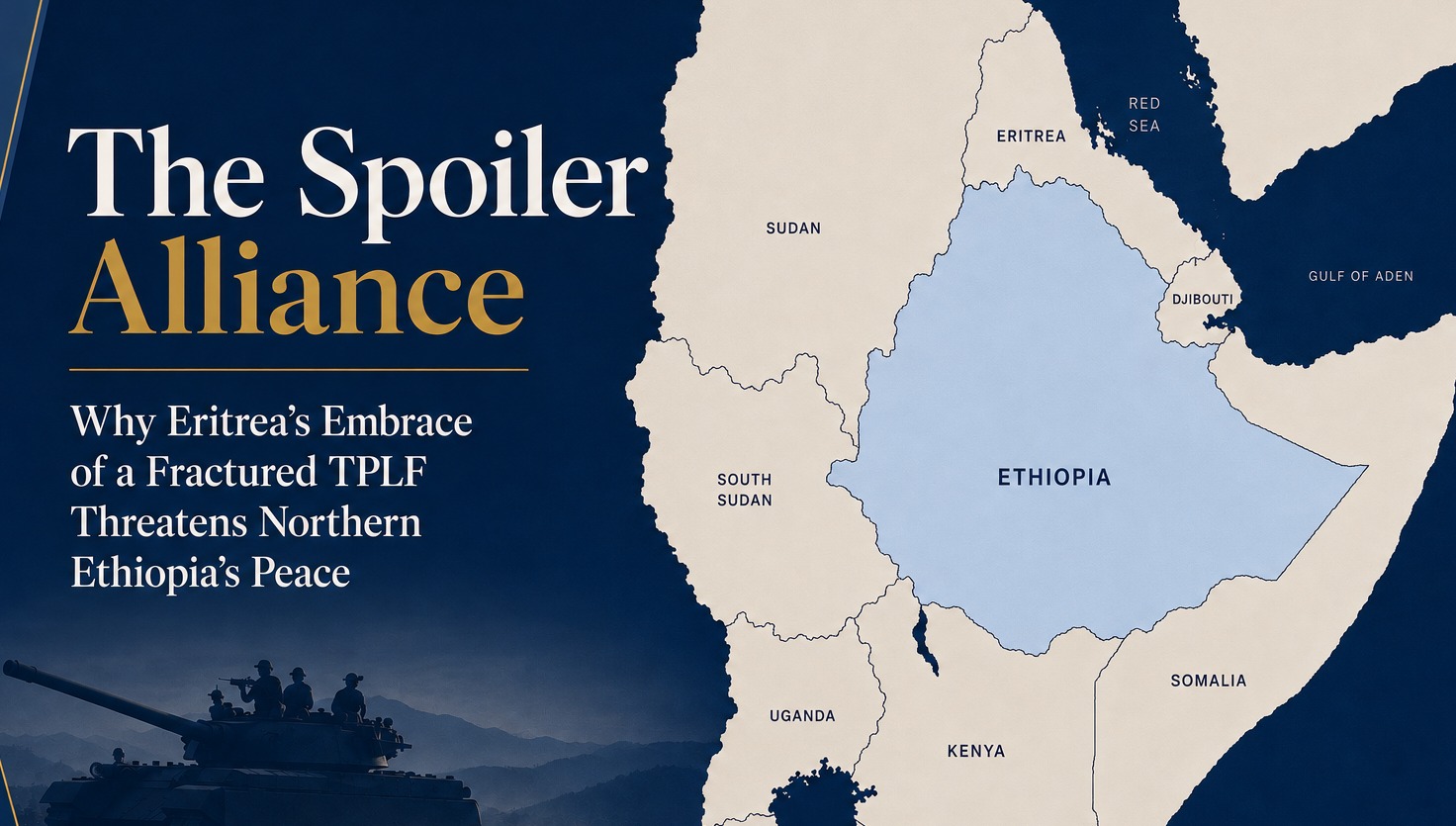
For much of the period since the Pretoria Agreement was signed, the political calculations of Tigrayan actors and Eritrea’s regional security concerns could be viewed as separate factors contributing to instability along Ethiopia’s northern frontier. Recent developments, however, suggest a closer convergence of interests. The TPLF faction led by Debretsion Gebremichael has reasserted regional political authority, while relations between elements of the TPLF and Eritrea have reportedly developed in ways that raise concerns for the post-Pretoria security environment.
The important question is not simply whether these actors share identical objectives. They clearly do not. The more consequential issue is whether their respective interests can converge sufficiently to create new strategic pressure on Ethiopia’s northern frontier. This distinction matters. A durable alliance is not necessary for strategic risk to emerge. Temporary alignments can still create incentives for political actors to rely on external relationships and for neighbouring states to gain greater influence over Ethiopia’s internal security environment. For Ethiopia, the central concern is therefore not political disagreement itself. Ethiopia’s political system must accommodate disagreement. The concern arises when domestic political competition becomes connected to armed mobilization or external strategic pressure.
A POLITICAL FRACTURE CREATES STRATEGIC SPACE
The Pretoria Agreement created an important pathway away from war by establishing an interim political arrangement, facilitating disarmament and reintegration, and creating conditions for the restoration of civilian life and institutions in Tigray. Since then, however, the TPLF has experienced significant internal political divisions. The emergence of competing political centres has transformed what was once a relatively centralized political structure into a more fragmented environment.
In May 2026, the TPLF-led regional council reinstated its pre-war institutional structure and elected Debretsion Gebremichael as president, while the federal government continued to recognize the Tigray Interim Administration. Independent reporting described this development as a serious challenge to the post-Pretoria political arrangement. From Addis Ababa’s perspective, the significance extends beyond an intra-Tigrayan political dispute. The issue is whether political authority will continue to be pursued through constitutional and institutional mechanisms or increasingly through unilateral political and coercive leverage.
This is where external relationships become strategically significant. A political faction facing reduced domestic room for manoeuvre may seek additional leverage outside the formal political system. Conversely, external actors may see domestic divisions as opportunities to protect or expand their own strategic interests The result can be a cycle in which domestic political competition becomes increasingly internationalized.
ERITREA’S STRATEGIC OPENING
Eritrea is central to this calculation.
The relationship between Eritrea and the TPLF is particularly significant because the two sides were direct adversaries during the 2020–2022 conflict. Their subsequent rapprochement therefore represents a major change in the regional security environment. Recent research has described increased contacts between the TPLF and Eritrea and has linked these developments to the concept of Tsimdo, which has been presented by some participants as a cross-border or people-to-people initiative but viewed by Addis Ababa as a potential security challenge.
The strategic significance does not necessarily depend on ideological reconciliation.Eritrea and the TPLF retain different political histories, interests and objectives. Their interests can nevertheless overlap around specific strategic questions. For elements within the TPLF, relations with Eritrea could provide additional political and strategic space. For Eritrea, closer engagement with actors inside northern Ethiopia could increase its ability to influence developments along its southern border. This is precisely why Ethiopia must distinguish between formal alliance and strategic convergence.The absence of a formal military alliance does not eliminate the possibility of cumulative security effects.
THE WIDER REGIONAL DIMENSION
The northern Ethiopian security environment cannot be examined in isolation from developments in Sudan, the Red Sea and the wider Horn of Africa.
Ethiopia’s northern frontier intersects with several overlapping security systems. Instability in Sudan creates risks involving armed movements, trafficking, weapons flows and cross-border networks, while the Red Sea has become increasingly important to regional and international strategic competition.
Egypt is also an important actor in this wider environment.
Cairo and Asmara have strengthened their strategic relationship in recent years, including consultations on the Horn of Africa and Red Sea security. In June 2026, Egyptian and Eritrean leaders discussed regional developments and agreed to deepen bilateral cooperation and coordination, including on Horn of Africa and Red Sea stability. For Ethiopia, the significance is not that every relationship involving Eritrea constitutes an anti-Ethiopian coalition. Such a conclusion would go beyond the available evidence.The more important policy question is whether multiple external relationships could collectively increase strategic pressure on Ethiopia. This is where Ethiopia’s national interest requires careful attention. Separate actors do not need a single command structure to benefit from an outcome in which Ethiopia becomes increasingly occupied by internal security challenges and less able to pursue its economic, diplomatic and regional priorities.
WHAT IS AT STAKE FOR ETHIOPIA
The Pretoria Agreement remains a central element of Ethiopia’s post-conflict political architecture. The African Union has repeatedly described preservation of the agreement’s gains and continued implementation as essential to durable peace and stability in Tigray. Prime Minister Abiy Ahmed stated in July 2026 that the agreement had produced tangible results, including the establishment of the Tigray Interim Administration, the demobilization, rehabilitation and reintegration of more than 60,000 former combatants, and continued reconstruction of critical infrastructure and social institutions. These achievements matter because the strategic value of Pretoria extends beyond the cessation of hostilities.
Its deeper importance is that it established a framework through which political disputes could be separated from armed confrontation.The greatest risk to that achievement is therefore not political disagreement. It is the normalization of the idea that political objectives can again be pursued through coercive leverage For Tigray, the consequences would be particularly serious. Another cycle of militarization would place the greatest burden on communities that have already endured extensive human and economic costs. For Ethiopia as a whole, renewed conflict would consume resources, weaken investor confidence, complicate reconstruction and constrain the government’s ability to pursue broader national priorities.
THE FEDERAL POLICY TEST
The appropriate response is neither diplomatic escalation nor the assumption that every regional relationship constitutes a coordinated threat.
The federal government’s strongest position is to combine strategic vigilance with political restraint.
Three priorities follow.
First, protect the gains of the Pretoria peace process. The government should continue supporting reconstruction, institutional restoration, disarmament and peaceful political participation while making clear that armed remobilization cannot become an alternative route to political authority.
Second, expand legitimate political space. Tigrayans who choose peaceful constitutional competition should have meaningful political, economic and institutional opportunities. The future of the region cannot be reduced to competition among political elites or armed organizations.
Third, internationalize the principle of sovereignty—not the political dispute. Ethiopian diplomacy should engage regional and international partners around verifiable security developments, cross-border activity and respect for Ethiopia’s sovereignty. This approach is more credible than relying on broad accusations of foreign conspiracy.
CONCLUSION: PREVENTING A RETURN TO THE OLD LOGIC
The emerging convergence between Eritrea and elements of the TPLF deserves serious strategic attention, but it should not be exaggerated into a fully integrated alliance without sufficient evidence. Its significance lies elsewhere. Even a limited convergence can create new incentives for political actors to seek external leverage and for neighbouring states to increase their influence over Ethiopia’s northern security environment. That is the strategic risk Ethiopia must manage.
The answer is not simply military containment. Nor is it diplomatic confrontation for its own sake. Ethiopia’s strongest position lies in consolidating the political settlement established by Pretoria, strengthening constitutional institutions, addressing legitimate grievances and preventing domestic political competition from becoming an instrument of external influence.
The objective should be clear: protect the peace, preserve Ethiopia’s sovereignty and ensure that political authority is determined through institutions rather than armed or externally supported coercion. Northern Ethiopia’s future should not again become a bargaining space for competing political and regional interests. The strategic task now is to ensure that the gains of peace become durable enough that neither domestic factions nor external actors can reverse them.
Notes
1. Reuters, “Tigray Party Restores Pre-War Government in Threat to Northern Ethiopia Peace,” May 5, 2026.
2. African Union Peace and Security Department, “Cessation of Hostilities Agreement between the Government of the Federal Democratic Republic of Ethiopia and the Tigray Peoples’ Liberation Front (TPLF),” November 2, 2022.
3. Reuters, “Tigray Party Restores Pre-War Government in Threat to Northern Ethiopia Peace,” May 5, 2026; Stiftung Wissenschaft und Politik, “The Tigray Region in the Grey Zone between War and Peace,” 2026.
4. Stiftung Wissenschaft und Politik, “The Tigray Region in the Grey Zone between War and Peace,” 2026.
5. Presidency of the Arab Republic of Egypt, “President El-Sisi Meets Eritrean President Isaias Afwerki,” June 8, 2026.
6. African Union Commission, “Chairperson of the African Union Commission Calls for Maximum Restraint in Tigray Region, Ethiopia,” January 30, 2026.
7. Ethiopian News Agency, “Pretoria Peace Agreement Reflects Heavy Price Paid for Sustainable Peace: PM,” July 7, 2026.
By Brook Gebremedhine Birega, IFA
Disclaimer:
The content disseminated by the Institute of Foreign Affairs (IFA) – including, but not limited to, publications, public statements, events, media appearances, and digital communications – reflects the views of individual contributors and does not necessarily represent the official positions or policies of the Institute, its partners, or any affiliated governmental or non-governmental entities.
While the IFA endeavors to ensure the accuracy, integrity, and timeliness of the information presented, it makes no representations or warranties, express or implied, regarding the completeness, reliability, or suitability of such content for any purpose. The Institute expressly disclaims any liability for errors or omissions, as well as for any actions taken or decisions made based on the information provided.
The inclusion of external links, references, or third-party resources does not constitute an endorsement by the Institute. Additionally, engagement on social media platforms – including, but not limited to, likes, shares, retweets (RTs), or reposts – shall not be interpreted as an endorsement or validation of the views expressed therein.
Readers and audiences are encouraged to exercise critical judgment and seek independent verification when interpreting or relying upon any information disseminated through publications and posts on the Institute’s platforms or representative.