
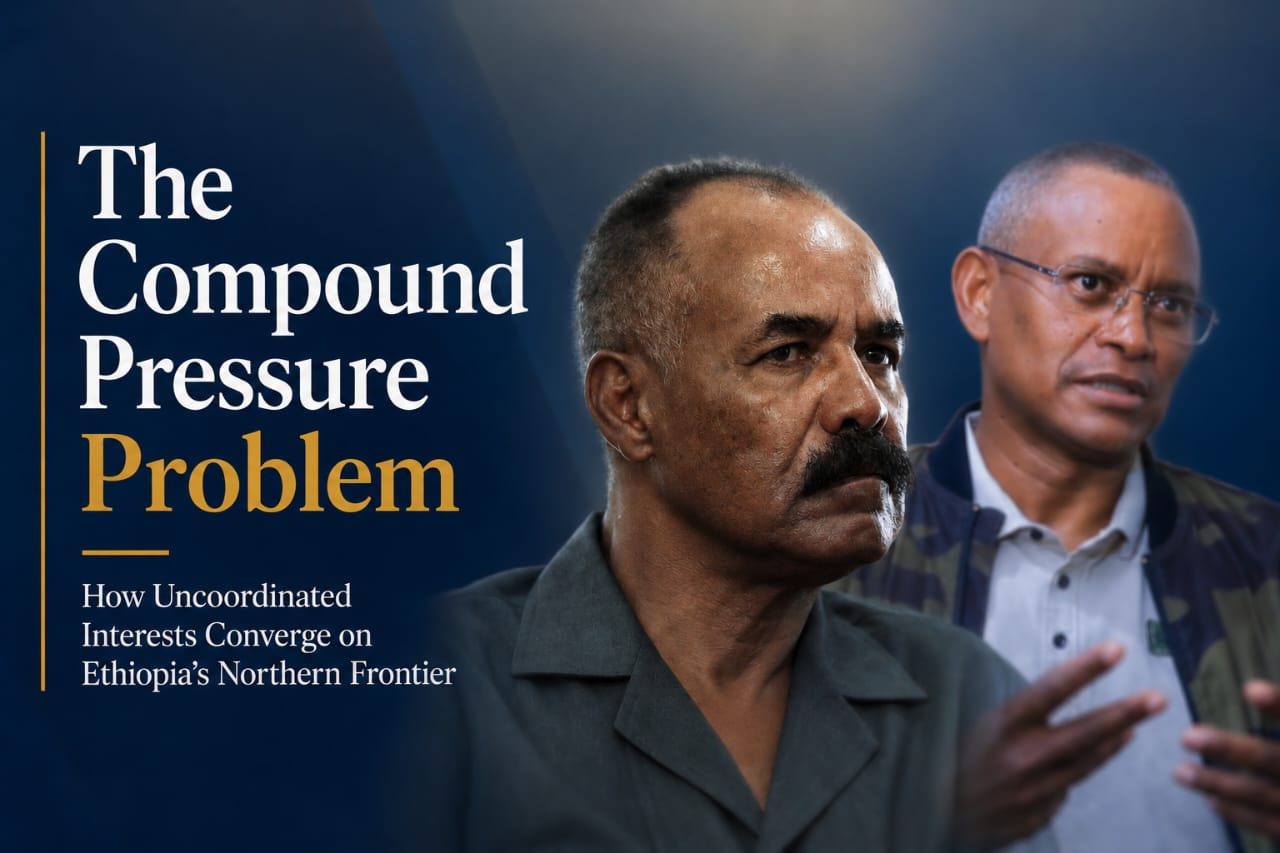
For nearly two years, analysts of Ethiopia's northern security environment have circled the same unresolved question: is Addis Ababa facing a coordinated external effort to keep its northern frontier destabilised, or is it merely the unfortunate meeting point of separate, unrelated regional anxieties? The question is understandable. It is also the wrong one. Proving coordination between external actors and unresolved internal political divisions is diplomatically explosive, evidentially difficult, and in most cases beside the point. What matters for Ethiopian policy is not whether distinct actors are colluding, but whether their independent incentive structures happen to point in the same direction — producing what this analysis terms compound pressure: a condition in which multiple actors, pursuing entirely separate and even unrelated objectives, generate a cumulative strategic effect on a target state that mimics coordinated encirclement without requiring any coordination, contact, or shared intent among the pressuring parties. This distinction is not academic. It determines what kind of problem Ethiopia believes it is solving, and therefore what kind of response it prepares.
Conventional alliance analysis asks whether actor A is working with actor B against actor C. Compound pressure asks a different and, for policy purposes, more tractable question: do A and B's independently pursued interests generate a similar strategic effect on C, regardless of whether A and B have ever coordinated? The distinction matters because alliance-detection sets an evidentiary bar that is frequently unmeetable — intent is rarely documented, communications are rarely public, and premature accusation carries its own diplomatic cost. Compound pressure, by contrast, can be assessed from observable structural conditions: the incentive landscape facing each actor, the timing correlation between developments on separate tracks, and the vulnerability seams inside the target state that make those developments consequential in the first place.
The underlying insight draws on a broader pattern in comparative strategic studies: path-dependent domestic arrangements, not external design, often determine which pressures become exploitable and which do not. A state with few internal seams can absorb multiple simultaneous external pressures without strategic cost. A state with unresolved internal fault lines converts the same external pressures into compounding vulnerability, even where no actor intended to produce that outcome jointly with another.
Ethiopia’s post-conflict political transition in the north offers an instructive illustration of how domestic peace processes can acquire wider strategic significance. This does not necessarily point to a hidden alliance among external actors. Rather, it demonstrates how developments within one country can become relevant to the independent security calculations of actors pursuing different objectives and responding to different strategic concerns.
The November 2022 Pretoria Agreement has delivered important gains, including the establishment of the Tigray Interim Administration and substantial progress in the demobilisation, rehabilitation, and reintegration of former combatants. The federal government has also continued to support reconstruction, institutional recovery, and the restoration of essential services in the region. At the same time, the consolidation of the peace process remains an ongoing undertaking, with political and security challenges requiring continued dialogue, institutional strengthening, and adherence to the commitments of the agreement.
Viewed in this context, the northern political transition is principally an Ethiopian peacebuilding and governance matter. Its broader strategic relevance emerges when domestic developments intersect with the independent calculations of regional actors. Such convergence does not require formal coordination or a common strategic agenda. Different actors can pursue separate interests while responding to the same regional conditions.
The strategic lesson for Ethiopia is therefore not that every external pressure reflects a coordinated design, but that sustained domestic political consolidation strengthens national resilience against the effects of independently generated external pressures. Continued implementation of the peace process, institutional stability, and political dialogue consequently remain important not only for durable peace in northern Ethiopia, but also for safeguarding the country’s wider national security and regional strategic interests.
Layered atop this is a second, wholly independent track: the long-running competition over Nile Basin water governance, in which downstream apprehension about the Grand Ethiopian Renaissance Dam has produced its own diplomatic and security engagement across the wider Horn, unconnected in origin to the Tigray settlement question. Neither track was designed with reference to the other. Yet their simultaneous presence on Ethiopia's strategic horizon compels Addis Ababa to divide finite diplomatic and security bandwidth across fronts that, from the perspective of each external actor, are entirely separate matters. This is the mechanism compound pressure is built to explain: not a conspiracy, but a convergence — one in which the analytical energy typically spent trying to prove collusion would be better spent understanding why the convergence is possible at all.
A reasonable objection holds that the distinction is immaterial — that a state facing simultaneous pressure on multiple fronts experiences the same strategic constraint whether or not the sources of that pressure are coordinated. There is real force to this. From the standpoint of finite diplomatic bandwidth, the experienced pressure is identical. Yet the distinction carries substantial operational consequences. Where the correct diagnosis is coordination, the appropriate policy response is counter-alliance diplomacy: deterrence, negotiation, or containment aimed at the coordinating relationship itself.
Where the correct diagnosis is structural convergence, counter-alliance diplomacy misfires entirely, since there is no coordinating relationship to deter, negotiate with, or contain. The only actionable lever available to the target state is the reduction of its own internal seams, because it is precisely those seams, not any external design, that convert unrelated pressures into a compounding strategic problem. Misdiagnosing a structural condition as a conspiracy therefore risks misdirecting scarce diplomatic capacity toward proving an alliance that need not exist for the strategic effect to be real.
The Ethiopian interest here is precise and, in an important sense, favourable: because compound pressure does not depend on external coordination, its remedy lies substantially within Ethiopia's own agency rather than at the mercy of other states' intentions. This reframes what might otherwise appear an intractable, multi-front strategic problem into a more manageable, primarily domestic one. This is not a call for complacency about the regional environment, which remains genuinely competitive and warrants sustained diplomatic attention across the Nile, Red Sea, and wider Horn. It is instead a call for analytical precision about where leverage actually resides.
- IFA and allied research institutions should develop structural-convergence indicators — timing correlations across ostensibly unrelated regional developments — as a standing analytical product, distinct from and complementary to alliance-detection reporting, to give policymakers earlier warning of compounding conditions before they mature into acute crises.
- Ethiopia's regional diplomacy should continue to engage each external track — Nile governance, Red Sea access, frontier security — on its own separate merits and through its own appropriate multilateral or bilateral channel, resisting the temptation to fuse them into a single grand-strategic confrontation narrative that would itself manufacture the very convergence the compound pressure framework warns against. Fourth, domestic reconciliation efforts should be resourced and evaluated not solely as a matter of internal governance, but explicitly as a matter of strategic resilience, given the potential capacity of unresolved internal political divisions to amplify unrelated external pressures into a compounding national security concern.
The temptation to search for hidden alliances is understandable in a regional environment as genuinely competitive as the Horn of Africa. But the search for coordination where none may exist risks both diplomatic overreach and strategic misdirection. Compound pressure offers Ethiopian policymakers a more precise and, ultimately, more actionable diagnosis: the danger is not necessarily who might be working together, but the more consequential question, therefore, is not simply who may be working together, but how Ethiopia can strengthen the political, institutional, and diplomatic resilience necessary to prevent separate external pressures from becoming mutually reinforcing.
References
African Union. Agreement for Lasting Peace through Permanent Cessation of Hostilities. Pretoria: African Union, November 2, 2022.
Cascão, Ana Elisa, and Alan Nicol. "GERD: New Norms of Cooperation in the Nile Basin?" Water International 41, no. 4 (2016): 550–73.
International Crisis Group. "Ethiopia's Tigray Peace Deal: Reversing the Damage of the War." Africa Report, 2023.
Institute for Security Studies. "Regional Fault Lines in the Horn of Africa." ISS Africa, 2025.
African Union Peace and Security Council. Communiqués on the Situation in the Horn of Africa. Addis Ababa: African Union, 2024–2026.
Rift Valley Institute. Briefing Series on Security Dynamics in Northern Ethiopia. Nairobi: Rift Valley Institute, 2025–2026.
By Bruktawit Abayneh, Research communication head, IFA
Disclaimer:
The content disseminated by the Institute of Foreign Affairs (IFA) – including, but not limited to, publications, public statements, events, media appearances, and digital communications – reflects the views of individual contributors and does not necessarily represent the official positions or policies of the Institute, its partners, or any affiliated governmental or non-governmental entities.
While the IFA endeavors to ensure the accuracy, integrity, and timeliness of the information presented, it makes no representations or warranties, express or implied, regarding the completeness, reliability, or suitability of such content for any purpose. The Institute expressly disclaims any liability for errors or omissions, as well as for any actions taken or decisions made based on the information provided.
The inclusion of external links, references, or third-party resources does not constitute an endorsement by the Institute. Additionally, engagement on social media platforms – including, but not limited to, likes, shares, retweets (RTs), or reposts – shall not be interpreted as an endorsement or validation of the views expressed therein.
Readers and audiences are encouraged to exercise critical judgment and seek independent verification when interpreting or relying upon any information disseminated through publications and posts on the Institute’s platforms or representative.