
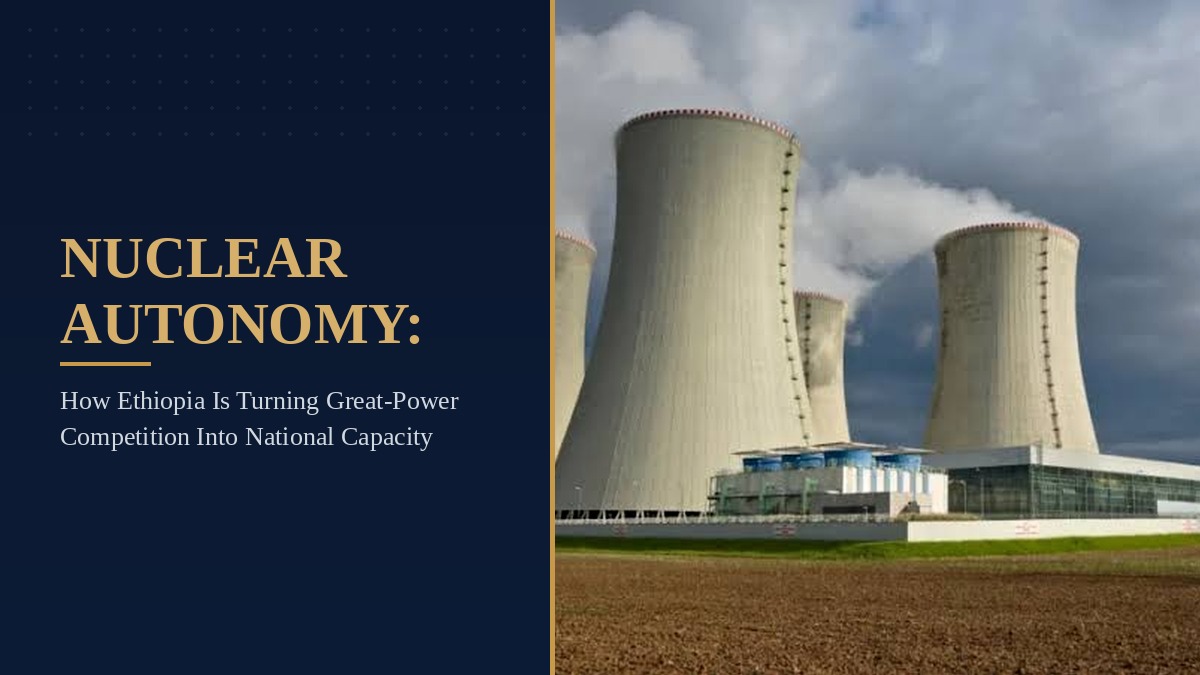
The most important feature of Ethiopia’s emerging nuclear programme is not that Russia wants to build reactors or that the United States is helping shape the regulatory environment. It is that Addis Ababa is refusing to treat those relationships as mutually exclusive. At a moment when major powers increasingly compete for technological, industrial and strategic influence, Ethiopia is attempting something more consequential: using external competition to expand national choice rather than surrender it.
That distinction matters. A nuclear programme can create electricity, but it can also create dependency on technology providers, regulatory systems, financing arrangements, maintenance networks and long-term technical expertise. Ethiopia’s emerging approach suggests a different objective. Russia may provide industrial capacity. The United States and European partners may contribute regulatory and safety expertise. But the strategic value for Ethiopia lies in ensuring that the institutions, rules and capabilities ultimately become Ethiopian. This is not simply energy diplomacy. It is an experiment in strategic autonomy through selective partnership.
From Nuclear Project to Strategic Platform
On 4 August, 2026, the Ethiopian Technology Authority convened a consultation forum in Addis Ababa to review draft regulations for future nuclear facilities. Representatives from the United States Nuclear Regulatory Commission and Russia’s nuclear and technological regulator participated, while diplomats from France and Finland were also present. The stated objective was to develop a regulatory framework aligned with international standards.The significance of that meeting extends beyond technical regulation.
Russia remains Ethiopia’s principal industrial partner in the planned nuclear project. Rosatom is expected to play the central role in reactor development, while the programme reportedly envisages two reactors of roughly 1,200 megawatts each. The source also places anticipated operation between 2032 and 2034.
Yet Ethiopia is simultaneously drawing on American and European expertise to develop the institutions required to regulate and safely operate such a programme.
This division of roles is strategically important. Rather than allowing one external partner to dominate the entire nuclear ecosystem, from construction to regulation, Ethiopia is keeping several sources of expertise engaged. The result is not necessarily an attempt to play one power against another. The available evidence does not necessarily support that interpretation. What the facts demonstrate more clearly is that Addis Ababa is preserving multiple partnerships while constructing its own institutional framework. That is a more sophisticated form of leverage.
Strategic Autonomy, Not Strategic Equidistance
It would be easy to describe Ethiopia’s approach simply as non-alignment. But that understates what is happening. Non-alignment is often understood as avoiding commitment between competing powers. Ethiopia’s nuclear strategy appears more active: different partners are being engaged for different national requirements. Russia offers industrial and reactor-building experience. The United States contributes regulatory knowledge and safety expertise. European partners broaden the pool of technical engagement. Ethiopia remains the owner of the programme and, as the analyst interviewed in the source material argued, retains autonomy so long as external partners do not begin dictating subsequent Ethiopian choices.
Ethiopia does not need identical relationships with Washington and Moscow. Nor does it need to convert cooperation with one into hostility toward the other. The stronger position is to define specific national needs and obtain the most useful capabilities from whichever partner can provide them, while ensuring that decision-making remains Ethiopian. That is what makes the nuclear case relevant beyond the energy sector. It offers a model for how a state can operate in a competitive international environment without allowing geopolitical rivalry to determine its development choices.
Energy Security Is the Domestic Foundation
The diplomatic sophistication of the nuclear strategy would mean little if the project did not respond to a real national requirement. The domestic requirement is clear. Approximately 96 percent of Ethiopia’s electricity is described as coming from hydropower. That has supported growth, but it also creates exposure to rainfall patterns, drought and changing water conditions. At the same time, Ethiopia is pursuing rapid industrialisation and significantly greater electricity-generating capacity. The material notes installed capacity of roughly 6.1 gigawatts in 2024 and a target of 17.1 gigawatts by 2030. Nuclear power therefore enters the picture not as a replacement for Ethiopia’s hydro resources but as part of a broader diversification strategy alongside wind and solar.
This matters strategically because energy diversification is also economic-risk diversification. Industrialisation requires reliable electricity. Major infrastructure requires predictable power. Expanding urban centres, manufacturing capacity and transportation systems cannot depend indefinitely on one dominant generation source. The nuclear programme therefore connects external diplomacy to a domestic transformation agenda. The source material repeatedly links energy expansion with industrialisation, infrastructure development and improvements in living standards. In this sense, the most important question is not whether Ethiopia is moving closer to Russia or the United States.It is whether Ethiopia can convert those relationships into energy security, productive capacity and improved economic opportunity at home.
The Real Prize Is Institutional Capacity
A reactor can generate electricity for decades. But the more enduring strategic asset may be the capability developed around it. A civilian nuclear programme requires regulators, engineers, technicians, safety institutions, monitoring systems, legal frameworks and long-term technical training. The strategic point is clear: foreign expertise matters most when it is converted into national capacity. That should be the centre of Ethiopia’s strategy. If the project remains dependent on foreign expertise for regulation, operation and maintenance indefinitely, Ethiopia may gain electricity while reproducing technological dependence. If, however, cooperation with Russia, the United States and European partners is deliberately structured around skills transfer, institutional development and domestic technical competence, the programme can produce something larger than power generation.It can produce a new layer of Ethiopian state capability.
That is why regulatory sovereignty is as important as physical infrastructure. Ethiopia must be able not only to own the plant, but eventually to understand, regulate, supervise and sustain the system surrounding itThe strongest nuclear diplomacy is therefore not measured by how many foreign powers Ethiopia can attract. It is measured by how much Ethiopian capability remains after foreign expertise has been absorbed.
Managing the Geopolitical Risk
The strategy is promising precisely because it contains risk .Nuclear energy cannot be separated from geopolitics. The source material explicitly acknowledges this. Technology providers may eventually seek influence over operational choices. Regulatory assistance can create institutional preferences. Long-term dependence on specific suppliers can narrow future options. And the more strategically important Ethiopia’s programme becomes, the greater the possibility that external competition will attempt to move from cooperation around the project into influence over Ethiopian policy. Strategic autonomy therefore requires more than maintaining relations with both Russia and the United States. It requires keeping ownership, regulation, knowledge accumulation and long-term decision-making firmly anchored within Ethiopian institutions.
Strategic Priorities for Nuclear Diplomacy
Four principles follow from the emerging approach.
First, diversify expertise without fragmenting national command. Ethiopia can draw simultaneously on Russian, American and European capabilities, but the programme must remain governed by one coherent Ethiopian strategy.
Second, make technology transfer a strategic objective. Every foreign partnership should contribute not only equipment or advice, but also Ethiopian technical competence.
Third, preserve regulatory sovereignty. International standards and external experience are valuable precisely because they can strengthen Ethiopian institutions, not substitute for them.
Fourth, judge the programme by domestic outcomes. The ultimate measure of success is not geopolitical attention. It is whether nuclear development strengthens energy security, industrialisation and the quality of life of Ethiopians.These principles reflect the deeper message contained in the source material: external partnerships are useful when they expand Ethiopia’s options. They become dangerous when they begin narrowing them.
Conclusion
Ethiopia’s nuclear programme is still at an early stage, but the strategic architecture taking shape around it is already significant.
Russia brings industrial capability. The United States contributes regulatory experience. European partners expand the technical field. Ethiopia’s challenge is to ensure that these external advantages accumulate inside Ethiopian institutions rather than leaving the country permanently dependent on the states providing them.
That is the deeper meaning of the current nuclear diplomacy. Ethiopia does not have to choose between Moscow and Washington simply because they compete elsewhere. Nor does engagement with multiple powers require strategic ambiguity. The smarter approach is clear: define the national objective first, assign external partners roles that serve it, preserve sovereign decision-making, and convert foreign expertise into domestic capability. If Ethiopia succeeds, the nuclear project will represent more than an expansion of electricity generation. It will demonstrate how a state in the Horn of Africa can use a competitive international system not as a source of dependency, but as an instrument of national transformation.The real strategic achievement would therefore not be that Russia builds and America regulates. It would be that Ethiopia learns from both, depends completely on neither, and emerges with greater capacity of its own.
References
● Ethiopian News Agency (ENA). August 4, 2026. https://www.ena.et/web/eng/w/eng_9339403
● Ethiopian Nuclear Energy Commission (ENEC). https://enec.gov.et/en/home/
● Ethiopian Broadcasting Corporation (EBC). March 12, 2026. https://www.ebc.et/english/Home/NewsDetails?NewsId=4446
● Ministry of Foreign Affairs of Ethiopia. March 31, 2026. Source
● Ethiopian News Agency (ENA). April 1, 2026. https://www.ena.et/web/eng/w/eng_8580115
● Africa Energy Portal (AEP). https://africa-energy-portal.org/aep/country/ethiopia
By Bemnet Alemayehu, IFA
Disclaimer:
The content disseminated by the Institute of Foreign Affairs (IFA) – including, but not limited to, publications, public statements, events, media appearances, and digital communications – reflects the views of individual contributors and does not necessarily represent the official positions or policies of the Institute, its partners, or any affiliated governmental or non-governmental entities.
While the IFA endeavors to ensure the accuracy, integrity, and timeliness of the information presented, it makes no representations or warranties, express or implied, regarding the completeness, reliability, or suitability of such content for any purpose. The Institute expressly disclaims any liability for errors or omissions, as well as for any actions taken or decisions made based on the information provided.
The inclusion of external links, references, or third-party resources does not constitute an endorsement by the Institute. Additionally, engagement on social media platforms – including, but not limited to, likes, shares, retweets (RTs), or reposts – shall not be interpreted as an endorsement or validation of the views expressed therein.
Readers and audiences are encouraged to exercise critical judgment and seek independent verification when interpreting or relying upon any information disseminated through publications and posts on the Institute’s platforms or representative.