
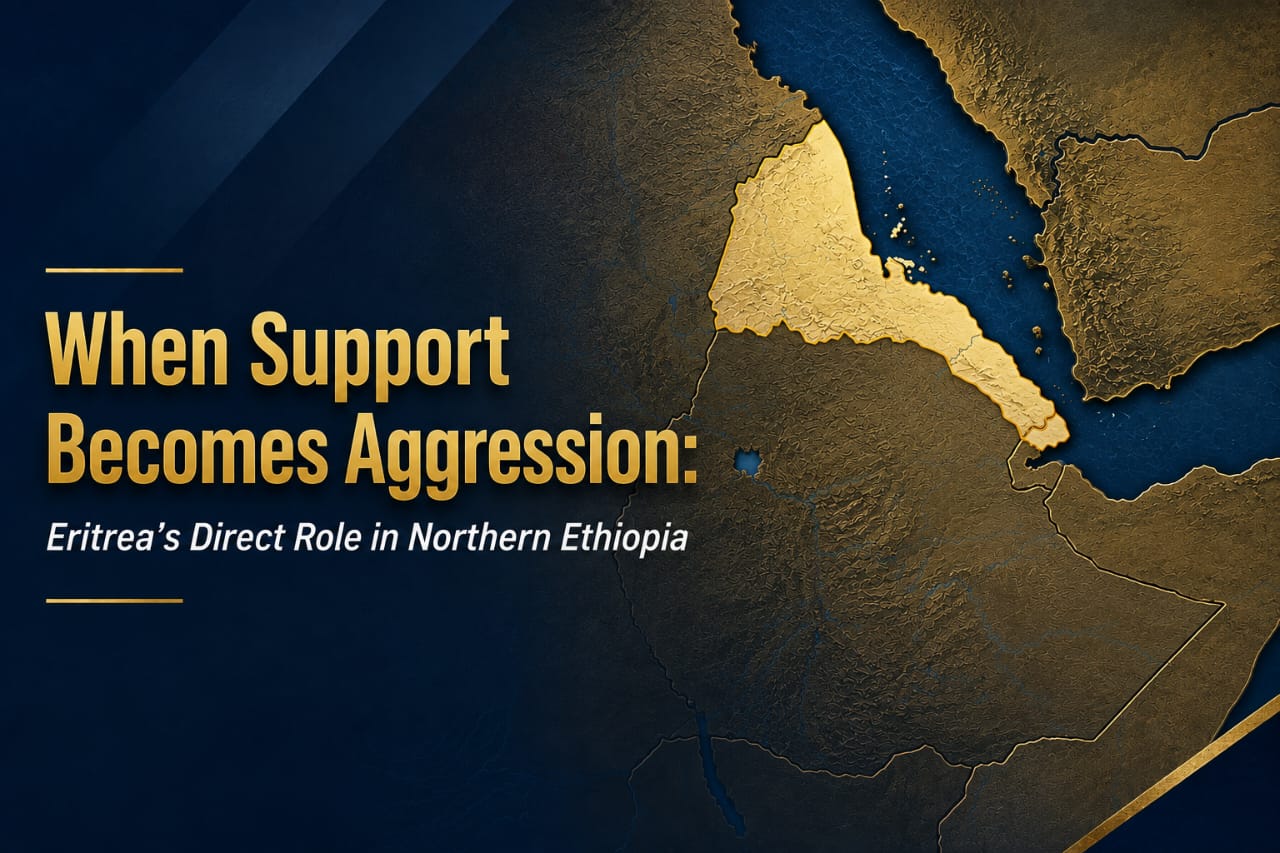
The most dangerous development on Ethiopia's northern frontier is not simply the possibility of another confrontation with Eritrea. It is the erosion of the distinction between Ethiopia's internal conflict and external aggression. For years, instability in northern Ethiopia could still be discussed through two relatively separate frames. One concerned domestic armed actors, political divisions, and the unfinished consequences of conflict inside Ethiopia. The other concerned interstate relations with Eritrea. That distinction is becoming increasingly difficult to sustain.
Recent developments described by Ethiopian officials point to a concerning pattern of alleged Eritrean involvement along Ethiopia’s northern frontier. Reports of Eritrean military personnel, intelligence operatives, heavy military assets, and coordination with Ethiopian armed actors—together with the reported presence of Eritrean military officials in areas such as Zalambessa—suggest a level of engagement that, if independently substantiated, would go beyond political backing or conventional proxy support. The significance lies not simply in Eritrea’s alleged support for actors opposed to the federal government, but in the possibility that Eritrean state personnel and military capabilities are operating directly inside Ethiopian territory.
If that threshold has been crossed, the strategic character of the crisis changes. What might previously have been treated primarily as an internal Ethiopian security challenge increasingly becomes a question of sovereignty, attribution, and interstate responsibility. Direct and attributable foreign military participation would weaken the distinction between sponsor and participant and bring the situation closer to the international legal framework governing interstate uses of force. Ethiopia’s strategic task is therefore twofold: to establish the facts and attribution with credible evidence, while ensuring that restraint is not interpreted as acceptance of the erosion of its sovereign territorial boundaries. The central question is therefore no longer simply whether Eritrea is supporting forces opposed to Addis Ababa. It is whether Eritrea's involvement has crossed the threshold at which an internal Ethiopian security crisis begins to acquire the character of an interstate confrontation.
From Proxy Support to Direct Participation
States have long supported armed actors beyond their borders without formally becoming parties to their conflicts. Proxy warfare depends precisely on this ambiguity. Political support can be denied, arms transfers can be concealed, and intelligence cooperation can remain difficult to attribute. Local forces can provide an external sponsor with influence while preserving distance from direct responsibility.
But proxy relationships change character when the sponsor itself becomes operationally present. The alleged presence of Eritrean commanders, military assets, and intelligence personnel inside Ethiopia would therefore carry significance beyond the amount of support involved. It would begin to collapse the distinction between sponsor and participant.
This distinction is essential: supplying an armed actor is one form of external interference, while planning operations with that actor, deploying personnel alongside it, or inserting military capabilities across an international boundary raises a fundamentally different set of questions concerning sovereignty, territorial integrity, and state responsibility.
The Attribution Threshold
Modern conflict rarely moves neatly from peace to war. The more common danger is incremental escalation. Political coordination develops into logistical assistance; logistical assistance becomes intelligence sharing; intelligence sharing expands into military planning; and military planning is followed by physical presence. At each stage, ambiguity narrows. This creates an attribution threshold: the point at which the actions of armed groups operating inside a state can no longer be assessed independently from the foreign state allegedly enabling, directing, or participating in those actions.
When Sovereignty Becomes the Central Issue
Ethiopia's concern, as reflected in available reports, is that Eritrean involvement may have moved beyond diplomatic hostility toward physical participation inside Ethiopian territory. Ethiopia remains committed to peaceful resolution and regional stability, while firmly safeguarding its sovereignty and territorial integrity through measured, lawful, and proportionate means.
By Bemnet Alemayehu, IFA
Disclaimer:
The content disseminated by the Institute of Foreign Affairs (IFA) – including, but not limited to, publications, public statements, events, media appearances, and digital communications – reflects the views of individual contributors and does not necessarily represent the official positions or policies of the Institute, its partners, or any affiliated governmental or non-governmental entities.
While the IFA endeavors to ensure the accuracy, integrity, and timeliness of the information presented, it makes no representations or warranties, express or implied, regarding the completeness, reliability, or suitability of such content for any purpose. The Institute expressly disclaims any liability for errors or omissions, as well as for any actions taken or decisions made based on the information provided.
The inclusion of external links, references, or third-party resources does not constitute an endorsement by the Institute. Additionally, engagement on social media platforms – including, but not limited to, likes, shares, retweets (RTs), or reposts – shall not be interpreted as an endorsement or validation of the views expressed therein.
Readers and audiences are encouraged to exercise critical judgment and seek independent verification when interpreting or relying upon any information disseminated through publications and posts on the Institute’s platforms or representative.