
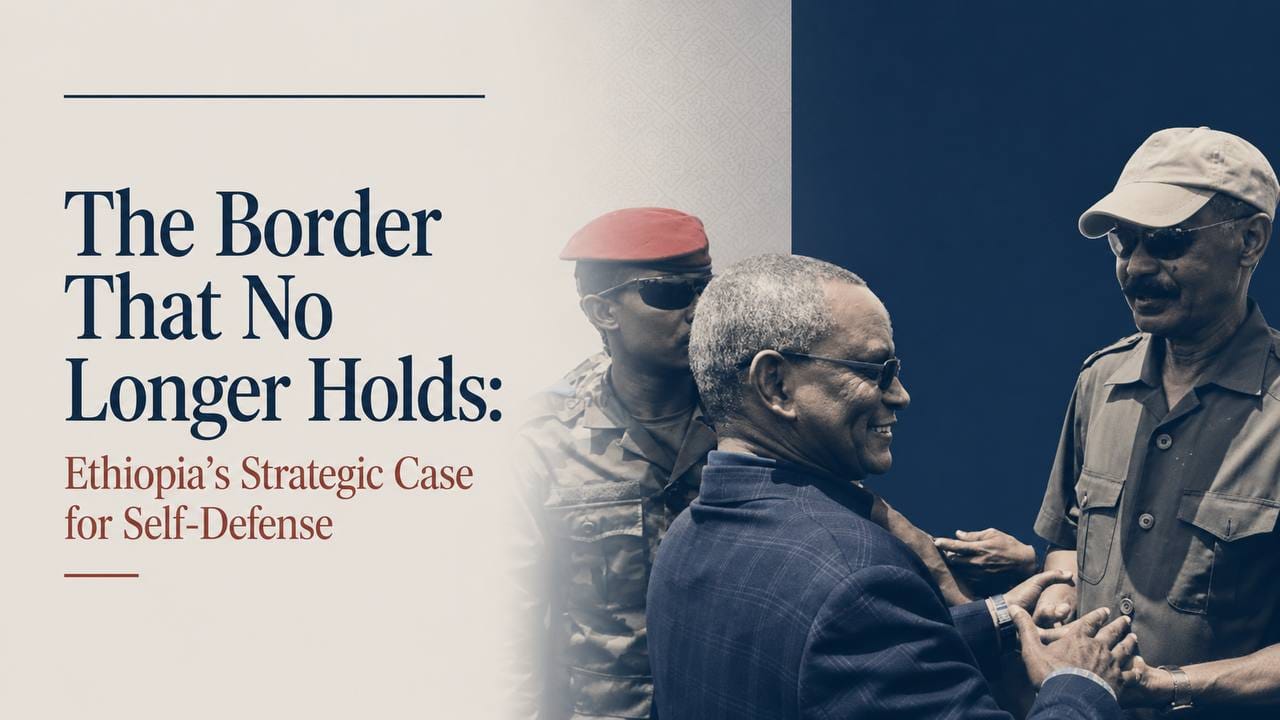
Why Addis Ababa Says Eritrea's Hand in Ethiopia's Internal War Has Already Crossed into Aggression?
The Ethio-Eritrean border was supposed to be the settled part of the story. Fought over from 1998 to 2000, delimited by an international commission in 2002, and diplomatically reopened in 2018, it has been treated in most outside commentary as a resolved file — a rare success in a region short on them. Addis Ababa's current position cuts directly against that reading. The argument coming out of Ethiopian official and analytical circles is not that the border is unresolved, but that it has stopped functioning as a border at all. Military assets, personnel, and political backing are described as moving from Eritrea into Ethiopia “on an unprecedented scale,” in the words of former State Minister for Foreign Affairs Ambassador Dina Mufti. What was a hard international boundary, in this telling, has become a blurred line of diminishing relevance.
The claim being made is specific, not rhetorical. It is that Eritrea has become the senior partner in an alignment with TPLF hardliners and Fano elements hostile to the Federal Government — that Asmara is no longer a neutral neighbor bruised by old grievances, but an active participant enmeshed in the security and political landscape of northern Ethiopia. Officials describe this as a development that has been building for some time but has now become “unmistakably public,” pointing to the fighting between federal forces and TPLF elements on August 1 and 2 as confirmation rather than a new development. In this account, the border's erosion was already underway; the events of early August simply made it visible.
From this reading, Ethiopia's legal position follows directly. If a neighboring state's forces are documented crossing into national territory in coordination with domestic armed factions, this constitutes, in the government's framing, an open and incontestable violation of sovereignty and territorial integrity — and it is that violation which activates Ethiopia's inherent right to self-defense under international law. Officials are explicit that this is not a hypothetical or anticipatory claim. It rests on the customary principle, recognized since the International Court of Justice's Nicaragua ruling, that a state does not need to absorb a direct invasion to be the victim of armed aggression; sponsoring, arming, or embedding proxy forces across a border can itself meet that threshold. Article 51 of the UN Charter's guarantee of self-defense, and the African Union Constitutive Act's protection of territorial integrity, are invoked together as the legal foundation for a response Addis Ababa describes as both legitimate and justified.
This legal framing matters because it changes what kind of dispute this is understood to be. A boundary disagreement invites negotiation; a documented armed attack invites a security response. Ethiopian officials are, in effect, arguing that Eritrea's own conduct — not any Ethiopian escalation — has already moved the dispute from the first category into the second. The 2018 rapprochement, on this reading, normalized diplomatic relations without ever resolving the underlying military posture along the frontier, leaving a gap between the appearance of peace and the reality on the ground that has now become impossible to ignore.
The most consequential part of the government's argument concerns what happens next. Ethiopian officials have named a specific trigger: further escalation by Tsimdo-aligned forces, particularly a prepared offensive in the Raya and Alamata areas. Should that offensive materialize, the stated position is that it would constitute a major act of aggression requiring a forceful Ethiopian response — one intended not merely to repel the immediate threat but to eliminate the capacity behind it. Officials have been unusually direct in stating that this could extend, “if necessary,” to regime change in Eritrea, framed explicitly as a means of securing Ethiopia's long-term security rather than as a territorial or political ambition in itself. The stated objective, in this account, is not conquest but the restoration of “enduring peace and stability between the two countries and across the wider region.”
The regional weight of this argument is considerable. A dispute long treated as bilateral and largely settled is being reframed, in Addis Ababa's telling, as an active and ongoing security emergency with implications for the whole Horn — one in which Ethiopia positions itself not as the initiator of conflict but as the party responding to a pattern of aggression it did not choose. That framing also carries a message to other actors in the region: that quiet backing for internal Ethiopian factions will be treated, and responded to, as a direct challenge to Ethiopian sovereignty rather than as deniable interference.
Whether that framing holds beyond Ethiopia's own institutions is a separate question from whether the underlying facts it describes are accurate. But as a statement of how the Ethiopian government itself understands the stakes, the argument is unambiguous: the border has stopped holding, and Ethiopia regards what comes next as self-defense, not escalation.
By IFA Staff Writer
Disclaimer:
The content disseminated by the Institute of Foreign Affairs (IFA) – including, but not limited to, publications, public statements, events, media appearances, and digital communications – reflects the views of individual contributors and does not necessarily represent the official positions or policies of the Institute, its partners, or any affiliated governmental or non-governmental entities.
While the IFA endeavors to ensure the accuracy, integrity, and timeliness of the information presented, it makes no representations or warranties, express or implied, regarding the completeness, reliability, or suitability of such content for any purpose. The Institute expressly disclaims any liability for errors or omissions, as well as for any actions taken or decisions made based on the information provided.
The inclusion of external links, references, or third-party resources does not constitute an endorsement by the Institute. Additionally, engagement on social media platforms – including, but not limited to, likes, shares, retweets (RTs), or reposts – shall not be interpreted as an endorsement or validation of the views expressed therein.
Readers and audiences are encouraged to exercise critical judgment and seek independent verification when interpreting or relying upon any information disseminated through publications and posts on the Institute’s platforms or representative.