
Defining Authority Production
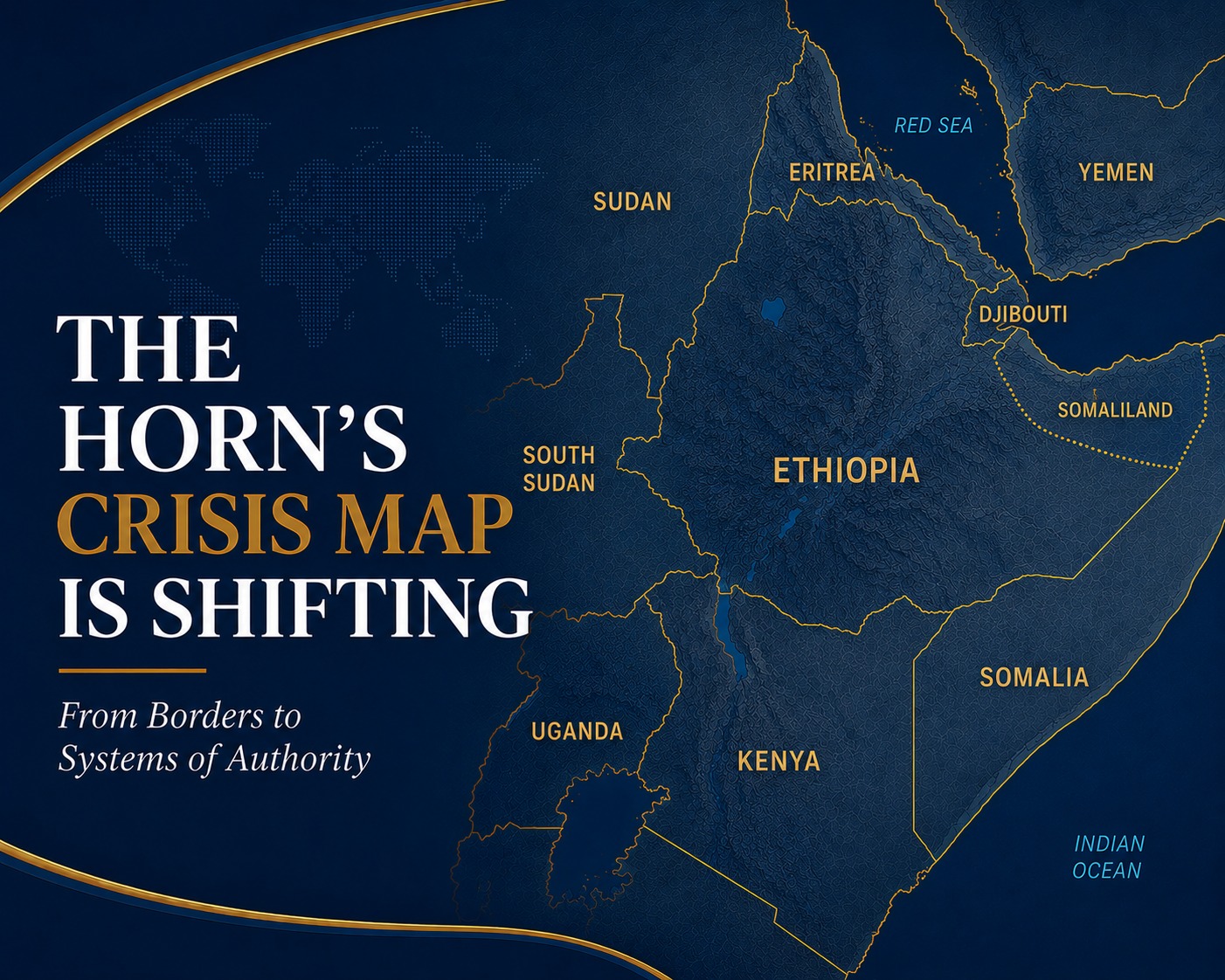
Authority production is the practical capacity to tax movement, recruit forces, regulate trade, and settle disputes. In parts of the Horn, these functions have become partially detached from formal sovereignty as armed groups, militias, and commercial networks increasingly perform tasks once associated with the state. The map is not being redrawn through new borders; it is being reshaped through competing systems of authority operating inside and across them.
Sudan and Somalia: Two Versions of the Same Mechanism
The Africa Center for Strategic Studies identifies roughly 150 militias and armed formations influencing Sudan's political and military outcomes, many administering checkpoints and taxing transport routes. Sudan's fragmentation is institutional as well as territorial. Somalia shows a related pattern: military operations may clear territory, but the effect is rarely durable when state institutions cannot quickly replace the administrative functions previously exercised by insurgents. Al-Shabaab's use of mobile courts and systematic transit taxation demonstrates that authority is built through predictability as much as coercion.
A Necessary Distinction
A fair objection is that describing armed groups as producing "authority" risks equating illegitimate coercion with legitimate governance, and that the analytical framing could inadvertently launder the standing of actors like Al-Shabaab or Sudanese militias. The distinction holds if stated precisely: the claim is not that these actors possess legal or moral legitimacy, which they plainly do not, but that they can acquire functional authority — the practical capacity to shape behaviour and extract compliance — even without legitimacy in law. Ignoring this distinction because it is uncomfortable would leave policymakers unable to explain why purely kinetic responses against these actors so often fail to produce durable order.
Ethiopia's Counter-Trend
Ethiopia's central challenge is different from its neighbours': not the replacement of state authority by parallel armed administrations, but the need to strengthen the legitimacy and reach of its own formal institutions. The National Dialogue is best understood in this light — a state-led effort to keep dispute resolution within constitutional institutions rather than outsourcing it to informal or armed structures.
Mapping the Real Map
Ethiopia should establish an interagency authority-mapping function linking foreign affairs, border administration, and customs institutions to maintain a continuously updated picture of formal and informal authority near its frontiers, and use it to inform corridor agreements with practical risk assessments of local gatekeepers and informal taxation systems, not only sovereign-level agreements with partner governments. Borderland policy should combine security presence with local administration and lawful commerce, so border communities experience the state as the most reliable provider of order, while Ethiopia encourages AU and IGAD mediation frameworks to treat authority restoration — taxation, justice, service delivery — as a core measure of implementation rather than a secondary post-conflict concern.
Conclusion
The central strategic question is no longer only who holds the border. It is who governs the systems through which people, goods, and legitimacy move. Ethiopia's advantage will depend on recognizing that shift earlier than others and shaping its regional posture accordingly.
Notes
1. Africa Center for Strategic Studies, Mapping the Armed Actors in the Sudan Conflict.
2. International Crisis Group, New Chapter, Same Stalemate: Somalia's War with Al-Shabaab.
3. Ethiopian News Agency, reporting on Ethiopia's National Dialogue and consensus-building process.
4. African Arguments, What Al-Shabaab Understands About Somali Authority.
By Amen Biniyam, IFA
Disclaimer:
The content disseminated by the Institute of Foreign Affairs (IFA) – including, but not limited to, publications, public statements, events, media appearances, and digital communications – reflects the views of individual contributors and does not necessarily represent the official positions or policies of the Institute, its partners, or any affiliated governmental or non-governmental entities.
While the IFA endeavors to ensure the accuracy, integrity, and timeliness of the information presented, it makes no representations or warranties, express or implied, regarding the completeness, reliability, or suitability of such content for any purpose. The Institute expressly disclaims any liability for errors or omissions, as well as for any actions taken or decisions made based on the information provided.
The inclusion of external links, references, or third-party resources does not constitute an endorsement by the Institute. Additionally, engagement on social media platforms – including, but not limited to, likes, shares, retweets (RTs), or reposts – shall not be interpreted as an endorsement or validation of the views expressed therein.
Readers and audiences are encouraged to exercise critical judgment and seek independent verification when interpreting or relying upon any information disseminated through publications and posts on the Institute’s platforms or representative.