
Defining Embedded Leverage
This brief describes the resulting asymmetry as embedded leverage: influence generated by security relevance, accumulated operational knowledge, and the practical costs of rapid replacement — not a bargaining chip to be traded for maritime concessions, which would be diplomatically counterproductive and inconsistent with the mission's purpose.
From Diplomatic Rupture to Security Continuity
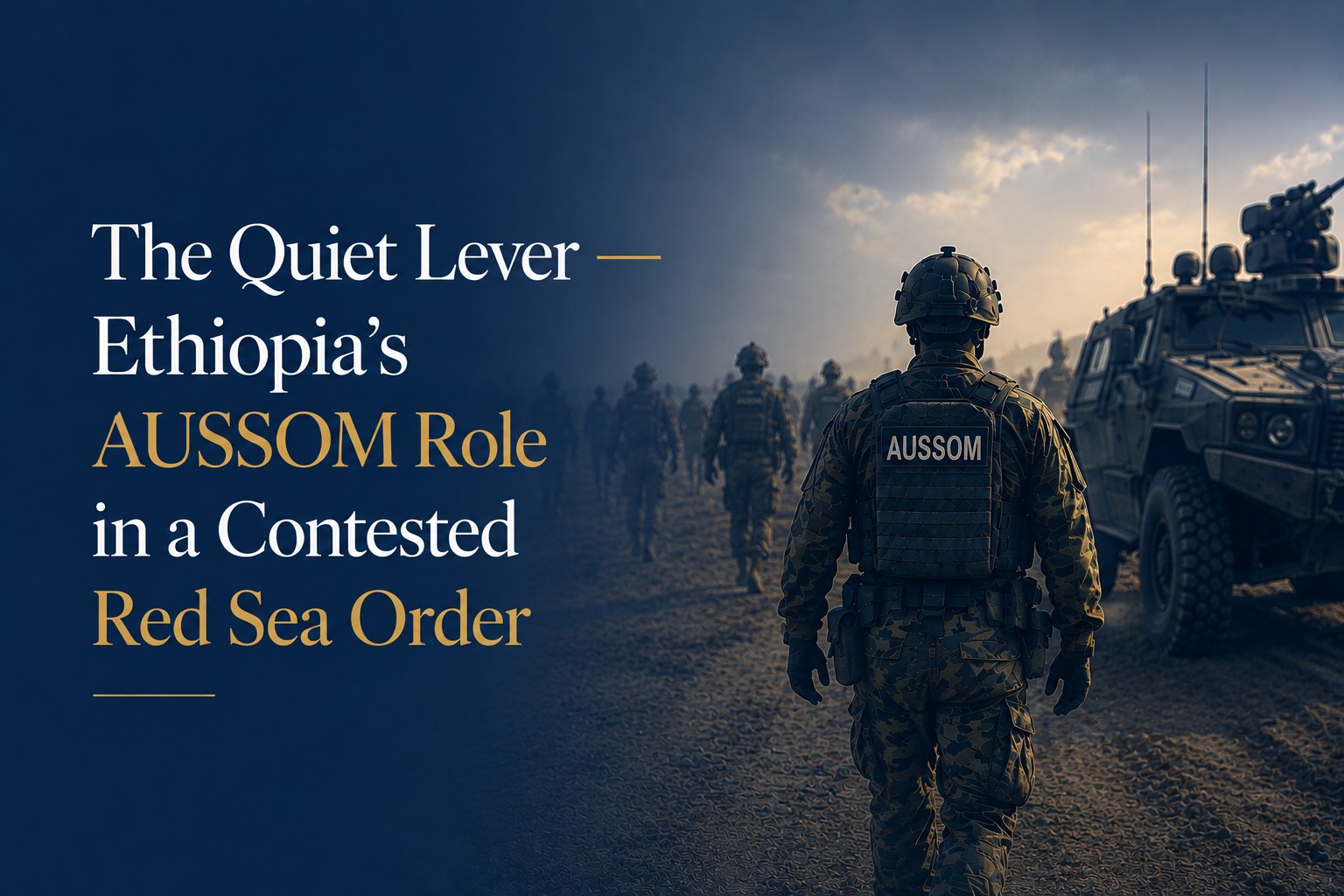
The durability of this role is best understood against the severity of the 2024 rupture, when Somalia rejected Ethiopia's Somaliland agreement and stated Ethiopian forces would not participate in AUSSOM.¹ The Ankara Declaration of December 2024 reaffirmed mutual sovereignty and territorial integrity while formally recognizing Ethiopian soldiers' sacrifices in AU missions, opening technical negotiations under Turkish facilitation in 2025.² Ethiopia's subsequent inclusion among AUSSOM contributors reflects a working compartmentalization: essential security cooperation preserved without requiring the immediate settlement of every political disagreement.
Does the Lever Actually Move Anything?
A sceptic might argue that embedded leverage is largely rhetorical — Somalia retains full sovereign authority over foreign forces on its territory, AUSSOM's design is to transition security responsibility to Somali institutions, and Ethiopia's contribution remains vulnerable to financing gaps and improvements in Somali force capacity. On this view, troop presence buys goodwill but no real diplomatic weight on the maritime file.
This is largely correct, and it is why this brief does not claim troop presence can substitute for a negotiated maritime agreement. Embedded leverage is conditional and time-bound; it creates diplomatic relevance and political confidence, not a veto over Somalia's choices. Its value lies precisely in demonstrating that Ethiopia can remain a responsible security partner while difficult political questions are under negotiation elsewhere — softening the environment for the Ankara process without being mistaken for a substitute for it.
Sequencing Ethiopia's Posture
Ethiopia should treat the Ankara process and AUSSOM as mutually reinforcing but institutionally distinct tracks, with the Ministries of Foreign Affairs and Defense coordinating assessments so that operational decisions and political messaging do not work at cross-purposes. Egypt's parallel AUSSOM role should not automatically be read as proof of a unified anti-Ethiopian front — Egypt, Ethiopia, Djibouti, Kenya, and Uganda all operate under the same AU mandate.
Making the Lever Count
Ethiopia should establish a permanent Ethiopia-Somalia security dialogue linking foreign ministries and defense institutions, complementing rather than replacing AUSSOM structures, while preserving a clear separation between peace-support obligations and maritime negotiations and rejecting any suggestion that troop deployments are conditional bargaining instruments. It should use AU forums to advocate for coherent force planning and financing among troop-contributing countries, particularly given Egypt's and Ethiopia's parallel roles, and develop a managed-transition plan for any future reduction of Ethiopian troops that prioritizes Somali force capacity and bilateral counterterrorism cooperation.
Conclusion
Ethiopia's AUSSOM role complicates the claim that it has been excluded from the region's emerging security order. The strategic task is to convert temporary operational relevance into durable institutional cooperation — building confidence rather than advertising dependency, and preparing for a future in which Ethiopia's influence rests on trusted bilateral arrangements rather than troop numbers alone.
Notes
1. Somali National News Agency, "Defense Minister: Ethiopia Excluded in the New AU Mission in Somalia," November 9, 2024.
2. Republic of Türkiye Ministry of Foreign Affairs, "Ankara Declaration by the Federal Democratic Republic of Ethiopia and the Federal Republic of Somalia," December 11, 2024.
3. Intergovernmental Authority on Development, "Communiqué of the Extra-Ordinary Summit of the Troop Contributing Countries to AUSSOM," April 26, 2025.
4. African Union, "AUC Chairperson Addressed the AU Peace and Security Council's Informal Consultation on the Future of AUSSOM," July 8, 2026.
By Bethel Sileshi, IFA
Disclaimer:
The content disseminated by the Institute of Foreign Affairs (IFA) – including, but not limited to, publications, public statements, events, media appearances, and digital communications – reflects the views of individual contributors and does not necessarily represent the official positions or policies of the Institute, its partners, or any affiliated governmental or non-governmental entities.
While the IFA endeavors to ensure the accuracy, integrity, and timeliness of the information presented, it makes no representations or warranties, express or implied, regarding the completeness, reliability, or suitability of such content for any purpose. The Institute expressly disclaims any liability for errors or omissions, as well as for any actions taken or decisions made based on the information provided.
The inclusion of external links, references, or third-party resources does not constitute an endorsement by the Institute. Additionally, engagement on social media platforms – including, but not limited to, likes, shares, retweets (RTs), or reposts – shall not be interpreted as an endorsement or validation of the views expressed therein.
Readers and audiences are encouraged to exercise critical judgment and seek independent verification when interpreting or relying upon any information disseminated through publications and posts on the Institute’s platforms or representative.