
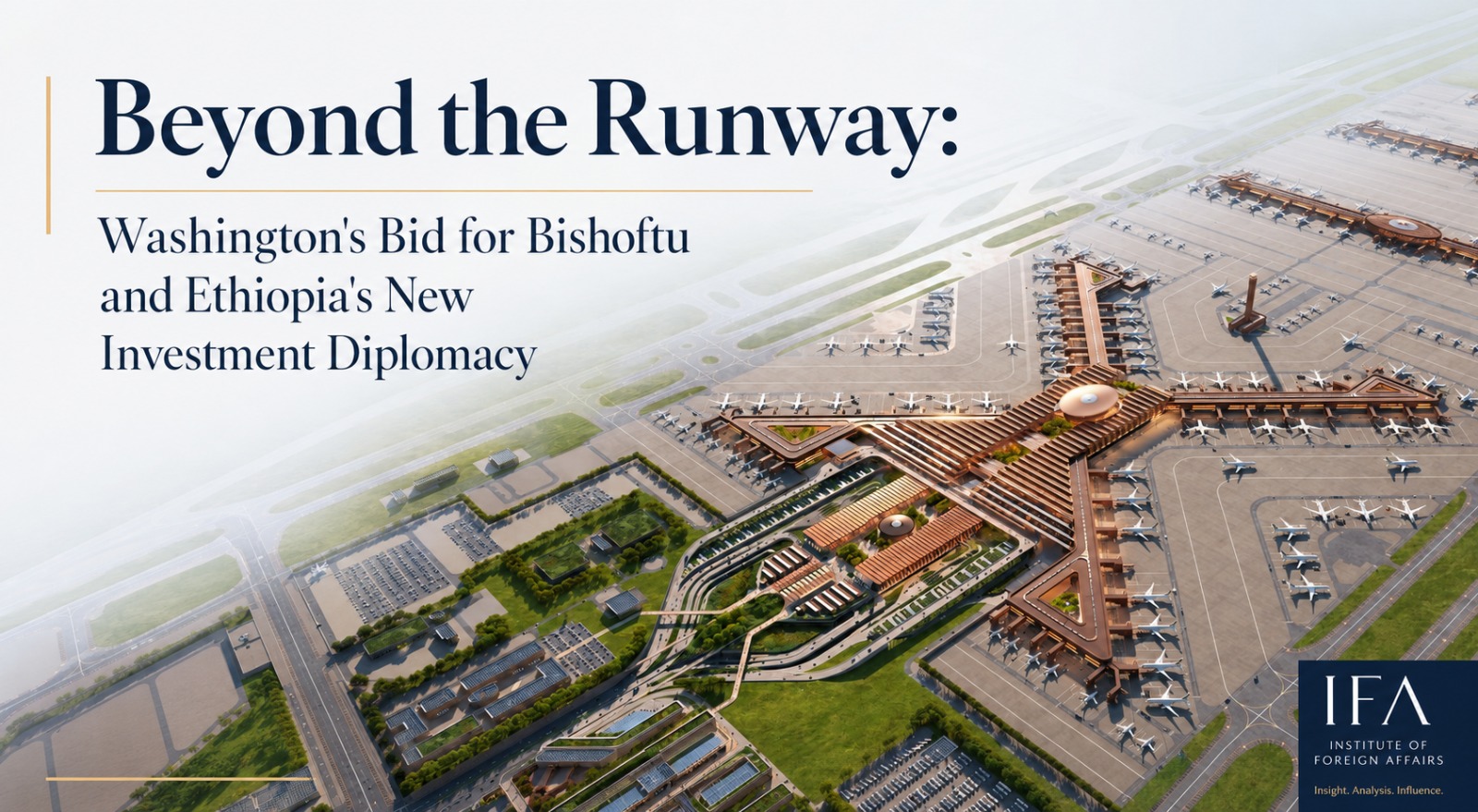
Africa is entering a different phase in its engagement with the world. The central question is no longer simply who will provide the most development assistance, but who will secure access to the continent's next generation of strategic infrastructure. That shift became visible in Addis Ababa when Mark Mitchell, Deputy Assistant Secretary of Commerce for the Middle East and Africa, publicly called for strong United States participation in Ethiopia's Bishoftu International Airport project. The statement was notable not because Washington expressed interest in Ethiopia, but because it did so by competing for participation in a project whose strategic purpose, ownership and long-term direction remain under Ethiopian control. This was not a conventional offer of assistance. It was a bid for access.
The distinction matters. For decades, many large infrastructure projects across Africa were framed primarily around financing gaps. Governments sought external capital, while outside partners often shaped the terms, sequencing and technological choices attached to major projects. Competition largely occurred among African states seeking investment rather than among investors seeking entry into nationally defined projects.
Bishoftu suggests a different model.
Official African Development Bank documents place the project cost at about US$10 billion, with the Bank mandated to mobilise as much as US$8 billion in debt financing and considering up to US$500 million from its own balance sheet. Some subsequent media reports have used a higher estimate of approximately US$12.5 billion. Whatever the final financing envelope, the planned scale is clear: an initial capacity of 60 million passengers, rising to 110 million, and cargo capacity of roughly 3.7 million tonnes a year.
Its scale alone makes the project important. More significant, however, is the diplomatic environment developing around it. Rather than tying the airport to a single financier, contractor or technology provider, Ethiopia has kept several project components open to international competition. Bishoftu therefore represents more than an aviation investment. It reflects an emerging model of investment diplomacy in which national infrastructure becomes a platform through which international competition is organised rather than avoided. The strategic question is no longer simply who will build the airport. It is whether Ethiopia can convert competing external interest into sustainable financing, technology, market access and long-term national capability without surrendering control over the project's direction.
A Different Kind of Competition
Washington's interest in Bishoftu is driven by concrete commercial incentives. Ethiopian Airlines is the largest network carrier in Africa and the anchor of an aviation ecosystem extending across aircraft procurement, engines, maintenance, training, digital systems, cargo management and airport operations. Official African Development Bank reporting for the fiscal year ending June 2025 recorded US$7.6 billion in revenue and 19 million passengers, while later public reporting indicates further growth. Participation in Bishoftu therefore offers access to a commercial relationship that could last for decades.
The connection to American industry is direct. Ethiopian Airlines confirmed in April 2026 that it had converted options for six Boeing 787-9 aircraft into firm orders, strengthening an already substantial relationship with Boeing. American interest in the airport should therefore be read not as a stand-alone construction bid, but as an effort to secure a larger position across aviation equipment, services, logistics and technology.
The United States is not alone. Chinese state-owned firms entered the project during its early stages, while European, Gulf, Turkish, Indian and other international companies have shown interest in engineering, procurement, construction, financing and technology packages. The result is not a simple contest between Washington and Beijing. It is a wider competition over who will participate in the infrastructure and logistics architecture of a rapidly expanding African market. That distinction matters because a binary geopolitical frame would understate Ethiopia's room for manoeuvre. The more Ethiopia preserves competition across different components of the project, the more space it retains to compare financing terms, technological quality, implementation capacity and long-term strategic value.
Competitive Infrastructure Leverage
This approach can be understood as competitive infrastructure leverage: the deliberate organisation of a major national project in a way that encourages multiple external actors to compete for participation while domestic institutions retain authority over ownership, procurement and strategic direction. Diversification is often treated simply as a way to reduce dependence on a single partner. Competitive infrastructure leverage goes further. It turns competition itself into a strategic resource. Instead of selecting one external patron and accepting the risks of concentration, Ethiopia can make participation conditional on stronger financing, better technology, greater local capacity building and more credible long-term commitments.
For a country pursuing strategic autonomy, the logic is clear. Bargaining power does not come only from the ability to reject an offer. It also comes from ensuring that no single partner becomes indispensable. Where several actors are competing, Ethiopia can sequence contracts, diversify exposure and preserve room for adjustment if one partner's financing, technology or political conditions become unfavourable.
The financing structure points in this direction. The African Development Bank has been appointed mandated lead arranger, global coordinator and bookrunner, but the project is not framed as an exclusive bilateral undertaking. Different partners can contribute across financing, construction, technology and operations without controlling the entire project. This is multi-alignment in operational form: external actors compete to support an Ethiopian priority rather than Ethiopia organising its priority around the preferences of one external actor. The value of the strategy, however, will depend on whether domestic institutions preserve that openness throughout implementation. Early diversification can still evolve into later dependence if one contractor controls critical systems, one lender dominates refinancing, or one technology provider creates proprietary lock-in.
Beyond Aviation: A Continental Logistics Platform
Bishoftu should not be understood as an airport in isolation. Modern hub airports organise economic ecosystems. They connect passenger traffic, cargo, customs, logistics, digital systems, hospitality, finance, maintenance, manufacturing and business services. Their strategic value lies not only in moving aircraft, but in concentrating networks of trade and investment around a single node. For Ethiopia, this function is especially important. Ethiopian Airlines has already established Addis Ababa as one of Africa's principal aviation gateways. Bishoftu provides the physical capacity required to sustain that position as passenger and cargo volumes expand. The project is designed primarily as a transit platform, linking African markets to one another and connecting them with Europe, Asia, the Middle East and the Americas.
The cargo dimension may be even more consequential. Capacity of roughly 3.7 million tonnes annually could support high-value exports, pharmaceuticals, perishables, e-commerce, light manufacturing and time-sensitive supply chains. Combined with industrial parks, customs reform, rail and highway connections, the airport could help Ethiopia capture more value from regional trade rather than serving only as a transit point.
This directly relates to continental integration. The African Development Bank presents Bishoftu as a regional integration project aligned with its objective of connecting African economies. The project's relevance also extends to the African Continental Free Trade Area and the Single African Air Transport Market, both of which require physical connectivity alongside legal and regulatory commitments.
The opportunity is not automatic. A large airport without efficient ground connections, customs systems and industrial linkages risks becoming an expensive transport facility rather than a genuine logistics platform. Bishoftu's success will therefore depend on whether it is integrated into a wider national strategy linking aviation with railways, expressways, dry ports, industrial zones, digital infrastructure and regional corridors.
A New Geography of Influence in the Horn
The project's regional significance extends beyond commercial returns. Strategic influence in the Horn of Africa has traditionally been measured through ports, sea lanes and proximity to the Bab el-Mandeb. Those assets remain indispensable, particularly as competition intensifies around Red Sea access, corridor alignments and maritime security.
Bishoftu introduces a complementary source of leverage by moving part of the region's strategic weight inland. Ports connect the Horn to the world, but inland hubs determine how passengers, freight, capital and technology are aggregated and distributed across the continent. A country that organises those flows can become strategically important even without a coastline.
This does not eliminate Ethiopia's maritime constraints. Reliable access to ports remains a core national interest, and no airport can substitute for the movement of bulk goods by sea. Bishoftu does, however, alter the position from which Ethiopia approaches corridor and access negotiations. A state that functions as the principal aviation and cargo hub for a growing regional market is not merely a petitioner seeking access. It is also a node on which neighbouring corridors, carriers and commercial networks increasingly depend.
Ethiopia's leverage in the Horn will therefore rest on two connected strategies: securing dependable access to maritime infrastructure and building inland infrastructure that makes regional connectivity more valuable. Bishoftu complements rather than replaces Ethiopia's maritime strategy.
The airport also gives external powers a longer-term stake in Ethiopia's stability and connectivity. Firms that invest in terminals, logistics systems, aircraft fleets, engines and maintenance networks acquire interests extending beyond a single contract. This can deepen economic partnerships, but it can also embed strategic competition inside critical national infrastructure. The same project that creates leverage can produce new dependencies if contractual, technological and financing choices are not carefully managed.
The Limits of the Strategy
The case for Bishoftu should not become a case for strategic overconfidence. Competitive infrastructure leverage is not self-executing. It depends on institutional capacity, procurement discipline and the ability to manage complex relationships among financiers, contractors and technology providers.
Diversified procurement can preserve bargaining flexibility, but it also increases coordination risks. Different contractors may operate under incompatible technical standards, financing timelines or maintenance systems. Delays in one component can affect the entire project. Without a strong central authority, diversification can produce fragmentation rather than leverage.
Financing is another constraint. The African Development Bank's model envisages large-scale debt mobilisation. That requires careful management of foreign-exchange exposure, cost escalation, refinancing risk and traffic assumptions. Passenger and cargo growth may justify the investment over time, but the project should be stress-tested against slower demand, construction delays, exchange-rate pressure and changes in global aviation.
Technology dependence also deserves attention. Airports increasingly rely on proprietary digital systems, security infrastructure, air-traffic technologies and maintenance platforms. Choosing a provider can create long-term lock-in even where construction contracts are diversified. Ethiopia therefore needs to assess not only initial cost, but interoperability, data control, cybersecurity, maintenance requirements and the availability of domestic technical expertise. The social and territorial dimensions are equally important. The African Development Bank has reported a substantial allocation for livelihood restoration and resettlement of affected communities. Delivery of those commitments will influence project legitimacy, implementation timelines and the broader credibility of Ethiopia's infrastructure diplomacy.
Geopolitical balancing will also be tested. Commercial decisions may be interpreted by external actors through strategic rivalry. Awarding one package to a Chinese firm and another to an American, European or Gulf provider may preserve diversity, but it can also create pressure for exclusivity, standards alignment or political concessions. Ethiopia's challenge is to separate commercial value from geopolitical pressure without pretending that the two can be fully disconnected.
Policy Implications
The strategic value of Bishoftu will ultimately depend on the quality of domestic coordination behind it. The Ministry of Finance, Ethiopian Airlines Group, the Ethiopian Investment Commission, the Ministry of Transport and Logistics and the Ministry of Foreign Affairs should operate through a permanent interagency mechanism responsible for financing exposure, procurement coherence, technology standards and the diplomatic implications of strategic-sector participation.
First, procurement should be evaluated through a long-term value framework rather than initial price alone. Bids should be assessed against financing sustainability, technology transfer, local workforce development, maintenance capacity, cybersecurity, interoperability and resilience. The cheapest proposal may create the highest long-term dependence.
Second, Ethiopia should preserve competition across the full project cycle. Diversification should not be limited to prequalification and early construction. Financing, digital systems, maintenance, cargo operations and training should also avoid unnecessary concentration where interoperability allows multiple providers.
Third, Bishoftu should be integrated into Ethiopia's broader logistics and industrial strategy. Rail, road, customs, digital and industrial-zone investments must be sequenced around the airport's development. The project should support export diversification and regional trade rather than function only as a transit facility for international passengers.
Fourth, participation by foreign firms should be tied to measurable domestic capability. Local subcontracting, technical training, research partnerships and knowledge transfer should be written into contracts and monitored through clear benchmarks. The objective should not be foreign participation for its own sake, but the gradual development of Ethiopian capacity to operate, maintain and upgrade critical systems.
Fifth, financing governance should include transparent stress tests and periodic public reporting on cost, debt exposure, implementation milestones and traffic assumptions. This would strengthen accountability while reducing the risk that commercial optimism obscures emerging vulnerabilities.
Finally, the diplomatic narrative surrounding Bishoftu should remain disciplined. Ethiopia should present the project neither as alignment with one bloc nor as an arena for great-power confrontation. Its value lies precisely in remaining open to multiple partners under nationally defined conditions. Strategic autonomy will be preserved not by excluding external actors, but by preventing any one of them from determining the project's direction.
Conclusion
Bishoftu International Airport is more than a large aviation project. It is a test of whether Ethiopia can organise external engagement around national priorities rather than external preferences. Washington's public bid for participation is significant because it captures a wider shift. Ethiopia is not approaching major powers only as a recipient seeking assistance. It is presenting a strategic asset and requiring external actors to demonstrate what financing, technology and commercial value they can contribute.
The airport will not by itself resolve Ethiopia's maritime challenge, settle the Horn's political disputes or eliminate foreign dependence. It can, however, change the position from which Ethiopia enters those debates. By building an inland aviation and logistics node through which regional passengers, freight and capital may increasingly move, Ethiopia is creating a form of strategic relevance that complements its search for reliable access to the sea.
The deeper significance of Bishoftu therefore lies less in the runway than in the diplomatic model emerging around it. The opportunity is to convert international competition into long-term national capability. The risk is that weak coordination, financing pressure or technological dependence could convert the same competition into a new form of vulnerability.
Whether Bishoftu becomes a model of Ethiopian investment diplomacy will depend not on the scale of foreign interest, but on Ethiopia's ability to govern that interest. The central question is no longer simply who will build Bishoftu. It is whether Ethiopia can use the project to reshape the terms on which Africa engages global capital, technology and power.
References
[1] African Development Bank Group, "The $10 Billion Mega-Airport Financing Partnership Between Ethiopian Airlines and African Development Bank Takes Off," 12 August 2025.
[2] African Development Bank Group, "Ethiopia: Ceremonial Signing Appointing the African Development Bank as Mandated Lead Arranger to Mobilize $8 Billion for Africa's Largest Airport," 11 August 2025.
[3] African Development Bank Group, "EOI: Financial Model Auditor, Bishoftu International Airport Project in Ethiopia," 24 April 2026.
[4] African Development Bank Group, "Ethiopia: Bishoftu International Airport Project, P-ET-DA0-013," 24 September 2025.
[5] Ethiopian Airlines, "Ethiopian Airlines Converts Options of Six Boeing 787 Dreamliner Airplanes into Firm Orders," 21 April 2026.
[6] ch-aviation, "US Eyes Role in Ethiopia Bishoftu Airport Project," 30 July 2026.
[7] Reuters, carried by IOL, RT Africa and TradingView, "US Wants Stake in Ethiopia's Major Airport Project," 30 July 2026.
[8] CNN, "Africa's Biggest Airport Is Being Built in Ethiopia for $12.5 Billion," 23 April 2026.
[9] TRT Afrika, "Ethiopia Begins Construction of Africa's Biggest Airport," January 2026.
[10] Gulf News, "Ethiopia Eyes Sky-High Ambitions with $12.5 Billion Airport," 2026.
By Amen Biniyam, IFA
Disclaimer:
The content disseminated by the Institute of Foreign Affairs (IFA) – including, but not limited to, publications, public statements, events, media appearances, and digital communications – reflects the views of individual contributors and does not necessarily represent the official positions or policies of the Institute, its partners, or any affiliated governmental or non-governmental entities.
While the IFA endeavors to ensure the accuracy, integrity, and timeliness of the information presented, it makes no representations or warranties, express or implied, regarding the completeness, reliability, or suitability of such content for any purpose. The Institute expressly disclaims any liability for errors or omissions, as well as for any actions taken or decisions made based on the information provided.
The inclusion of external links, references, or third-party resources does not constitute an endorsement by the Institute. Additionally, engagement on social media platforms – including, but not limited to, likes, shares, retweets (RTs), or reposts – shall not be interpreted as an endorsement or validation of the views expressed therein.
Readers and audiences are encouraged to exercise critical judgment and seek independent verification when interpreting or relying upon any information disseminated through publications and posts on the Institute’s platforms or representative.