
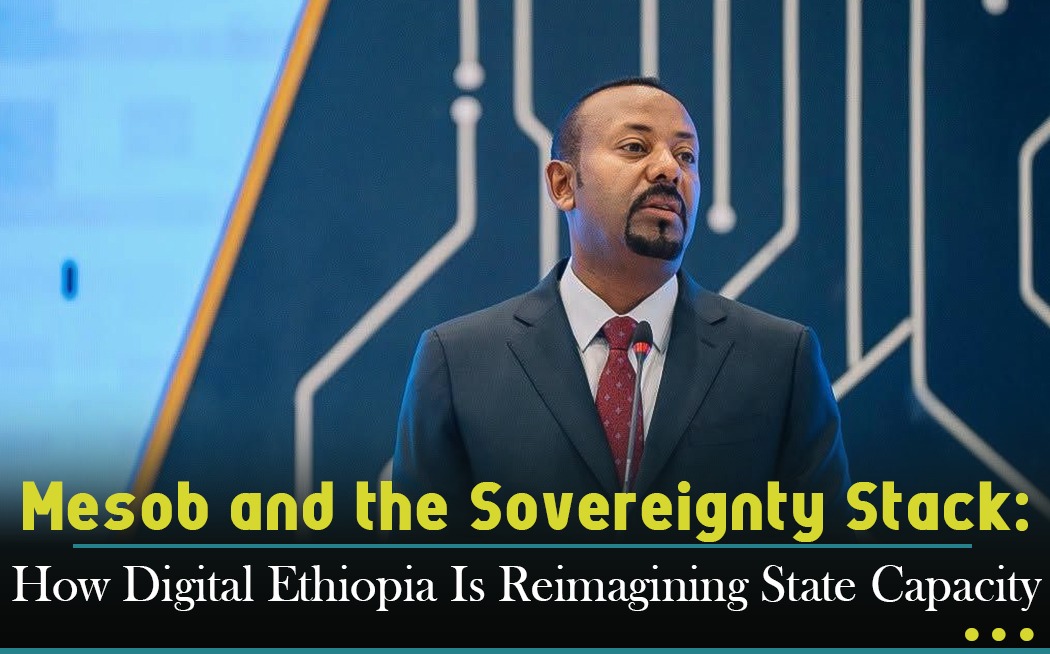
The opening of the Mesob Innovation Exhibition in Addis Ababa was presented as a celebration of Ethiopia's emerging digital economy. Entrepreneurs, technology firms, public institutions, and innovators gathered to showcase solutions intended to transform commerce, public services, finance, and everyday life. Yet the exhibition was significant for reasons extending beyond innovation itself. Mesob offered a glimpse into a larger national project: the construction of a new architecture of state capacity.
Digital transformation is often described as a modernization agenda. Governments digitize services, expand connectivity, and improve administrative efficiency. Ethiopia is pursuing all these objectives. However, viewing Digital Ethiopia solely through the language of modernization misses the deeper strategic logic underpinning the project. What is emerging is not simply a digital-economy strategy but an effort to build the institutional foundations of sovereignty in the twenty-first century.
For much of the twentieth century, sovereignty was measured through territory, military capability, diplomatic recognition, and control over physical infrastructure. Those foundations remain indispensable. Yet the emerging international order increasingly rewards states that can govern digital identity, secure payment systems, regulate data flows, protect critical information infrastructure, and establish trusted digital platforms. Digital capability is no longer a technical supplement to governance. It is becoming one of its defining pillars.
Seen through this lens, Mesob represents more than a technology exhibition. It reflects Ethiopia's attempt to construct what may be described as a sovereignty stack: an interconnected architecture of digital identity, payment rails, data-governance systems, digital infrastructure, and regulatory institutions designed to strengthen national capability in an increasingly networked world. The first layer of this sovereignty stack is identity.
Fayda is often discussed as a national identification initiative. In practice, it is becoming foundational digital-state infrastructure. By early 2026, nearly 30 million residents had received a Fayda digital identification number, making it one of the fastest digital-public-infrastructure deployments on the continent. A secure and interoperable identity system enables citizens to access services, verify eligibility, open financial accounts, receive transfers, and engage with public institutions through a trusted and reusable credential.
The strategic significance of digital identity lies in its ability to create a common trust architecture across institutions. Roads move goods. Power grids move electricity. Digital identity moves trust. Once identity verification becomes interoperable across banks, telecommunications providers, public agencies, educational institutions, and health systems, the state acquires an entirely new operational layer.
Historically, one of the principal weaknesses confronting many developing states has been fragmented administrative systems. Citizens often navigate multiple institutions operating with incompatible records and verification mechanisms. Digital identity offers a pathway toward institutional coherence. The long-term significance of Fayda therefore lies not merely in enrollment figures but in its capacity to reduce friction between citizens and institutions while expanding the operational reach of the state. The second layer is digital finance.
The rapid expansion of Telebirr and the growth of M-PESA Ethiopia demonstrate that digital payments have moved beyond experimentation and entered the realm of mass adoption. By mid-2025, Telebirr had surpassed 54.8 million users and facilitated approximately 2.38 trillion birr in annual transactions, while subsequent reporting placed the platform above 58 million users and more than 6.8 trillion birr in cumulative transaction value. Meanwhile, M-PESA Ethiopia reached more than 10.8 million registered customers and has continued expanding as integration with Ethiopia's broader digital-payment ecosystem deepens.
This transformation matters because payment systems function as the economic nervous system of a modern state. They reduce transaction costs, expand financial inclusion, strengthen fiscal capacity, and generate the data infrastructure necessary for credit markets and financial innovation. In economies where informality has historically constrained participation and state reach, digital payments perform a broader state-building function.
What makes Ethiopia's model particularly noteworthy is its combination of national ownership and controlled competition. Ethio Telecom provides scale and institutional reach, while Safaricom Ethiopia introduces investment, innovation, and competitive pressure. If managed effectively, this arrangement could produce one of Africa's most dynamic digital-finance ecosystems. The strategic challenge is ensuring that competition strengthens national capability rather than merely redistributing market power. The third layer of the sovereignty stack is data governance.
As identity systems, payment platforms, digital public services, and artificial-intelligence applications expand, data increasingly becomes a strategic resource. States unable to govern data effectively risk becoming dependent on external actors for functions that now shape economic competitiveness, security, and public administration.
Ethiopia's Personal Data Protection Proclamation No. 1321/2024 represents an important effort to establish the legal foundations of digital sovereignty. The legislation creates a framework for personal-data protection, defines responsibilities for data controllers and processors, and establishes rights for citizens operating within the digital ecosystem.
This legal architecture matters because trust remains the decisive variable in digital transformation. Citizens will embrace digital systems only if they trust the institutions governing them. Likewise, governments cannot fully realize the benefits of digitization if public confidence in digital infrastructure remains weak.
Data protection is therefore not merely a technical issue. It is a legitimacy issue. The digital state ultimately runs on trust, and trust is increasingly shaped by how information is governed. The fourth layer of the sovereignty stack is digital infrastructure and interoperability.
Digital transformation is often discussed through applications and platforms, but these systems depend upon deeper infrastructure. Cloud services, interoperable government platforms, cyber security architecture, broadband connectivity, and data centers increasingly function as critical national infrastructure. The effectiveness of digital identity, digital finance, and digital public services ultimately depends upon the resilience of these underlying systems.
Digital Ethiopia 2030 recognizes this reality by identifying digital infrastructure, interoperability, and institutional integration as prerequisites for broader transformation. The objective is not simply to place services online but to build an ecosystem in which institutions can communicate, exchange information, and deliver services more effectively. In this sense, interoperability is not a technical convenience; it is a mechanism for expanding state capability. Yet the sovereignty-stack framework also exposes a strategic dilemma.
Digital sovereignty remains incomplete if critical infrastructure remains externally dependent. States may digitize governance while relying on foreign cloud providers, imported hardware, external cyber security services, or foreign-owned digital platforms. Such arrangements can improve efficiency while simultaneously creating new forms of vulnerability. The same digital systems that expand state capability can, if poorly structured, expose states to technological dependence.
This tension is becoming increasingly relevant across the developing world. The pursuit of digital transformation often requires external technology, investment, and expertise. However, excessive dependence can weaken strategic autonomy. The challenge for Ethiopia is therefore not merely to digitize but to cultivate indigenous capabilities capable of reducing long-term technological dependence. A digitally connected state is not automatically a digitally sovereign state.
This distinction is becoming more important as artificial intelligence, cloud computing, and cross-border data flows emerge as central components of economic competitiveness. States that fail to develop domestic technological capacity may discover that digital modernization and digital dependence advance simultaneously.
Mesob thus reveals something larger than a collection of innovative technologies. It illustrates how Ethiopia increasingly views digital transformation as a state-building project. Identity systems expand trust and administrative coherence. Digital payments deepen financial inclusion and economic visibility. Data-governance frameworks strengthen legitimacy. Infrastructure and interoperability increase institutional effectiveness. Together, these layers form a sovereignty stack designed to enhance state capacity in a changing international environment.
The relevant question is no longer whether Ethiopia will digitize. That trajectory is already underway. The more consequential question is whether Digital Ethiopia can evolve from a modernization project into a sovereignty project capable of anchoring durable state capacity in an increasingly networked world. If the twentieth century was defined by the construction of territorial states, the twenty-first may increasingly be defined by the construction of digital ones. Ethiopia's success will depend not simply on adopting technology but on transforming digital capability into enduring sovereign capacity.
Notes
1. National ID Program Ethiopia, “National ID,” accessed June 2026, https://id.gov.et/;
2. National ID Program Ethiopia, “Ethiopia's Digital ID Chief Lays Out Roadmap for Reaching 90 Million Enrollments by 2027,” 2026.
3. Ethio Telecom, 2025/26 Fiscal Year First Half-Year Business Performance Report (Addis Ababa: Ethio Telecom, 2026); Reuters, “Ethio Telecom's Full-Year Pretax Profit Up More Than 80%,” July 24, 2025; Safaricom Ethiopia, Quarterly Business Update, 2026.
4. Federal Democratic Republic of Ethiopia, Personal Data Protection Proclamation No. 1321/2024 (Addis Ababa: Federal Negarit Gazette, 2024).
5. Ministry of Innovation and Technology, Digital Ethiopia 2030: A Strategy for Ethiopia's Digital Transformation, revised edition (Addis Ababa: FDRE Ministry of Innovation and Technology, 2025); United Nations Economic Commission for Africa, Digital Transformation Strategy in Africa: Progress and Prospects (Addis Ababa: UNECA, 2024).
By Meron, IFA
Disclaimer:
The content disseminated by the Institute of Foreign Affairs (IFA) – including, but not limited to, publications, public statements, events, media appearances, and digital communications – reflects the views of individual contributors and does not necessarily represent the official positions or policies of the Institute, its partners, or any affiliated governmental or non-governmental entities.
While the IFA endeavors to ensure the accuracy, integrity, and timeliness of the information presented, it makes no representations or warranties, express or implied, regarding the completeness, reliability, or suitability of such content for any purpose. The Institute expressly disclaims any liability for errors or omissions, as well as for any actions taken or decisions made based on the information provided.
The inclusion of external links, references, or third-party resources does not constitute an endorsement by the Institute. Additionally, engagement on social media platforms – including, but not limited to, likes, shares, retweets (RTs), or reposts – shall not be interpreted as an endorsement or validation of the views expressed therein.
Readers and audiences are encouraged to exercise critical judgment and seek independent verification when interpreting or relying upon any information disseminated through publications and posts on the Institute’s platforms or representative
#