
Background and Context
The Horn of Africa, a pivotal geostrategic crossroads linking the Middle East, Africa, and the Indian Ocean, has unequivocally becomes a focal point for intense international competition and strategic interest. Türkiye, under the leadership of President Recep Tayyip Erdoğan, has
increasingly projected its influence beyond its traditional spheres of engagement, exhibiting a
"multi-vector" foreign policy that seeks to maximize its global standing and strategic autonomy
(Öztürk & Demirbaş, 2021). This engagement is particularly pronounced across the African
continent, where Türkiye has dramatically expanded its diplomatic presence, opened numerous embassies, and forged new partnerships. For instance, since 2002, Türkiye has expanded its diplomatic footprint to 44 embassies across Africa and hosts 37 African missions [1]. The growing security partnerships also manifests the increasing influence of Türkiye in Africa and
Defense cooperation Ankara inked with several countries. This expansion marks a departure from Ankara's traditional diplomatic engagement in Africa. It marks a shift in diplomatic instruments that hinge on soft power to defense diplomacy, which involves the export of arms and delivery of military training [2]. In this regard, for instance, Ankara has significantly increased arms sales to the African countries, and signed security cooperation agreements with 30 African states, expanded the establishment of naval task forces, and took part in peacekeeping missions. The diplomatic pivot Ankara made is arguably the byproduct of the internal dynamics, such as the growing defense industry of Ankara. Similarly, this success in Africa is attributed to Türkiye's new approach of diplomatic engagement with Africa, namely the ‘no strings attached’ diplomatic approach pursued [3]. The Turkish model of aid and humanitarian assistance in Africa departs from the
Washington and Beijing model. Turkey provides only grants to African countries, with no place
for loans. This is one of the aspects that differentiates Turkey from both traditional donors, such as the EU, and emerging donors such as China. Turkey provides all its official development assistance (ODA) to the continent through bilateral channels [4]. These twin factors have
made Ankara not only an attractive security provider on the continent but also offered it leverage
which it uses in the establishment and strengthening of its military footprint and the control of
strategic ports and geopolitically significant positions in the Horn of Africa region [5]. Within this broader African strategy, the Horn of Africa holds a special and elevated significance
for Ankara. In the Horn region, Türkiye is driven by a confluence of economic interests, pressing
security concerns, and a profound desire to enhance Ankara's global standing [6]. In the Horn of Africa, for instance, Türkiye has inked a military framework agreement with
governments of both Ethiopia and Somalia. The Ethiopia-Turkey military cooperation agreement
inked in 2021 is a comprehensive military cooperation across various fields. From the vantage
point of Türkiye's regional ambition, the framework sets the foundation for potential Ankara
logistics and military support that enables it to navigate complexities and influence regional
security outcomes [7]. Similarly, Ankara's wide-ranging engagement with the governments of Somalia could be taken as
a showcase of the broader regional ambitions. Over a decade now, Türkiye is the
forerunner investor and military supporter of the Somalian State. The relation which began in
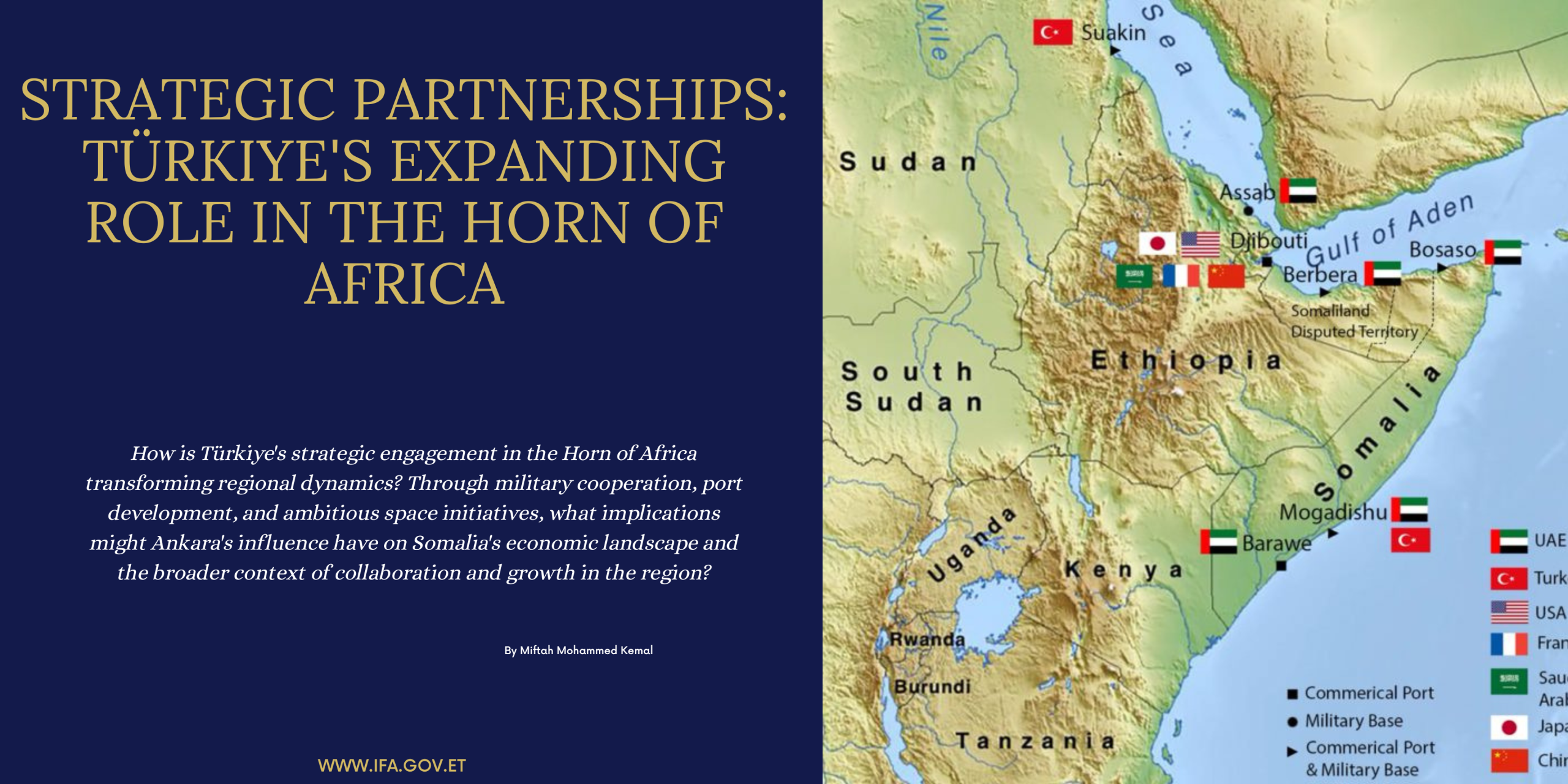
humanitarian aid gave way to the establishment of military cooperation, energy deals, and has now grown into the next level of cooperation in the sphere of space and rocket industry. Between 2015 and 2020, with 54.9 %, Somalia was the top recipient of Turkish Aid in Africa [8].
Turkish Somali cooperation can be taken as a good example that showcases Türkiye's new model
of diplomatic engagement in Africa that departs from the traditional development assistance-based approach [9]. The following section unpacks this unique, strategic, and evolving cooperation of Ankara with Mogadishu, considering the regional geopolitical and security implications of the cooperation. Economic Investment, Port Development, and Resource Exploration Türkiye's economic ties to the core states in the Horn of Africa are not only substantial but are also deeply embedded and strategically oriented. Ankara has made a route into the region, holding a significant position by investing in Ethiopia across various sectors, as the second-largest foreign investor in Ethiopia [10]. By the same token, Turkey's hand in Somalia's economic and development activities is significant. It has heavily invested in the Mogadishu port development and modernization, as well as in other infrastructure [11]. In effect, such roles provide Ankara with leverage and create opportunities, simplifying its activities to control vital maritime gateways. The Ankara-Mogadishu cooperation reached the most strategic level in the introduction of the subsequent signing of an agreement for oil and gas exploration in Somalia by a Turkish company in 2024 [12]. This milestone event marked the long-term and deeper dedication of Ankara to Somalia's energy sector development. The positive results of the years-long seismic studies have already sparked a greater hope for Somalia's economic transformation and simultaneously unlocked the window of opportunity in terms of natural resources and energy supply to satisfy the growing Turkish industries' demand for energy [13]. However, this development is not without challenge, as it involves different interest groups operating in the natural gas and petroleum industry. It could spark competition from these actors, including countries from the Middle East. Military Presence and Robust Security Cooperation The biggest investment of Türkiye in Somalia is perhaps made in the establishment of Turksom
military center in Mogadishu since 2017 [14]. This boosted Ankara's visibility and strategic position in Somalia's nation-building and security architecture. Over the past several years, Ankara is engaged in the training of thousands of Somali men in uniform, which includes the special elite forces of the Gorgor and Somalia’s vital naval forces, at its state-of-the-art facility in Mogadishu [15]. This has strengthened the limited maritime security capability of the Somalian government, which is vital for the latter's fight against piracy and illegal fishing [16]. On the logistics side, Türkiye is the forerunner supplier of modern military equipment to the Somalian Federal Army and Defense forces. It supports the government in military intelligence in the federal government's war against the Al-Shebab groups. The permanent presence of a Turkish military base provides Ankara with a crucial forward operating location, substantially enhancing its ability to project military power, conduct counter-terrorism operations, and rapidly respond to regional contingencies, thereby fundamentally altering the regional security calculus and potentially influencing the balance of power. This assured and robust diplomatic gesture of Ankara in Somalia, however, is not without challenge. The diplomatic fallout unfolded in the region and Somalia in 2024 has already been implicated in Türkiye's hegemonic ambitions when Egypt signed in to the horn by signing a couple of bilateral military agreements with Mogadishu over the last two years. This could potentially collide with Türkiye's current roles and ambitions in the region, where it has
invested a lot, both economically and militarily. The chance of diverging interests leading to potential rivalry between the two appears to be significant. This is because Egypt and Turkey have history of competing geopolitical interests and ambitions in the Middle East and North Africa. Considering this, the Horn region is most likely to become a new battlefield for these powers to compete for geopolitical and regional power projection. The Egyptians' arrival in Somalia has already created a sense of insecurity among Turks who enjoy an alliance with both Ethiopia and Somalia. Emerging Spaceport Developments and Strategic Autonomy The recent agreement between Somalia and Türkiye involving the establishment of Türkiye's
factory that produces and or tests rockets utilizing the extensive offshore areas of Somalia marks
another big development in the cementing and growing cooperation between Ankara and
Mogadishu. It has a far-reaching implication in the regional security and technological calculus
[17]. At a minimum, the materialization of such programs shall not only attest to Ankara's native capabilities in one of the most strategic areas, but it could also transform Somalia's position in the global space industry to an unparalleled level. The implementation of this project translates into boosting Ankara's drive towards strategic
autonomy in the military and technology sector, with a cascading effect on capabilities in the space sector program and the defense industry. For Somalia, the actualization of such schemes translates into multiple economic, technological, and military dividends. It attracts foreign direct investment, enables skill transfer, and generates revenue. This opportunity could also provide a unique chance for the Somali economy to diversify away from its dependence on pastoralism and into the technological innovation sector, thereby transforming Mogadishu into a leader in the nascent space economy in Africa. By extension and distributive effect. The program could draw attention, cooperation, and competition from actors interested in the military and space technology [18]. Implications for the Region and Ethiopia The trilateral relations of Türkiye with Somalia—encompassing port development, the establishment and operation of military bases, and plans to develop a rocket and spacecraft industry—will have far-reaching implications in the region and beyond. Firstly, Türkiye’s assertive and proactive presence poses challenges to the traditionally established powers with influence on the region, like the United States, China, and several Gulf states [19]. This, in turn, translates into the emergence of a multi-actor multi-polar arena. In such an environment, the regional powers will gain diverse options to forge partnerships. At the same time, such landscapes could become extremely complex, characterized by competing external interests, leading to entanglements in proxy rivalries. Secondly, Türkiye's potential dominance of the key ports in the region, combined with its sustained military presence, complemented by a likely naval surveillance activity and a potential project on the spacecraft operations could have a significant impact on both maritime security and governance in the region. Türkiye's growing naval presence could enhance regional anti-piracy efforts and contribute to combating illicit activities, but this could also potentially lead to the introduction of a new player in the security landscape, which has already been crowded. This could also result in a situation of increased race over critical sea-lanes, fishing rights, and hydrocarbon resources [20]. Thirdly, and most likely, Turkish investment in the energy sector shall render Somalia with
a lucrative source of finance and contributes to a situation of accelerated economic development
through backward and forward linkage of the extractive industry with other sectors. However, there is a potential risk for Somalia of overdependence on a single external power. This may also affect the sustainability and distribution of benefits [21]. Likewise, notwithstanding the strategic imperative of Türkiye's military support to Somalia's
stabilization and nation-building efforts, the continuous presence of foreign military bases, and
security forces also raise pertinent questions about national sovereignty, the potential for mission
creep, and the risk of becoming an active participant in a broader geopolitical rivalry that could
potentially have a destabilizing effect on the already fragile security landscape [22].
Similarly, the rocket science projects could translate into a new wave of race on the moon or in space.
Contrary to this, it may result in opening a new avenue of opportunity for technological interest in the Horn of Africa region [23]. The large-scale development and extraction sector
investments and cooperation should take into consideration the potential side effects of the environment and society at large. Given the current scarcity in Somalia’s economy and social setup, care should be taken to avert negative socio-economic spillovers in rural and urban communities, such as potential displacement of local people and the risk of resource-based violent conflicts [24]. Conclusion Ankara’s growing assertiveness in the Horn of Africa region in general and in Somalia in particular attests to the dramatic change of Türkiye’s foreign policy instruments from relying solely on soft power to using a combination of instruments vis-à-vis economic, military, and technological. The new strategy has been implemented in the region through the establishment of military centers, located at strategic ports, and entering a deal for the exploration and extraction of carbon fuels, as well as the ambitious space technology project in Somalia. These initiatives and deliverables have encouraged trade and investment, contributed to initiatives in Somalia’s nation-building and the fight against insurgency, and sparked a sense of hope for skills, knowledge, and technological transfer to the region. It has also made Ankara a significant regional actor. However, some of the initiatives and activities are not without risk. The interventions in the military sector, the rocket production or testing sector, as well as the oil extraction endeavors, could potentially spark some sort of competition and cause damage to the environment, the social fabric, and stability of the region, which has long suffered from instability and natural calamities and their subsequent impact on the local community. This entails Ankara and its regional partners to work proactively on frameworks used to deal with potential spillovers linked to the scarcity context of the regional economy, and delicate social fabrics in Somalia, such as conflict over resources, and development displacements. This could be materialized through sustainable development approaches implemented in the manner of conflict sensitivity, thereby navigating the complex social, economic, security, and geopolitical challenges deeply embedded in the region and Somalia. Ankara could navigate such complexities also by keeping the equilibrium between its regional goals and the importance of long-term regional stability and inclusive development. Bibliography
[2] Yasar, 2022.
[3] Mohammed, 2025; Yasar, 20022.
[4] Dipama, 2023, p. 8.
[5] Yasar, 2022.
[6] Gumus & Yılmaz, 2019.
[7] Nordic Monitor 2023.
[8] Dipama, 2023, p. 16.
[9] Saygılı, 2022.
[10] UNCTAD, 2023.
[11] Yavuz & Balci, 2018.
[12] Reuters, 2024.
[13] Daily Sabah, 2024.
[14] International Crisis Group, 2019; TRT World, 2017.
[15] Biegun, 2020.
[16] Adem, 2020; Menkhaus, 2019.
[17] Anadolu Agency, 2024; The EastAfrican, 2024.
[18] Pattiradjawane, 2023.
[19] Ismail, 2021.
[20] Tiryaki, 2022.
[21] O'Connell, 2023.
[22] Mohamed, 2020.
[23] Gatimu, 2023.
[24] World Bank, 2022. Image https://studies.aljazeera.net/en/reports/2018/05/lost-love-horn-africa-uae-180528092015371.html About the author
Miftah Mohammed Kemal, Researcher at the African Affairs Director General, The Institute of Foreign Affairs, PhD Candidate of International Politics at the University of South Africa Disclaimer: The content disseminated by the Institute of Foreign Affairs (IFA) – including, but not limited to, publications, public statements, events, media appearances, and digital communications – reflects the views of individual contributors and does not necessarily represent the official positions or policies of the Institute, its partners, or any affiliated governmental or non-governmental entities. While the IFA endeavors to ensure the accuracy, integrity, and timeliness of the information presented, it makes no representations or warranties, express or implied, regarding the completeness, reliability, or suitability of such content for any purpose. The Institute expressly disclaims any liability for errors or omissions, as well as for any actions taken or decisions made based on the information provided. The inclusion of external links, references, or third-party resources does not constitute an endorsement by the Institute. Additionally, engagement on social media platforms – including, but not limited to, likes, shares, retweets (RTs), or reposts – shall not be interpreted as an endorsement or validation of the views expressed therein. Readers and audiences are encouraged to exercise critical judgment and seek independent verification when interpreting or relying upon any information disseminated through publications and posts on the Institute’s platforms or representatives.
increasingly projected its influence beyond its traditional spheres of engagement, exhibiting a
"multi-vector" foreign policy that seeks to maximize its global standing and strategic autonomy
(Öztürk & Demirbaş, 2021). This engagement is particularly pronounced across the African
continent, where Türkiye has dramatically expanded its diplomatic presence, opened numerous embassies, and forged new partnerships. For instance, since 2002, Türkiye has expanded its diplomatic footprint to 44 embassies across Africa and hosts 37 African missions [1]. The growing security partnerships also manifests the increasing influence of Türkiye in Africa and
Defense cooperation Ankara inked with several countries. This expansion marks a departure from Ankara's traditional diplomatic engagement in Africa. It marks a shift in diplomatic instruments that hinge on soft power to defense diplomacy, which involves the export of arms and delivery of military training [2]. In this regard, for instance, Ankara has significantly increased arms sales to the African countries, and signed security cooperation agreements with 30 African states, expanded the establishment of naval task forces, and took part in peacekeeping missions. The diplomatic pivot Ankara made is arguably the byproduct of the internal dynamics, such as the growing defense industry of Ankara. Similarly, this success in Africa is attributed to Türkiye's new approach of diplomatic engagement with Africa, namely the ‘no strings attached’ diplomatic approach pursued [3]. The Turkish model of aid and humanitarian assistance in Africa departs from the
Washington and Beijing model. Turkey provides only grants to African countries, with no place
for loans. This is one of the aspects that differentiates Turkey from both traditional donors, such as the EU, and emerging donors such as China. Turkey provides all its official development assistance (ODA) to the continent through bilateral channels [4]. These twin factors have
made Ankara not only an attractive security provider on the continent but also offered it leverage
which it uses in the establishment and strengthening of its military footprint and the control of
strategic ports and geopolitically significant positions in the Horn of Africa region [5]. Within this broader African strategy, the Horn of Africa holds a special and elevated significance
for Ankara. In the Horn region, Türkiye is driven by a confluence of economic interests, pressing
security concerns, and a profound desire to enhance Ankara's global standing [6]. In the Horn of Africa, for instance, Türkiye has inked a military framework agreement with
governments of both Ethiopia and Somalia. The Ethiopia-Turkey military cooperation agreement
inked in 2021 is a comprehensive military cooperation across various fields. From the vantage
point of Türkiye's regional ambition, the framework sets the foundation for potential Ankara
logistics and military support that enables it to navigate complexities and influence regional
security outcomes [7]. Similarly, Ankara's wide-ranging engagement with the governments of Somalia could be taken as
a showcase of the broader regional ambitions. Over a decade now, Türkiye is the
forerunner investor and military supporter of the Somalian State. The relation which began in
humanitarian aid gave way to the establishment of military cooperation, energy deals, and has now grown into the next level of cooperation in the sphere of space and rocket industry. Between 2015 and 2020, with 54.9 %, Somalia was the top recipient of Turkish Aid in Africa [8].
Turkish Somali cooperation can be taken as a good example that showcases Türkiye's new model
of diplomatic engagement in Africa that departs from the traditional development assistance-based approach [9]. The following section unpacks this unique, strategic, and evolving cooperation of Ankara with Mogadishu, considering the regional geopolitical and security implications of the cooperation. Economic Investment, Port Development, and Resource Exploration Türkiye's economic ties to the core states in the Horn of Africa are not only substantial but are also deeply embedded and strategically oriented. Ankara has made a route into the region, holding a significant position by investing in Ethiopia across various sectors, as the second-largest foreign investor in Ethiopia [10]. By the same token, Turkey's hand in Somalia's economic and development activities is significant. It has heavily invested in the Mogadishu port development and modernization, as well as in other infrastructure [11]. In effect, such roles provide Ankara with leverage and create opportunities, simplifying its activities to control vital maritime gateways. The Ankara-Mogadishu cooperation reached the most strategic level in the introduction of the subsequent signing of an agreement for oil and gas exploration in Somalia by a Turkish company in 2024 [12]. This milestone event marked the long-term and deeper dedication of Ankara to Somalia's energy sector development. The positive results of the years-long seismic studies have already sparked a greater hope for Somalia's economic transformation and simultaneously unlocked the window of opportunity in terms of natural resources and energy supply to satisfy the growing Turkish industries' demand for energy [13]. However, this development is not without challenge, as it involves different interest groups operating in the natural gas and petroleum industry. It could spark competition from these actors, including countries from the Middle East. Military Presence and Robust Security Cooperation The biggest investment of Türkiye in Somalia is perhaps made in the establishment of Turksom
military center in Mogadishu since 2017 [14]. This boosted Ankara's visibility and strategic position in Somalia's nation-building and security architecture. Over the past several years, Ankara is engaged in the training of thousands of Somali men in uniform, which includes the special elite forces of the Gorgor and Somalia’s vital naval forces, at its state-of-the-art facility in Mogadishu [15]. This has strengthened the limited maritime security capability of the Somalian government, which is vital for the latter's fight against piracy and illegal fishing [16]. On the logistics side, Türkiye is the forerunner supplier of modern military equipment to the Somalian Federal Army and Defense forces. It supports the government in military intelligence in the federal government's war against the Al-Shebab groups. The permanent presence of a Turkish military base provides Ankara with a crucial forward operating location, substantially enhancing its ability to project military power, conduct counter-terrorism operations, and rapidly respond to regional contingencies, thereby fundamentally altering the regional security calculus and potentially influencing the balance of power. This assured and robust diplomatic gesture of Ankara in Somalia, however, is not without challenge. The diplomatic fallout unfolded in the region and Somalia in 2024 has already been implicated in Türkiye's hegemonic ambitions when Egypt signed in to the horn by signing a couple of bilateral military agreements with Mogadishu over the last two years. This could potentially collide with Türkiye's current roles and ambitions in the region, where it has
invested a lot, both economically and militarily. The chance of diverging interests leading to potential rivalry between the two appears to be significant. This is because Egypt and Turkey have history of competing geopolitical interests and ambitions in the Middle East and North Africa. Considering this, the Horn region is most likely to become a new battlefield for these powers to compete for geopolitical and regional power projection. The Egyptians' arrival in Somalia has already created a sense of insecurity among Turks who enjoy an alliance with both Ethiopia and Somalia. Emerging Spaceport Developments and Strategic Autonomy The recent agreement between Somalia and Türkiye involving the establishment of Türkiye's
factory that produces and or tests rockets utilizing the extensive offshore areas of Somalia marks
another big development in the cementing and growing cooperation between Ankara and
Mogadishu. It has a far-reaching implication in the regional security and technological calculus
[17]. At a minimum, the materialization of such programs shall not only attest to Ankara's native capabilities in one of the most strategic areas, but it could also transform Somalia's position in the global space industry to an unparalleled level. The implementation of this project translates into boosting Ankara's drive towards strategic
autonomy in the military and technology sector, with a cascading effect on capabilities in the space sector program and the defense industry. For Somalia, the actualization of such schemes translates into multiple economic, technological, and military dividends. It attracts foreign direct investment, enables skill transfer, and generates revenue. This opportunity could also provide a unique chance for the Somali economy to diversify away from its dependence on pastoralism and into the technological innovation sector, thereby transforming Mogadishu into a leader in the nascent space economy in Africa. By extension and distributive effect. The program could draw attention, cooperation, and competition from actors interested in the military and space technology [18]. Implications for the Region and Ethiopia The trilateral relations of Türkiye with Somalia—encompassing port development, the establishment and operation of military bases, and plans to develop a rocket and spacecraft industry—will have far-reaching implications in the region and beyond. Firstly, Türkiye’s assertive and proactive presence poses challenges to the traditionally established powers with influence on the region, like the United States, China, and several Gulf states [19]. This, in turn, translates into the emergence of a multi-actor multi-polar arena. In such an environment, the regional powers will gain diverse options to forge partnerships. At the same time, such landscapes could become extremely complex, characterized by competing external interests, leading to entanglements in proxy rivalries. Secondly, Türkiye's potential dominance of the key ports in the region, combined with its sustained military presence, complemented by a likely naval surveillance activity and a potential project on the spacecraft operations could have a significant impact on both maritime security and governance in the region. Türkiye's growing naval presence could enhance regional anti-piracy efforts and contribute to combating illicit activities, but this could also potentially lead to the introduction of a new player in the security landscape, which has already been crowded. This could also result in a situation of increased race over critical sea-lanes, fishing rights, and hydrocarbon resources [20]. Thirdly, and most likely, Turkish investment in the energy sector shall render Somalia with
a lucrative source of finance and contributes to a situation of accelerated economic development
through backward and forward linkage of the extractive industry with other sectors. However, there is a potential risk for Somalia of overdependence on a single external power. This may also affect the sustainability and distribution of benefits [21]. Likewise, notwithstanding the strategic imperative of Türkiye's military support to Somalia's
stabilization and nation-building efforts, the continuous presence of foreign military bases, and
security forces also raise pertinent questions about national sovereignty, the potential for mission
creep, and the risk of becoming an active participant in a broader geopolitical rivalry that could
potentially have a destabilizing effect on the already fragile security landscape [22].
Similarly, the rocket science projects could translate into a new wave of race on the moon or in space.
Contrary to this, it may result in opening a new avenue of opportunity for technological interest in the Horn of Africa region [23]. The large-scale development and extraction sector
investments and cooperation should take into consideration the potential side effects of the environment and society at large. Given the current scarcity in Somalia’s economy and social setup, care should be taken to avert negative socio-economic spillovers in rural and urban communities, such as potential displacement of local people and the risk of resource-based violent conflicts [24]. Conclusion Ankara’s growing assertiveness in the Horn of Africa region in general and in Somalia in particular attests to the dramatic change of Türkiye’s foreign policy instruments from relying solely on soft power to using a combination of instruments vis-à-vis economic, military, and technological. The new strategy has been implemented in the region through the establishment of military centers, located at strategic ports, and entering a deal for the exploration and extraction of carbon fuels, as well as the ambitious space technology project in Somalia. These initiatives and deliverables have encouraged trade and investment, contributed to initiatives in Somalia’s nation-building and the fight against insurgency, and sparked a sense of hope for skills, knowledge, and technological transfer to the region. It has also made Ankara a significant regional actor. However, some of the initiatives and activities are not without risk. The interventions in the military sector, the rocket production or testing sector, as well as the oil extraction endeavors, could potentially spark some sort of competition and cause damage to the environment, the social fabric, and stability of the region, which has long suffered from instability and natural calamities and their subsequent impact on the local community. This entails Ankara and its regional partners to work proactively on frameworks used to deal with potential spillovers linked to the scarcity context of the regional economy, and delicate social fabrics in Somalia, such as conflict over resources, and development displacements. This could be materialized through sustainable development approaches implemented in the manner of conflict sensitivity, thereby navigating the complex social, economic, security, and geopolitical challenges deeply embedded in the region and Somalia. Ankara could navigate such complexities also by keeping the equilibrium between its regional goals and the importance of long-term regional stability and inclusive development. Bibliography
- Adem, S. A. (2020). Turkey’s Foreign Policy in Somalia: Between Geopolitical Interests and Humanitarian Agenda. Insight Turkey, 22(3), 167-183.
- Anadolu Agency. (2024, February 29). Türkiye, Somalia agree on building rocket testing factory. Retrieved https://www.turkishminute.com/2025/08/06/turkeys-planned-spaceport-in-somalia-to-also-serve-as-test-site-for-long-range-missiles/ Retrieved on September 16, 2025
- Biegun, S. (2020). Turkish Soft Power in Somalia: A Case Study. Center for Strategic and International Studies (CSIS) Report.
- Daily Sabah. (2024, March 8). Turkish firm to explore oil in Somalia's offshore areas. Retrieved from https://www.dailysabah.com/business/energy/turkish-exploration-vessel-arrives-off-somalia-to-search-for-oil-gas Retrieved on September 16,2025
- Dipama, S., & Parlar, E. (2023). Assessing Turkey-Africa Engagements (APRI Policy Brief 2/2023). Berlin: APRI. https://doi.org/10.59184/pb023.03
- Gatimu, M. (2023). The Race for Space: Africa's Role in the New Frontier. African Review of Economics and Finance, 14(2), 87-105.
- Gümüş, H., & Yılmaz, H. (2019). Turkey’s Humanitarian Diplomacy in Africa: The Case of Somalia. Journal of Diplomacy and International Relations, 1(1), 55-72.
- Nordic Monitor (2023). Turkey approved military agreement with Ethiopia amid escalation between Cairo and Addis Ababa.
- International Crisis Group. (2019). Turkey's Engagement in Somalia: Opportunities and Challenges. Africa Briefing N°147.
- Ismail, A. H. (2021). The Geopolitics of the Horn of Africa: Competing Interests in a Strategic Region. Routledge.
- Menkhaus, K. (2019). Somalia: A Country in Transition. Lynne Rienner Publishers.
- Mohamed, A. H. (2020). The Impact of Foreign Military Bases on State Sovereignty: The Case of Somalia. Journal of African Security Studies, 8(1), 45-62.
- Mohammad T. Bani Salameh (2025). Turkey’s Strategic Expansion in Africa: Multifaceted Engagement in Ethiopia, Libya and Somalia. Insight on Africa 1–19 Sage. DOI: 10.1177/09750878251342765
- Nebahat T. Yaşar (2022). Unpacking Turkey’s Security Footprint in Africa. Trends and Implications for the EU NO. SWP Comment 42 JUNE 2022
- O'Connell, K. (2023). External Actors and African Development: Beyond Aid and Trade. Palgrave Macmillan.
- Öztürk, M., & Demirbaş, R. (2021). Turkey's Rising Influence in Africa: A New Paradigm for South-South Cooperation. Journal of International Affairs, 74(2), 115-132.
- Pattiradjawane, H. (2023). Geopolitics of Space: New Frontiers in International Relations. Springer.
- Reuters. (2024, March 8). Turkey signs deal to explore for oil in Somalia. Retrieved from [https://www.reuters.com/business/energy/turkish-ship-begin-oil-search-off-somalia-this-month-2024-10-03/ Retrieved on September 16, 2025
- Saygılı, A. (2022). Turkey in Africa: A New Chapter in Geopolitics. Lexington Books.
- The EastAfrican. (2024, March 1). Somalia, Turkey sign deal for rocket factory, offshore oil exploration. Retrieved from https://www.theeastafrican.co.ke/tea/business-tech/somalia-turkey-sign-energy-cooperation-deal-4548566 Retrieved on September 16, 2025
- Tiryaki, S. (2022). Turkey's Naval Strategy and Maritime Security in the Indian Ocean. Journal of Maritime Affairs and Fisheries, 9(1), 77-94.
- TRT World. (2017, September 30). Turkey opens its largest overseas military base in Somalia. Retrieved from https://www.trtworld.com/article/13095768 Retrieved on September 16 2025
- UNCTAD. (2023). World Investment Report 2023. United Nations Conference on Trade and Development.
- World Bank. (2022). Somalia Economic Update: Towards Economic Recovery and Resilience. World Bank Publications.
- Yavuz, M. H., & Balci, A. (2018). Turkey's Engagement with Africa: The Case of Somalia. In Turkey's Africa Policy: A New Global Player on the Continent? (pp. 115-134). Palgrave Macmillan.
[2] Yasar, 2022.
[3] Mohammed, 2025; Yasar, 20022.
[4] Dipama, 2023, p. 8.
[5] Yasar, 2022.
[6] Gumus & Yılmaz, 2019.
[7] Nordic Monitor 2023.
[8] Dipama, 2023, p. 16.
[9] Saygılı, 2022.
[10] UNCTAD, 2023.
[11] Yavuz & Balci, 2018.
[12] Reuters, 2024.
[13] Daily Sabah, 2024.
[14] International Crisis Group, 2019; TRT World, 2017.
[15] Biegun, 2020.
[16] Adem, 2020; Menkhaus, 2019.
[17] Anadolu Agency, 2024; The EastAfrican, 2024.
[18] Pattiradjawane, 2023.
[19] Ismail, 2021.
[20] Tiryaki, 2022.
[21] O'Connell, 2023.
[22] Mohamed, 2020.
[23] Gatimu, 2023.
[24] World Bank, 2022. Image https://studies.aljazeera.net/en/reports/2018/05/lost-love-horn-africa-uae-180528092015371.html About the author
Miftah Mohammed Kemal, Researcher at the African Affairs Director General, The Institute of Foreign Affairs, PhD Candidate of International Politics at the University of South Africa Disclaimer: The content disseminated by the Institute of Foreign Affairs (IFA) – including, but not limited to, publications, public statements, events, media appearances, and digital communications – reflects the views of individual contributors and does not necessarily represent the official positions or policies of the Institute, its partners, or any affiliated governmental or non-governmental entities. While the IFA endeavors to ensure the accuracy, integrity, and timeliness of the information presented, it makes no representations or warranties, express or implied, regarding the completeness, reliability, or suitability of such content for any purpose. The Institute expressly disclaims any liability for errors or omissions, as well as for any actions taken or decisions made based on the information provided. The inclusion of external links, references, or third-party resources does not constitute an endorsement by the Institute. Additionally, engagement on social media platforms – including, but not limited to, likes, shares, retweets (RTs), or reposts – shall not be interpreted as an endorsement or validation of the views expressed therein. Readers and audiences are encouraged to exercise critical judgment and seek independent verification when interpreting or relying upon any information disseminated through publications and posts on the Institute’s platforms or representatives.