
The Horn's Stability Problem Is Misdiagnosed
For decades, policymakers have approached instability in the Horn of Africa as a problem of weak states, unresolved interstate rivalries, and fragile political centers. As a result, diplomatic attention has focused overwhelmingly on capitals, summits, and elite bargaining. Yet many of the region's most persistent security challenges originate elsewhere.
The Horn's borderlands have become the principal arenas where insecurity and integration are simultaneously produced. Livestock economies, informal markets, refugee movements, pastoral mobility, kinship networks, and cross-border trade connect communities across state boundaries every day. These same spaces are also vulnerable to arms trafficking, illicit economies, insurgent movement, and resource competition. The question is not whether borderlands generate instability or integration. They generate both. The decisive variable is governance.
This reality carries an important implication for regional order. The Horn cannot be stabilized from its capitals alone. It must increasingly be stabilized from its frontiers.
Viewed through this lens, Ethiopia's Horn First principle and the African Union's border governance agenda point toward a broader transformation in how security and integration are understood across the region. Although they emerged from different institutional contexts, both reflect a similar strategic insight: durable stability depends less on controlling borders than on governing them effectively.
The relevant question is therefore no longer how states can secure their borders against cross-border interaction. It is how they can transform borderlands into spaces where security, development, and cooperation reinforce one another.
Why Hard Borders Often Produce Soft Security
Conventional approaches to security frequently treat borders as defensive perimeters. The stronger the barrier, the assumption goes, the stronger the security outcome. Yet the Horn's experience suggests otherwise.
Many frontier regions remain economically integrated regardless of political boundaries. Pastoral communities routinely move across borders in search of grazing land and water. Informal traders connect markets that formal infrastructure has failed to integrate. Families and social networks often span multiple states. Attempts to suppress these realities through coercive enforcement rarely eliminate cross-border movement. More often, they push economic activity into informal channels and weaken trust between local communities and state institutions.
Insecurity in border regions frequently emerges not because movement occurs, but because movement is poorly governed.
The Ethiopia-Somalia frontier illustrates this dynamic. Seasonal mobility and commercial exchange have long connected communities on both sides of the border. When governance mechanisms fail to accommodate these realities, local tensions can quickly become security concerns. Similar patterns can be observed along the Ethiopia-Kenya border, where livestock economies depend upon cross-border interaction, and along the Ethiopia-South Sudan frontier, where informal trade networks and refugee movements shape local stability.
These cases reveal a broader regional pattern. Borders are not merely security lines. They are political-economic systems. Where governance is weak, they become vulnerable to criminal economies and armed actors. Where governance is effective, they can function as platforms for cooperation and growth.
The African Union's Borderland Turn
This recognition increasingly informs continental thinking.
The African Union Border Programme, launched in 2007, is often understood primarily as a technical initiative focused on border delimitation and demarcation. Yet its deeper significance lies elsewhere. The programme reflects a gradual shift away from viewing borders exclusively as sovereignty markers and toward understanding them as governance spaces.
That shift became more explicit through the adoption of the Niamey Convention, which established a legal framework for cross-border cooperation among states, local authorities, and border communities. Rather than treating frontier zones solely as security concerns, the convention positioned them as arenas for peacebuilding, development, and regional integration.
This evolution reflects a broader realization across Africa. Many contemporary conflicts do not arise because borders are insufficiently defended. They arise because borderlands remain politically neglected, economically marginalized, and institutionally disconnected from national development strategies.
The African Union's border governance agenda therefore represents more than administrative reform. It reflects an emerging theory of conflict prevention. Stable borders are not simply those that are controlled. They are those that are governed in ways that create incentives for cooperation rather than competition.
Horn First and the Geography of Interdependence
The same logic increasingly underpins Ethiopia's Horn First principle.
Horn First is often discussed through the language of regional cooperation, economic integration, and collective security. Yet its deeper strategic significance lies in its recognition of geographic interdependence.
Ethiopia's security environment does not begin at its borders. It extends across them. Developments in Sudan, Somalia, South Sudan, Kenya, Djibouti, and Eritrea directly shape Ethiopia's economic prospects, migration pressures, trade routes, and security calculations. Likewise, developments inside Ethiopia reverberate throughout the region.
The Horn therefore functions less as a collection of separate national theatres than as an interconnected regional system.
From this perspective, Ethiopia's frontier regions are not peripheral spaces. They are the first points of contact between national interests and regional realities. They are where trade integration becomes operational, where security cooperation becomes tangible, and where regional diplomacy encounters local conditions.
The most plausible reading of Horn First is not simply that Ethiopia seeks closer relations with its neighbors. It is that Ethiopia increasingly recognizes that its own development depends upon the stability and connectivity of the borderlands that link the region together.
The Horn's Most Strategic Actors Live Far From the Capital
This reality challenges another common assumption: that regional order is primarily shaped by national governments.
Border communities often serve as the region's earliest warning systems. They are typically the first to observe changes in migration patterns, emerging conflict dynamics, illicit trade routes, or resource pressures. They frequently possess deeper knowledge of local realities than national institutions operating from distant capitals.
Yet borderland populations are often treated as security subjects rather than governance partners.
This approach carries significant costs. States lose access to local knowledge, weaken their legitimacy, and create openings for alternative authorities to fill governance gaps. Armed groups, criminal networks, and political entrepreneurs frequently thrive where states remain present only through coercive institutions.
The strategic importance of border communities therefore extends beyond development policy. It touches directly on state capacity, conflict prevention, and regional stability.
The Horn's most consequential governance challenge may not be extending authority outward from capitals. It may be creating governance systems that incorporate the knowledge, incentives, and participation of communities living at the frontier.
Regional Order Cannot Be Built From Summits Alone
The implications are regional as much as national.
For decades, efforts to strengthen regional integration in the Horn have largely focused on high-level diplomacy, interstate agreements, and institutional frameworks. These remain necessary. But they are insufficient.
Regional order ultimately succeeds or fails in the spaces where states interact with one another on a daily basis. Customs posts, livestock corridors, transport routes, local markets, and cross-border governance arrangements often matter as much as summit communiqués.
This is where the convergence between the African Union's border governance agenda and Ethiopia's Horn First principle becomes most visible.
Both suggest that integration should not be understood solely as an outcome of interstate diplomacy. It must also emerge from practical cooperation in the frontier zones where regional interdependence is already a lived reality.
The challenge is therefore not simply to connect capitals. It is to connect borderlands.
From Frontier Zones to Strategic Gateways
The Horn's borders will continue to be described as sources of insecurity. In many respects, they are. But this framing captures only part of the story.
The region's frontier zones are also among its most important assets. They connect markets, facilitate mobility, sustain livelihoods, and create channels through which cooperation can emerge even when formal political relations remain strained.
The choice facing regional governments is not between security and integration. Effective border governance requires both.
The Horn's future may ultimately depend less on decisions made in presidential palaces than on those made in border markets, grazing corridors, customs posts, local peace committees, and cross-border institutions. Regional integration has long been imagined as a project driven from capitals downward.
The Horn's borderlands suggest a different possibility: that the next phase of regional order will be built from the frontiers inward.
Footnote
African Union Peace and Security Department, “African Union Border Programme (AUBP),” updated 19 January 2025.
African Union, African Union Convention on Cross-Border Cooperation (Niamey Convention), adopted by the Twenty-Third Ordinary Session of the Assembly, Malabo, Equatorial Guinea, 27 June 2014.
African Union, African Union Strategy for Better Integrated Border Governance, African Union Commission, 2020.
Federal Democratic Republic of Ethiopia, Foreign Affairs and National Security Policy and Strategy, official policy document, 2002.
African Union Peace and Security Department, “African Union Border Programme and IGAD Establish IGAD Technical Coordination Mechanism on Border Governance,” press release, 23 September 2025.
Disclaimer:
The content disseminated by the Institute of Foreign Affairs (IFA) – including, but not limited to, publications, public statements, events, media appearances, and digital communications – reflects the views of individual contributors and does not necessarily represent the official positions or policies of the Institute, its partners, or any affiliated governmental or non-governmental entities.
While the IFA endeavors to ensure the accuracy, integrity, and timeliness of the information presented, it makes no representations or warranties, express or implied, regarding the completeness, reliability, or suitability of such content for any purpose. The Institute expressly disclaims any liability for errors or omissions, as well as for any actions taken or decisions made based on the information provided.
The inclusion of external links, references, or third-party resources does not constitute an endorsement by the Institute. Additionally, engagement on social media platforms – including, but not limited to, likes, shares, retweets (RTs), or reposts – shall not be interpreted as an endorsement or validation of the views expressed therein.
Readers and audiences are encouraged to exercise critical judgment and seek independent verification when interpreting or relying upon any information disseminated through publications and posts on the Institute’s platforms or representatives.
By:Emracle Sileshi
Article•11 min read•June 10, 2026
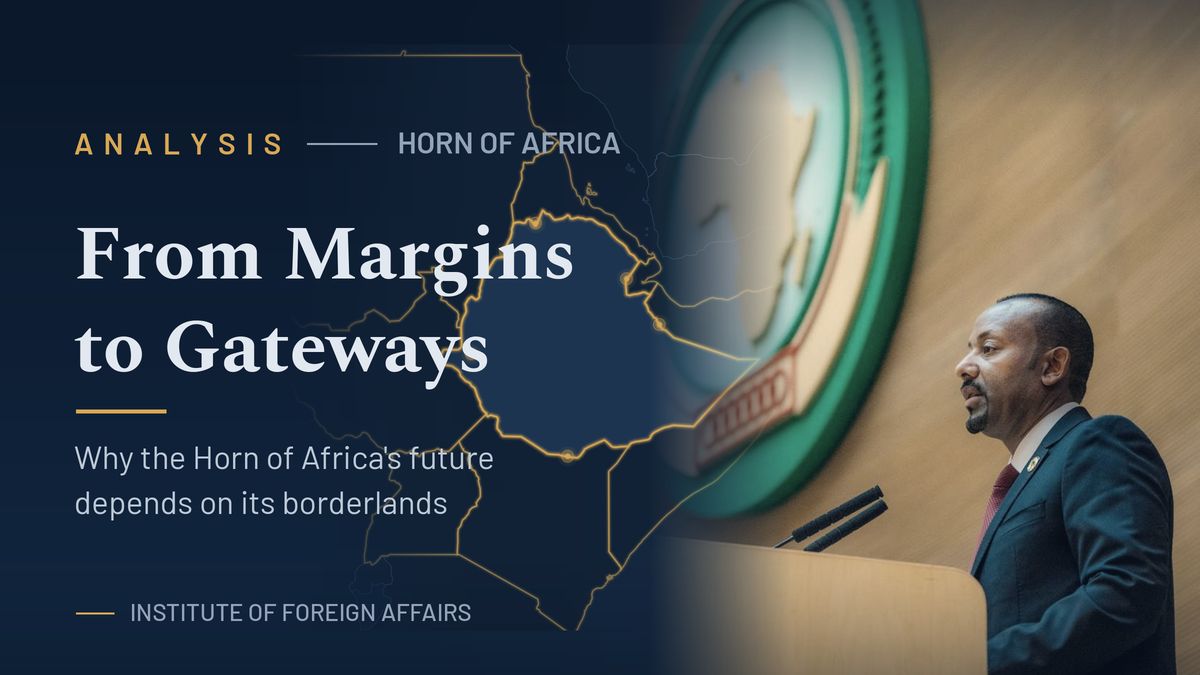
From Margins to Gateways: Why the Horn's Future Depends on Its Borderlands
#